


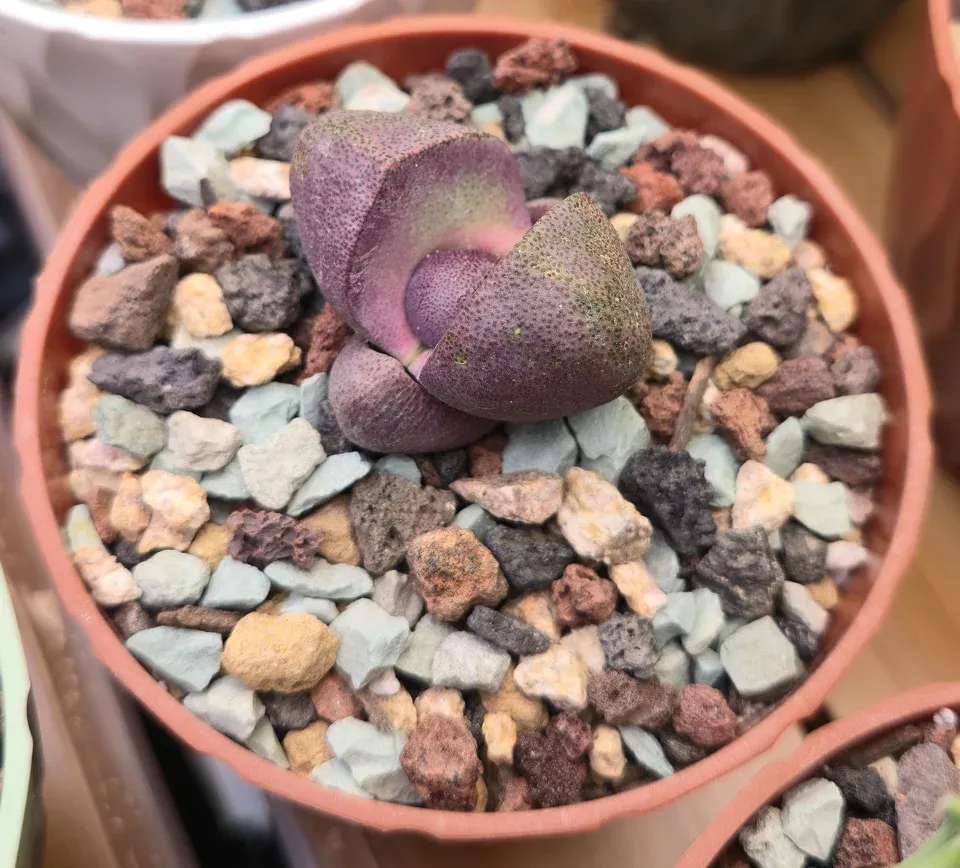
Shared planter and individual succulents
Plant 29 / 45 Shared planter and individual succulents
 Plant 29 / 45
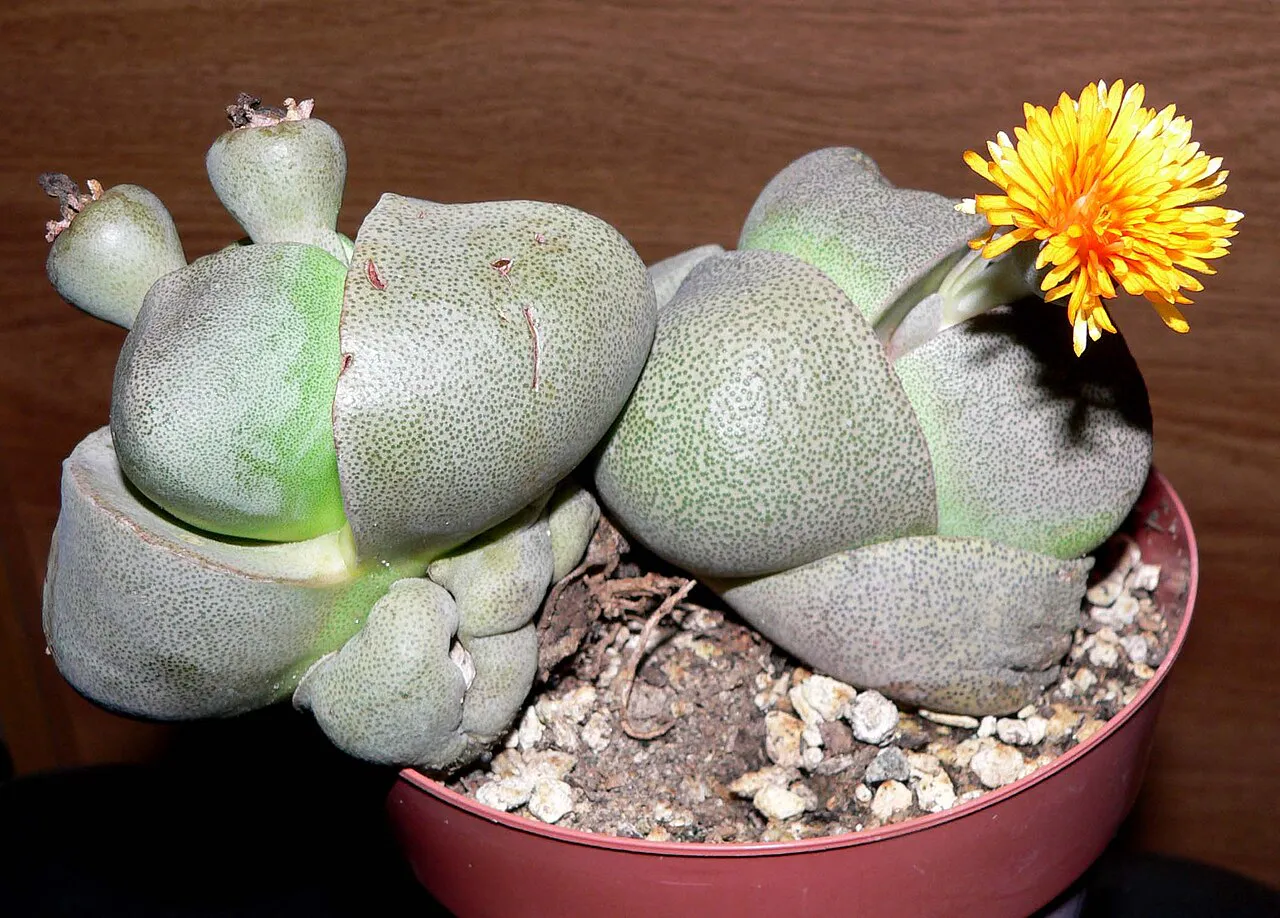
 Pleiospilos nelii 'Royal Flush'
Royal Flush split rock


Species reference · Stan Shebs · CC BY-SA 3.0 · Photo Source ↗
 Collection Record
- Succulent-06
 Permanent Label
G3 Identification
 Status
 Acquired From
- Mountain Crest Gardens
 Acquired On
- 2026-08-28 — received
 Google Sheets ID
- P28 ↗
 Photo History
- 11 captures · newest ↓
Measurements and Care History
 Measurements and Care History
Weights, watering, events, and charts for P28.
Spot it
 Spot it
What it looks like
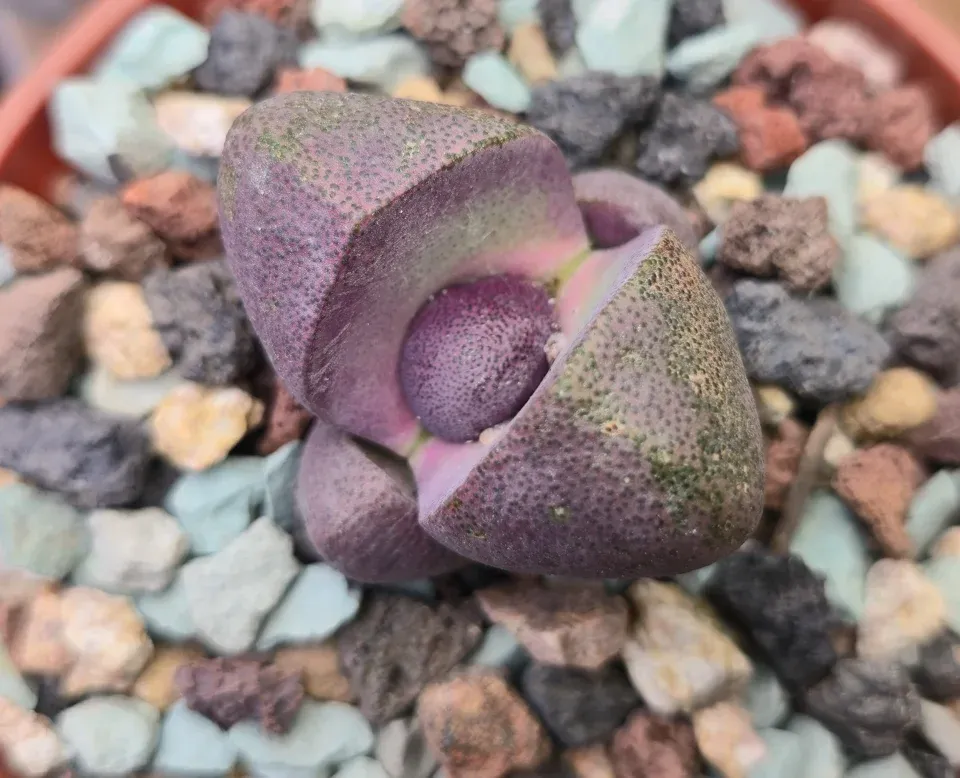
A compact pair of thick purple, dark-speckled leaves separated by a deep central fissure, making the plant resemble a smooth split stone set almost flush with the potting mix.
One curious thing
 One curious thing
Did you know?
The central fissure is both a flower opening and a renewal point: a new leaf pair forms inside while the older pair slowly dries and transfers its stored resources, so attached papery remains can be part of normal replacement.
Explore This Plant
A closer look
How this plant works
 How this plant works
One opposite leaf pair forms the stone-like body around a central cleft.
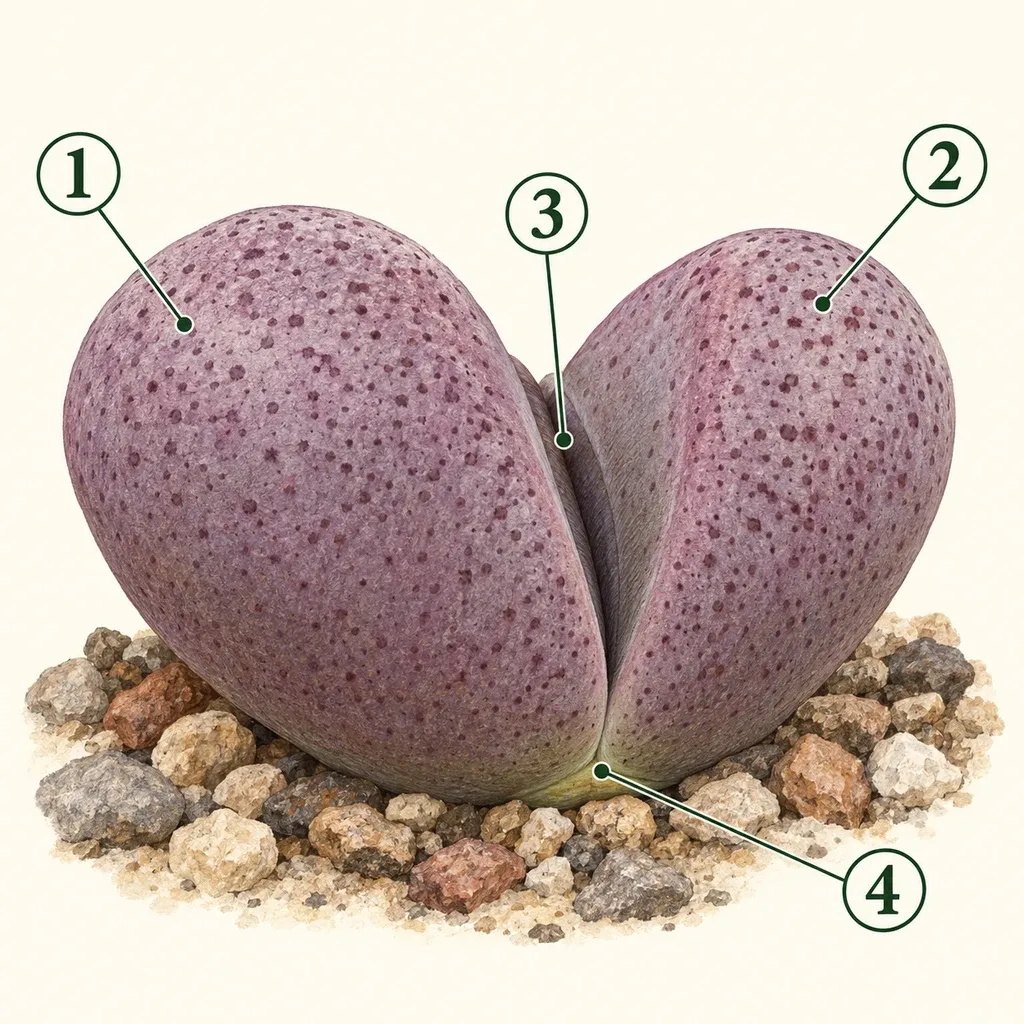
Thick leaf
A fleshy leaf holds water that can support the next pair.
Speckled surface
Fine spotting contributes to the stone-like appearance.
Central cleft
The opening separates the opposing leaves and allows new growth to emerge.
Joined base
The opposite leaves are joined at their lower base.
Habitat and origins
 Habitat and origins
Wild Pleiospilos nelii grows among sparse Karoo vegetation near South Africa’s Western and Eastern Cape boundary. Rounded speckled leaves blend with the surrounding stones. 'Royal Flush' is a cultivated pink-purple form of this compact mimicry plant, retaining the deep cleft and thick opposing leaves.
What growth can look like
 What growth can look like
- Stage 1
Hold a leaf pair
A compact pair forms the main visible plant.
- Stage 2
Reveal new leaves
The cleft opens around an emerging inner pair.
- Stage 3
Use the outer pair
Older leaves lose stored water and eventually dry as the new pair develops.
Follow the visible stage rather than a month-based schedule; wrinkling outer leaves during renewal does not alone call for watering.
Flowers
Flowers emerge from the cleft and resemble large daisies. SANBI describes the species’ fragrant blooms opening in mid-afternoon. The Royal Flush nursery listing gives conflicting golden and pink color descriptions.
As it matures
The nursery lists roughly 3–5 inches high and 3–4 inches across. The body stays compact as one leaf generation gradually replaces another.
Sources: [2]
Behind the name
Pleiospilos refers to its many spots. The species' woody seed capsules open when wet, letting raindrops release some seeds before the capsules close again as they dry.
Sources: [1]
Similar plants, useful clues
Green split rock ↗
The green split rock has the same thick, speckled leaf-pair structure, with grey-green coloring compared with Royal Flush’s pink-purple tones.
This plant in the collection
Its story so far
Arrived and repotted
Received from Mountain Crest Gardens and moved into a 4 × 4 × 3.7-inch round pot.
Collection record ↗Early size record
Measured 1.3 inches high × 1.7 inches wide, with a recorded pot weight of 353.5 g.
Collection record ↗
Then and now
Explore the sources
 Explore the sources
Names and identity
| Kind | Name |
|---|---|
| Accepted species | Pleiospilos nelii |
| Cultivar | 'Royal Flush' |
| Common name | Split rock |
| Cultivar wild range | None; the species is native to South Africa. |
'Royal Flush' is a pink-to-purple selection of the split rock. Each active body is made from thick opposing leaf pairs; a new pair emerges through the central split and uses water stored in the older pair.
Arrival and repotting

Ordered from Mountain Crest Gardens on August 25, 2026, this plant arrived on August 28 in a 2-inch nursery pot. Its roots were inspected by hand, and approximately 95% of the nursery soil was removed before repotting into the current 4 × 4 × 3.7-inch round pot. The arrival mix was slightly moist. On August 29, the complete pot weighed 353.5 g, and the plant measured 1.3 in high × 1.7 in wide with a ruler.
The mix is Molly's Succulent Mix with added perlite. The owner estimated 80% Molly's / 20% perlite on September 20; this is a recollection rather than a measured recipe.
The shipment was described as outdoor-grown in California sun and carried an agricultural inspection sticker. It was not quarantined after the initial hand inspection; routine pest checks remain useful.
Seller listing snapshot

Mountain Crest Gardens listing, inspected 2026-08-26:
| Seller field | Listing value |
|---|---|
| SKU | S2JY2848 |
| Product size | 2.0-inch pot |
| Current / seasonal color | Purple or black / blue or blue-green |
| Bloom | Highlights say golden; product field says pink |
| Hardiness | Zone 10; seller threshold 30 °F |
| Recommended light | Bright indoor light; full sun |
| Maximum height / body spread | 3–5 inches / 3–4 inches |
| Growth habit / seasonality | Clumping or mounding / year-round color |
| Special characteristics | Pet safe; showy blooms — seller fields |
The seller recommends an 80% mineral / 20% organic medium and a deep narrow pot. For this indoor plant, use root-zone dryness and the active leaf pair's firmness together: an older pair can wrinkle as the inner leaves draw on its stored water.
Origin, form, and publication
The underlying species is a South African mimicry plant whose speckled, angular leaf pairs resemble surrounding stone. GBIF accepts Pleiospilos nelii; the species was published in 1930. The cultivar name describes a horticultural color selection. The species produces fragrant, insect-pollinated flowers that open in mid-afternoon; its seed capsules open when wet and close as they dry.
September 25 condition update

The owner reported that the emerging new pair is firm, the oldest pair is getting quite small and wrinkled, and the second-oldest pair is still quite firm, with perhaps a very slight amount of softness. That possible softness remains uncertain. These are owner-reported tactile and leaf-stage observations. No new medium-moisture, root, weight, watering, or feeding observation accompanied the update.
Care in this collection

| Topic | Practical starting approach |
|---|---|
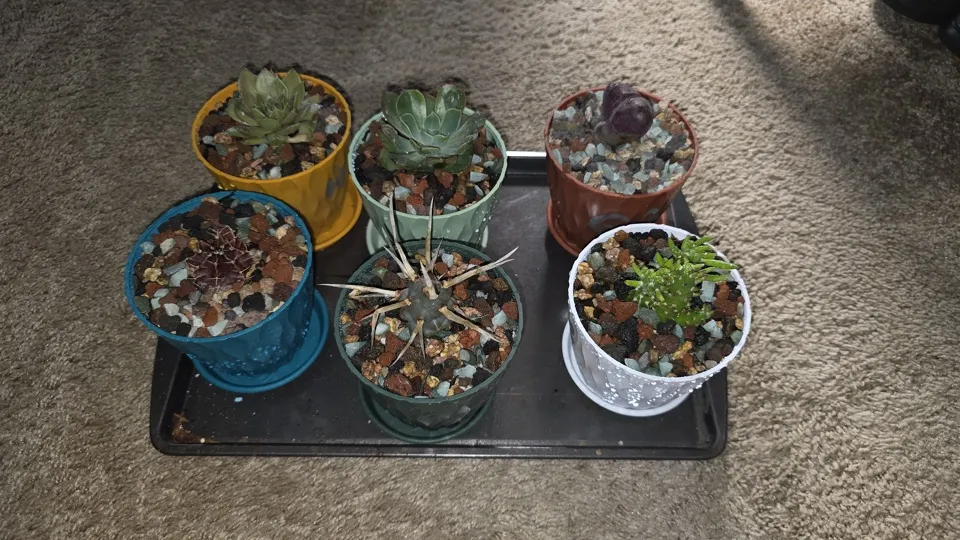
| Grow-light position | R2C4 · Bright. September 15 six-column/four-row front grid, facing the window. Low central split rock. Compare rosette-height exposure and retain its leaf-cycle watering restrictions. See the current placement guide. |
| Water | Use the active leaf cycle, firmness, medium dryness, and pot-weight trend as evidence. |
| Leaf replacement | Let the old pair be consumed while a new inner pair develops; wrinkling old leaves alone is not an automatic water signal. |
| Pot and mix | The current pot is a 4 × 4 × 3.7-inch round pot. The owner recalls Molly's Succulent Mix with approximately 20% added perlite (September 20 report; ratio estimated); depth still matters. |


Rotation, propagation, and watch points
- Keep a consistent photographed orientation until the active leaf cycle is understood; routine rotation can begin later if growth remains even.
- Multiple persistent leaf pairs, translucence, or a soft base can indicate excess water; isolate and inspect rather than adding another drink.
- Do not peel off an older pair that is still being absorbed.
- Judge watering from its leaf cycle and root-zone dryness, separately from the collection's ordinary cactus dry-down routine.
Sources

-
Owner condition report received September 25, 2026, about 5:09 p.m. EDT: firmness and condition of the three leaf pairs; exact hands-on observation time not supplied.
-
SANBI PlantZAfrica: split rock flowers, habitat and seed capsules
-
Owner arrival and repot observations, August 28–29, 2026; medium description, September 20: Molly's Succulent Mix with approximately 20% added perlite, an estimated proportion.
-
Mountain Crest Gardens: 'Royal Flush' split rock seller listing
-
LLIFLE succulent encyclopedia: Pleiospilos nelii 'Royal Flush'
-
Mountain Crest Gardens: general mesemb and rapidly draining mineral-soil guidance
Through the seasons
Plant Photo History
Recent photographs of this plant. Open a photo or its collection for the complete history.
From the nursery
Nursery Labels
Original nursery labels and packaging.


Botanical reference photos
Reference Gallery
Pleiospilos nelii species and cultivated forms
Form and growth
.jpg)
.jpg)
Look closer

.jpg)
Flowers and buds

.jpg)
.jpg)


