


 View on GitHub ↗
Display Layout and Light
Four wooden tables, with Money Tree on the separate north windowsill. These planning illustrations retain the September 16 arrangement, before the Serpent / Hook-spined swap. The latest light readings and plant positionsare documented separately; shading in the pictures remains an estimate.
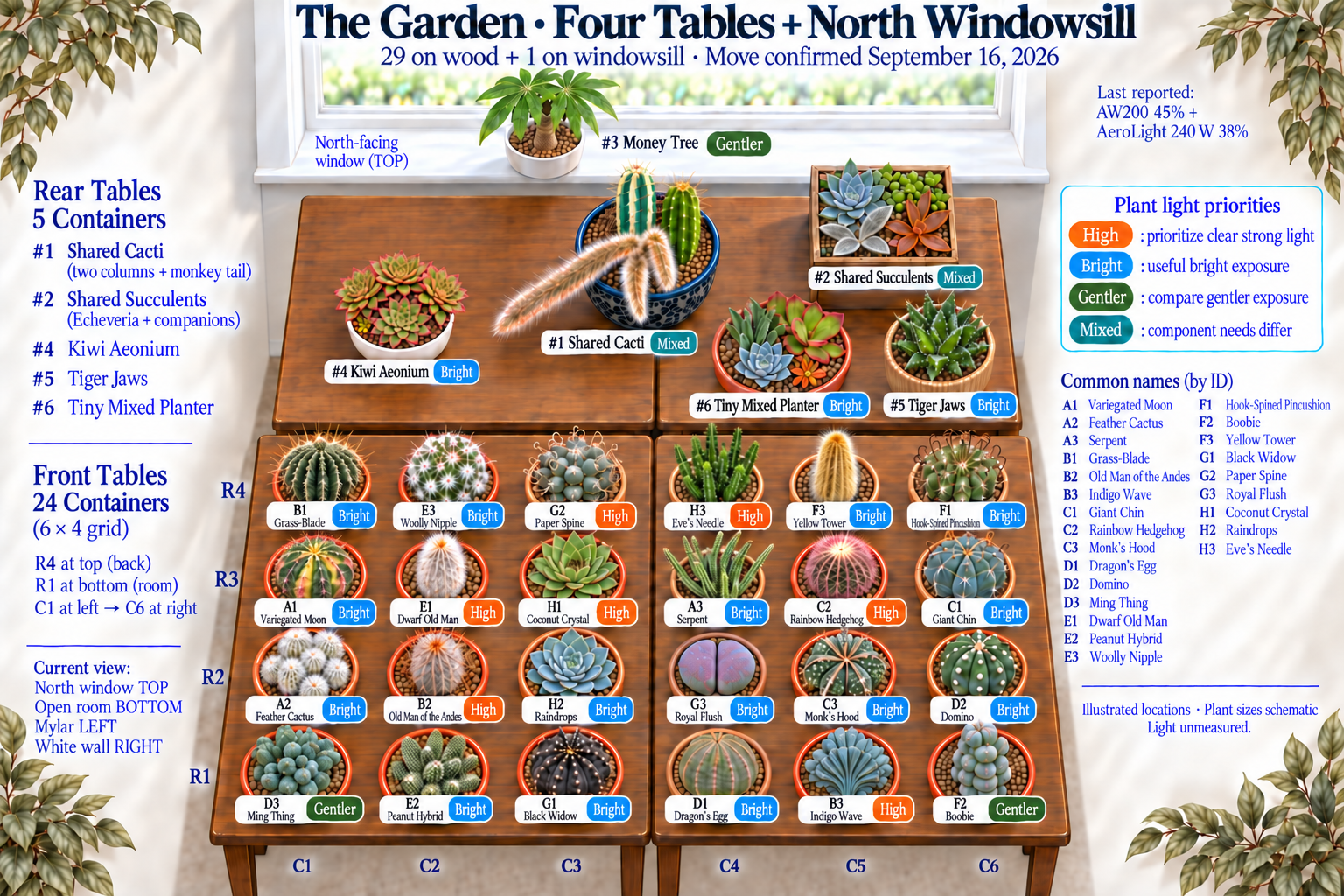
Four-Table Arrangement
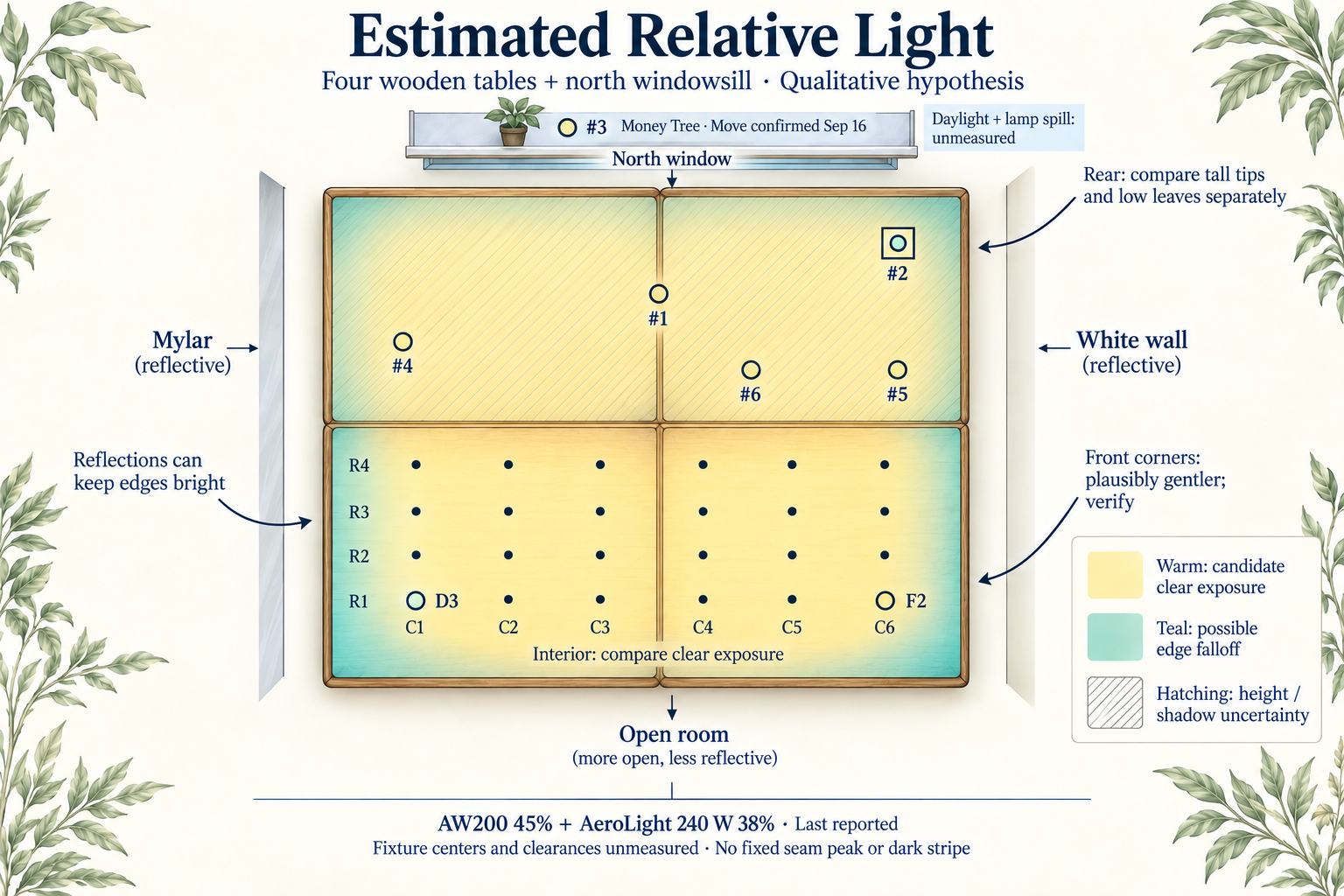
Estimated Relative Light

Current Placement
Plant locations, diagrams, and estimated relative light.

Equipment and Supplies
The maintained inventory and exact-model research.

Setup Archive
Earlier arrangements and the dated acclimation calendar.
Last updated: 2026-09-24
The equipment and supplies inventory lists the collection's products and model references. All four wooden tables are the LEJANEOYE two-tier bamboo side-table model, identified September 17; measured tabletop dimensions are recorded separately from seller specifications.
The container guide separates the 42 current botanical profile groups from two whole-planter overviews. P19, P20, P30, and P35 are shared containers: multiple profiles retain one label, one tracker history, and one current setup. The P-ID persists when a planting moves to a different pot; repots record a setup boundary rather than a new container ID.
Current routine
The collection has 34 tracked containers and 45 profiles: 44 active and one historical. Recent additions are P31 / #7 Peperomia Bicolor and P32 / #8 Tricolor oyster plant, purchased at Carlson's Greenhouses September 20, and P35 / #9 shared Lithops and P36 / #10 split rock, purchased at Home Depot in Howell, Michigan September 21.
The September 23 Lithops and split-rock repots are setup 2, using 80% Molly's Succulent Mix + 20% perlite. P35 holds four visible Lithops heads in the D'vine Dev Blush Mauve pot, logged as 4.2 in round; P36 holds one split-rock leaf pair in the Thirtypot speckled-brown pot, logged as 4 in round. Seller-selected sizes are 4.3 and 4.5 inches, respectively. Routine weights were 1247 g and 713.5 g, with dry medium and firm plants; neither batch includes watering or a verified dry baseline. Final growing positions, actual drainage, and usable internal depth remain unverified.
The cactus display uses continuous rotating canopy airflow and two Honeywell fans below the perforated tables, both on low. One is the HT900; the older, larger model is unidentified. The A22 controls fan cycles, with timings unrecorded. The TABYIK dehumidifier runs directly from a wall outlet.
P31 and P32 remain in six-inch nursery pots at their last recorded location on the room-side floor near the money tree. Their eight-inch repots and living-room display are planned below. The proposed medium combines airy, perlite-containing greenhouse mix with Molly's Succulent Mix; the ratio is undecided. Check root-ball fit, drainage, and moisture before repotting or watering.
The collection is in Fenton, Michigan. The cacti and succulents previously spent suitable dry summer weather outside. The permanent 2026 move indoors began July 31 after the first RO-water watering and several hours of drainage, followed by the dated AW200SE and paired-fan operating schedule.
Use the reported settings as a starting point, then judge compact new growth, leaf condition, and drying in the actual room.
Controlled indoor setup
Planned living-room houseplants
The September 22 plan places P31 / #7 Peperomia Bicolor and P32 / #8 Tricolor oyster plant side by side at the north-facing double glass sliding door, with P32 closest to the glass, P31 on the smallest Bamworld stool, and the FECiDA 54 W six-tube light clipped to a shelf. Two Juhefa three-head fixtures are available, each seller-rated about 10 W total; the optional Diivoo's input wattage is unverified. See the equipment inventory for exact models.
The last recorded location is the room-side floor near the money tree on September 20. Repots, the move, stool placement, and light installation remain unconfirmed. The living-room destination is separate from P21's cactus-room windowsill; clearances, exposure, and room conditions still need measurement.
Recommended first trial, not a confirmed installation: use the FECiDA alone for 12 daytime hours, with the Juhefas available for targeted fill only if canopy measurements show gaps. Omit the optional Diivoo from this initial trial. The living-room light trial retains inferred total-light comparisons of 4–6 DLI for P31 and 6–8 DLI for P32, including daylight. Measure representative leaves after dark, then assess daylight separately; if another lamp is added, remeasure the lights actually used together. No timer setting has been reported applied. The main display's timer, readings, airflow, and humidity do not establish conditions at the sliding door.
Established cactus-room display
September 15 table update: the owner replaced the former two 16 × 13-inch wooden tables plus a round glass table with four 16 × 13-inch wooden tables, adding two wooden tables and retiring the glass table. All 30 then-tracked pots were rearranged onto the wooden display shown in the new photos. The working interpretation is four tables in a 2 × 2 block, nominally 26 inches across × 32 inches toward the window, with 24 small pots in six columns × four rows at the room end and the six larger/shared containers behind them. Table orientation and gaps have not been tape-checked; the new tables' height is unmeasured. The owner confirmed September 20 that the former round glass display table is gone and no longer used; it was approximately 30 years old, with model unknown.
North-windowsill move confirmed September 16: the owner confirmed that #3 / P21 Money Tree is now on the north-facing windowsill, off the rear-left table. The move was planned on September 15 after the owner noticed downward-pointing leaves; its exact completion time was not supplied. The established arrangement has 29 containers on wood (24 small pots at the front and five larger/shared containers behind them), plus one money tree on the windowsill. The two September 20 houseplant purchases add P31 and P32, currently on the room-side floor near the money tree. Their eight-inch repots remain planned; the September 22 layout assigns the smallest stool to P31, with P32 closest to the living-room sliding door. The move and leaf-height exposure remain unconfirmed or unmeasured. Apart from the later owner-confirmed A3 Serpent / F1 Hook-spined exchange, the other positions stay as photographed, including #4 Kiwi Aeonium; the vacated table spot stays open. The supplied photo predates the move. Excess light remains the owner's suspected cause, not a diagnosis established by leaf posture. Sill dimensions, exact position within the sill, daylight, lamp spill and leaf-height clearance remain unmeasured.
The current diagram faces the window: north window top, open room bottom, Mylar left, white wall right. This rotates the old schematic view without changing the room. The two-foot end reflector remains absent. See the current placement guide for the current positions, earlier illustrative light map and owner light readings. The 48 approximate lux-derived PPFD readings were taken at individual plant heights, not one level plane. The whole mapped rectangle, including the intentionally unlit far edge, ranged from 145 to 677 estimated PPFD; the app's 13-hour DLI output ranged from 6.8 to 31.7. This is not calibrated PAR evidence, and the measurement date was not supplied. Only the A3/F1 exchange was confirmed after review. Old proposed swaps and the glass-spill gradient are historical.
The AW200 at 45% and AeroLight 240 W at 38%, Veg mode on both lights, shared 13 h 15 m total cycle including 15 m sunrise and 15 m sunset, 18-inch plant-tip reference and four independent ceiling hooks remain the last reported operating record. The September 15 photos do not remeasure controller settings, exact fixture centers or individual clearances. The previous one-inch table margins and ½–1-inch fixture gap must not be transferred to the new footprint as verified geometry.
The new 240 W manual requires the growing space below 86°F (30°C) during operation. Keep the existing settings for the first comparison; furniture dimensions alone do not justify increasing output. The equipment record gives the installed pair's specifications and operating guidance.
| Item | Current equipment |
|---|---|
| Light transition | AW200 + AeroLight 240 W, installed September 13; new four-table arrangement September 15; exact current fixture centers unmeasured |
| Controllers | Four planned independent E25 paths: AW200, AeroLight 240 W, and two AeroWave E6 Gen2 fans. Separate light percentages are reported; the new controller configuration has not been inspected |
| Location | Fenton, Michigan |
| Mount | Four ceiling hooks, two per fixture; each light suspended independently with separate adjustable hangers. Installed September 13; owner-reported 18-inch plant-tip reference |
| Tables | Four 16 × 13-inch wooden tops, inferred 2 × 2 block / nominal 26 × 32-inch footprint before gaps. Earlier tops were 18 inches high; new-table height unmeasured. Current arrangement: 29 pots on wood and #3 Money Tree on the north windowsill; the earlier photo shows all 30 on wood. |
| Rated power | AW200 200 W + AeroLight 240 W = 440 W rated total; actual dimmed consumption unmeasured |
| Advertised coverage | 240 W manufacturer claim: 4 × 2 ft. Current target: 29 pots on four wooden tables, with #3 on the separate north windowsill; owner supplied approximate per-height light comparisons; calibrated PAR coverage remains unverified. |
| Manufacturer PPFD figure | Owner supplied 48 lux-derived estimates at individual plant heights; these are not manufacturer or calibrated PAR measurements. Earlier AW200SE maps remain historical |
| Dimming | Both manuals list app 25–100% and off. Independent settings confirmed: AW200 45%, AeroLight 240 W 38% |
| Cross-canopy fans | Two VIVOSUN AeroWave E6 Gen2 units, each with its own E25, aimed from opposite ends of the black divider. The second is clipped high and aimed slightly downward. Each fan is rated 12 W and up to 320 CFM, with 90° horizontal oscillation. |
| Air movement | Last reported AW200 fan on gentle Natural Wind, plus both E6 Gen2 fans at Level 1–2 with offset sweeps. Recheck both light fans and canopy airflow after mounting |
| Current light setting | AW200 at 45%; AeroLight 240 W at 38%; 18-inch plant-tip reference. Both use the same 13 h 15 m total cycle, including 15 m sunrise and 15 m sunset |
| Camera | VIVOSUN GrowCam C4, 2K, 117° field of view, 2.4 GHz Wi-Fi, wall-mounted above the plants with a tested 256 GB microSD card for time-lapse |
| Reflector | VIVOSUN 6 mil diamond Mylar, 4 × 25 ft retained on the black divider, plus the existing loose floor-protection sheet. White wall uncovered; two-foot room-end return panel removed from the plan |
| Room sensor | Three owner-described sensing points from the VIVOSUN app-connected sensor and A22: two probes plus the sensor body on a shelf. Reported conditions are approximately 45–50% RH and temperatures in the 70s °F; locations are recorded below, with exact probe assignments unconfirmed |
| Dehumidifier | TABYIK DH-CS01, a 1,000 mL single-speed Peltier unit; owner reports it running directly from a wall outlet September 20, separately from the A22 |
| Air purifier | Levoit Core Mini-P, model LAP-C161-WUS, 7 W and 34 CFM CADR, run on low for background dust/pollen removal |
| Water container | 5-gallon HDPE #2 drinking-water jug for RO water, stored covered in the unused shower |
| Fertilizer | Tezula/Greencare MSU 13-3-15 Tap/Rain/RO formula, measured by mass with the collection-specific schedule; it already contains calcium, magnesium, and micronutrients |
| Foliage fertilizer | SUPERthrive Foliage-Pro 9-3-6 liquid, measured by volume. The #7/#8 plan uses 1/4 tsp/US gal at most every second ready watering once established and growing; plain RO next and whenever feeding is unsuitable. Keep separate from MSU. |
| Label printer | SUPVAN E11, 203 dpi monochrome thermal printer with 15 mm maximum media width; see the pot-label print reference |
The equipment plan uses four independent E25 control paths, with separate percentages reported for the two lights. The AeroLight's RJ45 connector is only for compatible AeroLight daisy chains; it is not an Ethernet connection for either canopy fan. AeroWave fans do not directly daisy-chain fan-to-fan. With E25 controllers, each independently controlled fan needs its own controller path; VIVOSUN's supported multi-fan splitter arrangement belongs to E42/E42A-class hardware, not the light's RJ45 socket. The installed setup uses one E25 for the light and one E25 for each fan; no light-to-fan or fan-to-fan cable chain is used. The new light gets its own E25 for independent brightness and schedule control.
Both canopy fans are now mounted on the black divider pole and approach the plant run from opposing directions. Offset their vertical angles and oscillation arcs so their moving air crosses the canopy without forming one constant wind tunnel or making the fans fight directly into each other. Start both E6 units at Level 1–2, check gentle airflow across the new four-table display, and treat the earlier daytime-only program as historical. The owner now reports continuous rotating canopy airflow and two Honeywell fans below the perforated tables, both set to Low. One is the purchased HT900; the older, larger fan's exact model and the A22 fan-cycle timings remain unrecorded. The second canopy fan is clipped high on the room-end divider pole and points slightly downward; exact hub heights and plant clearances remain measurements to record. See the paired-fan program and placement rules.
Historical Room and Measurement Record
The July 31/August layout below predates the September 15 four-table arrangement. It is retained as a measurement record. That earlier measurement set established a 36 in wide by approximately 60 in long bay, and the August expansion adds a second identical wooden table. All three surfaces are 18 in high. The 24 in round glass table occupies the window end; the two 16 × 13 in wooden tables follow it toward the room. Their centerlines run end to end beneath the fixture's long axis, not side by side across the 36 in width. The nominal 24 + 16 + 16 in footprint uses about 56 in of the approximately 60 in length, leaving only about 4 in before real gaps and leg interference. Treat that as access clearance, not an appliance bay.
That earlier layout kept A1–D3 in a measured three-column by four-row grid.
The second wooden table provisionally held the six August cacti, #4 Kiwi
aeonium, and #3 money tree. The September 15 four-table arrangement above supersedes both that layout and the later 24-on-wood/six-on-glass plan. The
GrowCam and reflector plan
retains the dated camera geometry and now keeps the room end open: line the
black divider first, leave the white wall uncovered, and
mount the camera rigidly on the right wall so it looks diagonally toward the
divider instead of directly into the window.
The historical browser grow-spot diagrams retain the former room,
all three tabletops, A1–D3, E1–F3, and #1–#4 plant or planter IDs,
assigned original-table risers, light clearance, fan sweep, camera view,
provisional open-room air-treatment
positions, and a riser calculator. The source tape photos and derived height
bands are indexed in
assets/measurements.
The PPFD figure is a manufacturer measurement, not the amount every plant will receive. Distance, dimming, position under the wing, plant height, and reflected light all change the actual canopy level. Light distance should be measured from the tallest plant tip, not from the shelf or pot rim.
For the earlier AW200SE identification, the manufacturer published a 5 × 5 reflective-tent map whose 12-inch center reads 1,214 µmol/m²/s and whose calculated mean is about 870. That does not agree with the 691 figure in the product table. Both are retained and explained in the deep guide rather than forcing them into a false single answer.

Measurement tools
| Tool | Intended use |
|---|---|
| VIVOSUN three-meter kit | Digital liquid pH, liquid TDS/EC/temperature, and approximate soil moisture/pH/light checks |
The liquid meters can help compare tap water and mixed fertilizer solutions. Treat the analog soil probe as a rough observation only: gritty cactus medium, small pots, and incomplete probe contact can produce misleading readings. Pot weight, root-zone dryness, and plant condition remain the watering decisions. Use the 0.01 g pocket scale—not the pot scale or an estimated scoop fraction—to measure the default 0.75 g/US gal cactus fertilizer dose.
Room observations, September 20: the owner reports approximately 45–50% RH and temperatures in the 70s °F near the collection. These are approximate current conditions, not a recorded day/night minimum or maximum. Three sensing points are reported: a probe on the far pair of wooden tables; a probe at plant height on the wall with about two inches of free lead allowing it to lean away from the wall; and an internal sensor in a body on a shelf about two feet from the cactus table. The equipment includes the probe-equipped VIVOSUN app-connected sensor and the A22 probe; the exact probe-to-device assignment is unconfirmed. The table probe is on the wooden display; the glass table is retired.
The Levoit LV600S humidifier is off; the owner has not started using it because it is not winter yet. Winter operating settings and a start date are unrecorded. The separate TABYIK dehumidifier is running directly from a wall outlet; the A22 controls fan cycles only.
The original operating schedule preserves the dated first-two-week measurement plan. Use the actual current sensor positions and readings when interpreting the growing conditions.
The dehumidifier is currently running directly from a wall outlet, as reported September 20. The earlier air-treatment plan recommended leaving this non-humidistat unit off during normal 30–55% RH conditions; that recommendation is not a description of its current operation. Use the room sensor rather than a watering date: a brief maximum above 60% is fine, while current RH above 60% at both a morning and evening check or a 24-hour minimum above 60% justifies a 12–24-hour trial. The Core Mini-P can run on low continuously, but it does not lower humidity or replace the paired canopy fans. See the dedicated air-treatment guide for placement and the full decision table.

August 14 substrate, airflow, and light reset
On 2026-08-14 the owner reported that the previous cactus medium was still losing about 10–20 g of pot weight per day on day 14 after watering. That is direct evidence that those pots had not reached a stable dry-weight floor. The loss includes both evaporation and plant water use, so it is not a literal measurement of how many grams of water remained around the roots.
All 18 individually potted cactus-display plants—P01–P18, labels
A1–F3—were emergency-repotted into 60% Molly's Succulent Mix and 40%
horticultural perlite by volume. The batch recipe was three cups Molly's to
two cups perlite. Only the old medium that stayed attached to the roots was
retained. This advances those containers to pot setup 2, so setup-1 wet and
dry weights remain historical rather than being averaged with the new blend.
The shared planters, money tree, and Kiwi aeonium (P19–P22) were not part of
this change.
Molly's is sold as a complete soilless medium, and the manufacturer also says growers may mix it with other amendments. The extra perlite is therefore an intentional collection-specific choice to reduce water retention in this indoor Michigan setup. Compare two or three watering cycles before changing the recipe again.
The same update added the second pole fan, lowered the AW200SE to 18 in, and raised it to 45%. The power change came three days ahead of the former August 17 step; August 14 is also the first explicitly confirmed 18-inch measurement. Hold those light and airflow settings steady while the first new-medium dry-down is measured; the next power increase is now conditional rather than automatic.
The care history records the first setup-2 plain Beauchamp's RO cycle for
P01–P18 at 4:22 p.m. on 2026-08-26 with no nutrients. Wet setup-2 weights were recorded
between 12:14 and 12:20 a.m. on 2026-08-27, about eight hours later. Preserve
that actual interval instead of treating those readings as the originally
planned 30–60-minute drainage baseline.
Individual pots and medium
| Part | Current product | Relevant details |
|---|---|---|
| Original cactus pots | SQKH 4-inch pots, six-pack | Polypropylene pots with bottom drainage holes and individual trays; still used by the A1–D3 starter group. |
| August cactus pots | Existing nursery and repotted containers | The six August cacti use 4 in pots. On September 26, 2026, the owner confirmed F2 / P17 Boobie cactus uses a normal 4 in pot, correcting the earlier 3 in description; no new repot was reported. |
| Kiwi aeonium pot | Carlson's Greenhouse 5 in pot | Current pot for Succulent-05. |
| Money-tree pot | Amazon Basics 6 in pot with drainage holes and ridges | Current 6 in matte-white pot for Houseplant-01 after transplanting from its Home Depot 4 in nursery pot. |
| Planned P31/P32 pots | Amazon Basics 8 in pot with saucer | Two owner-confirmed 8 in Amazon Basics destination pots with many drainage holes, one previously decorated; quantity is owner-reported. The Bamworld Nature stools are planned for the display; both plants are currently on the room-side floor near the money tree, with P31 assigned the smallest stool in the September 22 plan; completed placement and repotting remain unconfirmed. |
| Current P35/P36 pots | Thirtypot speckled-brown and D'vine Dev Blush Mauve | September 23 repots and photographs confirm D'vine Blush Mauve for P35 / #9 shared Lithops and Thirtypot speckled-brown for P36 / #10 split rock. Setup-2 logged sizes: 4.2 in round for P35; 4 in round for P36. Seller-selected sizes: 4.3 and 4.5 inches, respectively. Both use 80% Molly's + 20% perlite. Actual drainage and internal depth remain unverified. See the equipment inventory for seller dimensions and model. |
| Mountain Crest received/current pots | Received: six 2 in nursery pots; current: six matching 4 in round pots measuring 4 × 4 × 3.7 in | Received-pot shapes are not reliably documented. The owner reports removing about 95% of the nursery soil during the 2026-08-28 repot. Recorded pot size is 4 in for all six. September 20 medium record: Molly's Succulent Mix with approximately 20% added perlite (roughly 80/20), recalled rather than measured; this describes the existing repot, not a new setup. |
Current medium for P01–P18 |
Molly's Succulent Mix plus horticultural perlite | Pot setup 2: 60% Molly's and 40% perlite by volume, measured as three cups to two cups. Molly's is a soilless gritty blend of akadama, pine bark, lava rock, Hyuga, pumice, and mycorrhizae, with no commercial fertilizer. Only old medium clinging to roots was retained during the August 14 repot. |
| Historical medium | Back to the Roots Succulent & Cacti Mix, 12 qt | Previous peat-free packaged mix containing aged bark, perlite, horticultural sand, limestone, and a small amount of organic plant food. Retained as history because it was associated with the day-14 10–20 g/day loss observation. See the manufacturer product page and soil FAQ. |
| Top dressing | YISZM gritty mix, 2 lb | Approximately 5–8 mm mineral grit including lava rock and zeolite. It is being used as a thin decorative top layer. |
The starter group and six August cacti are individually potted, which makes watering and rearranging for light much easier. All 18 are now pot setup 2 in the tracker; do not rewrite or average their setup-1 history. The gritty top dressing is thin enough to be reasonable; leave enough visibility around plant bases to notice trapped moisture, softness, or discoloration.
Always empty water left in the small trays after a full watering. The trays protect the shelf; they are not reservoirs.
The money tree is a tropical tree, not a succulent. Water it when the upper part of its mix dries, but do not wait for the entire 6 in root ball to reach the cactus baseline. Keep it at the window/periphery rather than using its height to set the cactus canopy. Two or three scorch-free days are encouraging, not a completed sun-acclimation test; use the shade cloth only if leaves bleach or develop crisp tan patches. Let much of the Kiwi aeonium pot dry between waterings, but keep it outside the strongest cactus center.
The six August cacti and Kiwi aeonium came from Carlsons' Greenhouse on Torrey Road on 2026-08-10. The money tree came from the Howell Home Depot on 2026-07-29. Its genus-level LiveTrends tag is now archived.
Mountain Crest Gardens arrivals — repotted 2026-08-28
Three cacti and three succulents ordered from Mountain Crest Gardens on 2026-08-25 were received rooted on 2026-08-28 in 2-inch nursery pots; the received containers' shapes are not reliably documented. The owner reports removing about 95% of the nursery soil during repotting. The recorded pot size is 4 inches for all six. They now share the same round 4 × 4 × 3.7-inch pot model.
The permanent mapping is P23/G2 paper spine, P24/H1 Coconut
Crystal, P25/H2 Raindrops, P26/H3 Eve's needle, P27/G1 Black Widow,
and P28/G3 Royal Flush. The August 29, 2026 measurements were:
| Tracker ID | Scale weight | Ruler height | Ruler width |
|---|---|---|---|
P23 |
375.5 g | 1.25 in | 1.15 in |
P24 |
361.5 g | 1.0 in | 2.55 in |
P25 |
344 g | 1.35 in | 2.75 in |
P26 |
357.5 g | 1.8 in | 1.6 in |
P27 |
388 g | 0.5 in | 1.2 in |
P28 |
353.5 g | 1.3 in | 1.7 in |
The 2026-08-28 Check/Clean bulk round records slightly moist substrate for all six. It does not document watering or fertilizer use. The owner confirmed the arrangement in the current placement guide, including the later A3/F1 exchange. Exact individual plant-to-light clearance remains unmeasured. On September 20 the owner clarified that all six use Molly's with approximately 20% added perlite, probably less than the 40% used for P01–P18. The approximately 80/20 recipe is an estimate of the existing mix.
The owner chose not to quarantine after hand inspection and soil removal. The box carried a California agriculture inspection/certification sticker reported to say pest free, and the plants were described as outdoor-grown in California sun. Continue targeted pest checks and gradual indoor-light acclimation anyway; neither the sticker nor outdoor sun prevents a later issue or guarantees an instant transition to the AW200SE footprint. The 4-inch pots contain much more mix than the nursery containers, so verify drainage and use dry-down evidence instead of a fixed schedule. 'Coconut Crystal' remains indoors in the brightest and coolest practical succulent position, while Royal Flush keeps separate leaf-cycle watering logic.
Home Depot succulents — repotted 2026-09-02
P29/#5 probable Faucaria tuberculosa and P30/#6 tiny mixed
succulent planter were purchased from Home Depot, photographed, and repotted
on 2026-09-02. Their Smart Planet Home / Altman Plants labels identify P29 as
a 2.5-inch F. tigrina retail assortment and P30 as a five-inch terra-cotta
succulent garden; the latter's matching Home Depot listing says it contains five
plants. The exact store, current measured pot dimensions,
replacement-medium composition, weights, plant dimensions, and maintained
placement were not logged in that original acquisition note; current observations and the placement guide take precedence for subsequent conditions. Their source-quality publication photographs live in
separate Gyazo Collections; shared receipt and post-repot context captures are
reused across both records rather than uploaded twice.
The setup-2 repot descriptions are: P30 / #6 is logged as “5 inch shallow” with “Nursery cacti soil and my top dressing” at September 3, 2026, 12:18 a.m. EDT; P29 / #5 is logged as “4.25 round, 4.25 deep” with 80% Molly's Succulent Mix / 20% perlite with top dressing at 12:23 a.m. EDT. Both timestamps fall in the September 2 care day. These are owner-entered pot descriptions, not fresh ruler measurements. Current placement follows the confirmed placement guide; weights remain in the care history.
Use current moisture checks and pot measurements when assessing these containers. P30 has one shared history for its aggregate overview and three component groups (Succulent-10A/B/C). Weigh and water it once as a complete pot; separate component profiles describe the plants within it.
Shared planters
The succulent arrangement and older cactus arrangement are mixed planters. Their plants do not have perfectly identical needs, so they should be managed by observation rather than a calendar.
The starting pot records retain these substrate and pot descriptions. They are recorded starting information, not new ruler measurements or detailed mix recipes; later eligible Repot observations take precedence.
| Pot | Recorded pot description | Baseline medium |
|---|---|---|
P19 / #1 shared cacti |
8 in wide | Greenhouse succulent soil, already provided |
P20 / #2 shared succulents |
7 in diagonal | Greenhouse succulent soil, already provided |
P21 / #3 Money Tree |
6 in | Original nursery root-ball soil retained; remaining space filled with Back to the Roots cactus/succulent soil |
P22 / #4 Kiwi aeonium |
5 in | Greenhouse succulent soil, already provided |
- The succulent planter contains an echeveria, elephant bush, silver teaspoons, and copper spoons.
- The older cactus planter now contains a blue torch, monkey tail, and golden torch. It previously also contained Rehab-04, a probable silken pincushion cactus removed on 2026-07-24 after only a small patch of green flesh remained.
- Decorative moss around the older cacti makes the soil and plant bases harder to inspect. Removing it is useful during rehabilitation.
P19/#1has a recorded one-inch drainage hole: the September 1, 2026Otherobservation at 3:58 p.m. local time records drilling it and removing 6 g of ceramic. Current drainage rate is unmeasured. ForP20/#2, the owner confirmed September 20 that a plastic liner sits inside the wooden box and a one-inch hole was drilled through both the box bottom and liner. The drilling date, removed mass, and present drainage rate were not supplied.
Details still worth recording
The 2026-07-31 tape set established the 36 × approximately 60 in bay, 18 in tabletop height, 24 in glass diameter, 16 × 13 in wood top, approximately 26 in fixture width, 12.5–13 in tallest shared-cactus tip, and roughly 4–7 in starter-tip band. The second wooden table repeats the 16 × 13 × 18 in dimensions. The remaining measurements that will make the next lighting plan more precise are:
- the plant ID used as the 18-inch tallest-tip light reference;
- each individual pot's tabletop-to-tip height after final riser placement;
- tabletop-to-tip heights for the six August cacti, Kiwi aeonium, and money tree;
- exact individual plant-to-light clearance for the six Mountain Crest plants; their arrangement is confirmed and their Ruler dimensions and Scale weights are recorded;
- precise measured pot geometry beyond the logged P29/P30 size descriptions and any still-needed plant dimensions; their setup-2 repot media are recorded in the Repot observations, placement is confirmed, and current weights must be read from the care history;
- final original-AeroWave hub height and distance to the nearest plant;
- exact hub height, plant clearance, vertical angle, and app program for each E6 Gen2 fan;
- exact GrowCam mount positions, angles, and framing around the current display; both cameras and the full-day check are owner-confirmed working;
- a future common-height comparison if needed; keep it separate from the supplied 48 individual-plant-height estimates;
- actual day/night temperature and humidity ranges, if available; the September 20 report is approximately 45–50% RH and temperatures in the 70s °F, without a measured daily span;
- the final purifier/dehumidifier positions around the current four-table display and the first 24-hour RH response check; and
- repeatable readings at A3 and F1's actual heights after their confirmed exchange, if useful; previous occupants' readings do not establish their new exposure.