


 View on GitHub ↗
Current scope
The collection has 34 tracked containers. Thirty have established positions: 29 on the four-table display and Money Tree on the north windowsill. P31 Peperomia and P32 oyster plant are recorded on the room-side floor, with a separate living-room arrangement planned below. P35 Lithops and P36 split rock were repotted September 23; their final growing positions are unrecorded.
September 21 additions awaiting placement
P35 / #9 Lithops shared planter and P36 / #10 Split rock were repotted and photographed September 23, but have no recorded final growing position. Four visible Lithops heads now share the D'vine Dev Blush Mauve pot, and the split rock uses the Thirtypot speckled-brown pot. Seller-selected sizes are 4.3 and 4.5 inches; the setup-2 ledger records 4.2 in round and 4 in round, respectively. The bathroom-counter photographs show a temporary repotting location. Keep both pots off the established placement grid until the owner records their growing locations. Actual drainage, usable internal depth, leaf-stage monitoring, and gradual light acclimation still need attention; no DLI target or measured exposure is assigned by this record.
September 20 houseplant purchases
P31 / #7 Peperomia Bicolor and P32 / #8 Tricolor oyster plant were purchased directly from Carlson's Greenhouses on September 20 in owner-reported six-inch nursery pots. Both tags specify bright, indirect light. The plants remain in those pots, on the room-side floor near the money tree. Their nursery medium, drainage arrangement, root condition, and previous watering or fertilizer history are unrecorded; wet foliage at purchase does not establish that the roots were watered.
Two Amazon Basics eight-inch pots with many drainage holes are the planned repot destinations; one is decorated, with its plant assignment unrecorded. The proposed medium combines airy, perlite-containing Carlson's greenhouse mix with Molly's Succulent Mix; no blend ratio or completed repot is recorded. The planned supports are Bamworld pine stools, seller-listed at 7.8, 8.6 and 11.5 inches high. Receipt, assembly and measured heights remain unrecorded.
Planned living-room window and LEDs
The living-room plan uses a FECiDA advertised 54 W six-tube clip light, purchased September 21, with two existing Juhefa 10 W three-head fixtures available for fill. Juhefa's 10 W rating covers each complete fixture. A separate Diivoo is optional and has unverified input power. The equipment inventory lists exact models and seller specifications. This destination is separate from P21 Money Tree's north windowsill in the cactus room. Completed installation, applied settings, lamp distances, actual power draw and leaf-level exposure remain unrecorded.
The September 22 planned layout places the plants together at a north-facing double glass sliding door: P32 oyster plant closest to the glass, P31 Peperomia on the smallest Bamworld stool, and the FECiDA clipped to a shelf. Raising P31 should reduce shading by P32. The smallest stool's seller-listed height is 7.8 inches; assembled height, shelf height, lamp-to-leaf distances and P32's support are unmeasured. This remains a planned arrangement.
Recommended first trial: start with the FECiDA alone for 12 daytime hours, keeping the two Juhefas available as targeted fill if measurements show dim areas after adjusting the six heads. Leave the optional Diivoo out of that first trial. The six adjustable heads offer more positioning options for both canopies; more even coverage is an intended benefit to verify after setup. Both plants have bright-indirect nursery guidance; low-light survival is not the same as compact, well-colored growth. NC State qualifies Peperomia's low-light tolerance as especially applicable to non-variegated cultivars and warns that insufficient light can make oyster plants lanky and less purple. Give the oyster plant priority for the stronger measured position, while checking both canopies.
Use leaf-height measurements to choose a gentler starting exposure. The following are conservative collection-specific trial ranges inferred from bright-indirect care guidance, not published cultivar thresholds or measurements. Iowa State's broader foliage-houseplant categories are 3–6 DLI for low light and 6–10 for medium light; those categories support the comparison without establishing an exact requirement for either cultivar.
| Plant | Initial comparison range | Possible settled range after acclimation |
|---|---|---|
| P31 / #7 Peperomia Bicolor | About 4–6 mol·m⁻²·day⁻¹ | About 6–10, if new growth remains compact and undamaged |
| P32 / #8 Tricolor oyster plant | About 6–8 mol·m⁻²·day⁻¹ | About 8–12, if new growth remains compact and undamaged |
The previously reported far-table 18–22 app-estimated DLI is above these proposed starting comparisons and is not the default new-arrival spot. It is not a measured burn threshold either. Increase exposure gradually only after observing the plants and their root-zone moisture. Keep phone/app estimates distinct from calibrated PAR measurements, and do not change the existing light settings merely to fit a newly purchased basket. Species care evidence and the limits of the inference are linked in each profile.
For the new room, a 12–14-hour daytime light window is a reasonable initial trial, consistent with University of Minnesota foliage-houseplant guidance. The exact listings offer FECiDA 4/8/12/16/20-hour, Juhefa 4/8/12-hour, and optional Diivoo 4/8/12/18-hour timer choices, so 12 hours is a shared first setting, with the selected lights aligned to the same daytime window. A 14-hour preset and restart behavior after interrupted power are not established. An applied timer setting has not been reported. The old cactus-room 13 h 15 m program does not establish this setup's runtime. The higher settled ranges above are optional comparisons, not a schedule for increasing light when growth is already satisfactory.
For those initial DLI ranges, the equivalent constant PPFD is approximately as follows, in µmol·m⁻²·s⁻¹:
| Pot | 12-hour PPFD | 14-hour PPFD |
|---|---|---|
| P31 / #7 | 93–139 | 79–119 |
| P32 / #8 | 139–185 | 119–159 |
These PPFD equivalents assume constant light throughout the stated hours. DLI = average PPFD × hours × 0.0036; for example, 100 PPFD for 14 hours supplies 5.04 DLI. The intended comparison is the total from lamps plus daylight, so the lamps need not supply the entire dose where measured daylight contributes meaningfully.
- Measure the FECiDA alone after dark for the recommended first trial. Check representative upper, outer, and shaded leaf positions at each plant's actual canopy height, recording distances, control settings, and runtime. The owned UNI-T UT383BT with Android PPFD Meter can provide useful estimates; retain raw lux and the app's spectrum setting, because conversion for the lamps' spectra is not a calibrated PAR measurement.
- Assess daylight separately over the day, including a dim or overcast day. A noon daylight-plus-LED reading multiplied by the lamp timer overstates variable daylight. Check whether P32 still shades P31 despite the stool; a small sideways offset may help preserve a view of the glass. Repeat the comparison as winter daylight changes.
- For initial setup, roughly three FECiDA heads over each plant is a practical starting arrangement. Spread them over the canopy and outer foliage, then favor P32's stronger comparison range as readings justify. Adjust each head to the actual leaves: the stool changes P31's height, so equal head heights need not give equal clearances or exposure. Moving lamps closer can raise local intensity while shrinking coverage. Follow the supplied clearance guidance, keep foliage clear of hot fixtures and cold glass, and leave the sliding door's travel clear.
- Reposition the FECiDA heads first. If a part of either canopy remains underlit, add one Juhefa aimed at that area, then remeasure with all selected lights on together. Add the second only if another gap remains. The Juhefas and Diivoo list dimming; FECiDA dimming remains unverified. Avoid concentrating beams on one central patch. The Diivoo remains optional; compare it on/off at the same leaf positions only if considering it later. Acclimate gradually and watch for stretching, weaker color, bleaching, or scorch before considering any further purchase.
The living-room plan does not establish its temperature, humidity, airflow, or drying rate. Observe those conditions after the move and retain the existing houseplant moisture checks; moving alone does not reset a pot's weighing setup.
Photographed Arrangement
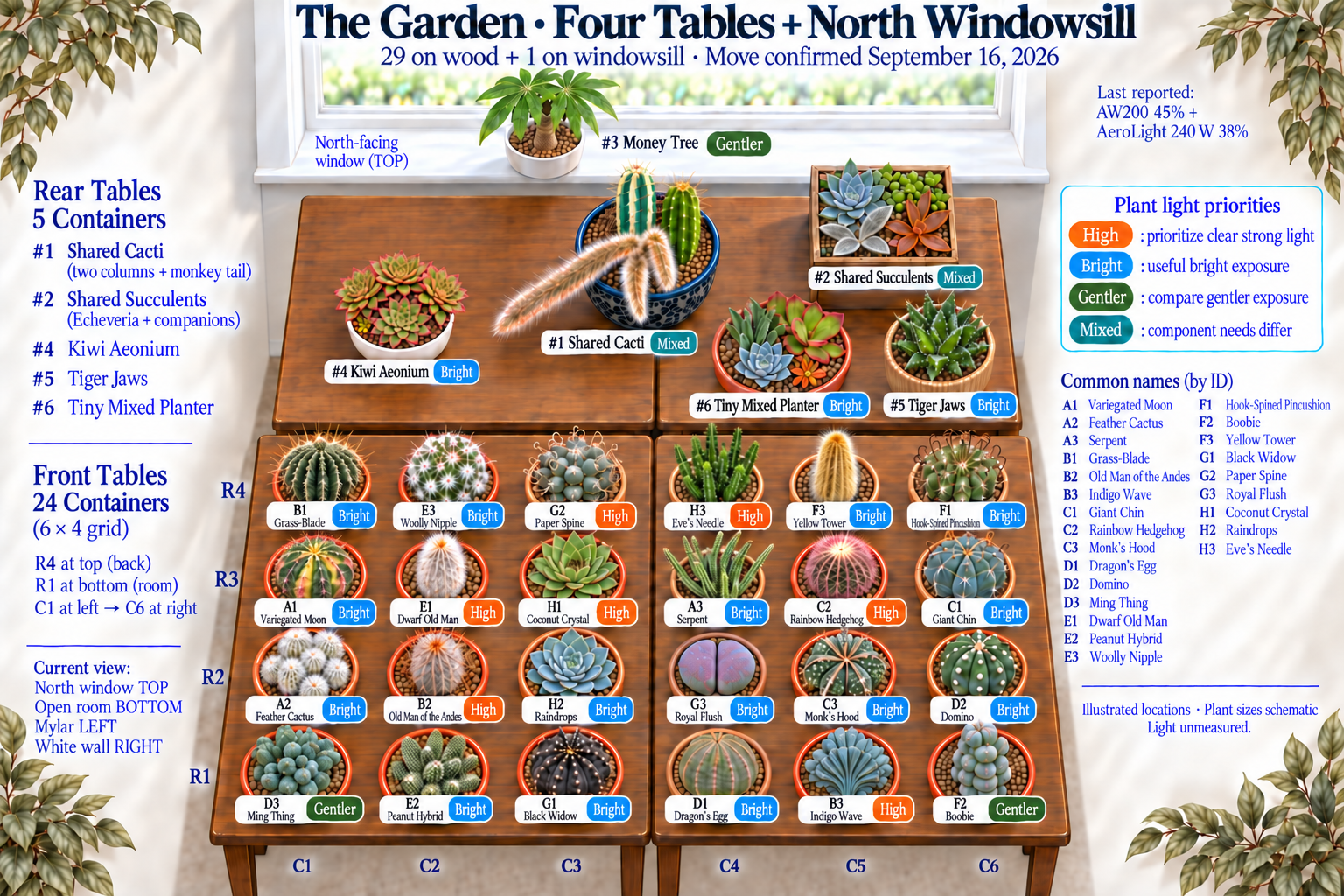
The owner added two new 16 × 13-inch wooden tables and rearranged the display on September 15, 2026. The supplied photos show 24 small pots in six columns × four rows at the room end, with the six larger or shared containers behind them toward the window. This replaces the previous two-table and round-glass placement plan.
Money Tree moved to the north windowsill September 16. The established arrangement has 29 containers on wood: 24 small pots at the front and five larger/shared containers behind them, plus #3 / P21 Money Tree on the windowsill. The table photographs predate that move and the A3/F1 exchange below. #4 Kiwi remains at the rear left, and the vacated Money Tree spot stays open. The two September 20 houseplants are separate from this grid; their proposed living-room arrangement is described above.
The working footprint is four tables in a 2 × 2 block, nominally 26 inches across × 32 inches toward the window, excluding gaps and rails. That orientation is inferred from the photographs, not a new tape measurement. The former round glass table is no longer in use. The new tables' height has not been measured; the earlier pair was 18 inches high.
The drawings face the window: window at top, open room at bottom, Mylar divider at left, white wall at right. The window is still north-facing with weak supplementary daylight, and the two-foot room-end reflector remains absent.
Last reported light settings: AW200 45%, AeroLight 240 W 38%, Veg mode on both, with 13 h 15 m total, including 15 m sunrise and 15 m sunset. The earlier 18-inch tip reference, four independent ceiling hooks and separate hangers remain the last operating record; the new photos do not remeasure clearance or fixture centers. Check the new footprint before carrying over the old one-inch margins or ½–1-inch gap as current geometry.

Owner Light Readings and Confirmed Swap
The owner supplied 48 lux-derived estimated PPFD readings at individual plant heights, rather than at one common level plane. The supplied map is viewed from the room side facing the window, with Ming Thing at its top-left. Do not rotate or transpose those readings into the older illustration's coordinate system without a verified point-to-pot mapping. The measurement date was not supplied.
Across the whole mapped rectangle, including the intentionally unlit far edge, the app estimates range from 145 to 677 µmol·m⁻²·s⁻¹. Its 13-hour DLI calculation ranges from 6.8 to 31.7 mol·m⁻²·day⁻¹. These are approximate phone/lux-sensor/app conversions, not calibrated PAR measurements or species thresholds. Height, shadows, and spectrum affect the comparison; the extrema do not describe every occupied pot or prove that the whole display has too little or too much light. The actual program remains 13 h 15 m total, including 15 m sunrise and 15 m sunset; the app's 13-hour DLI output is not a measured daily light integral through those ramps.
A3 Serpent Cactus and F1 Hook-spined Pincushion exchanged positions after this comparison. All other recorded positions remain unchanged, including P21 Money Tree on the north windowsill. The illustrations predate the exchange; the written grid below shows the current positions. Different-height plants do not inherit the previous occupant's light reading, and the comparison did not measure the windowsill.
Illustrated Views
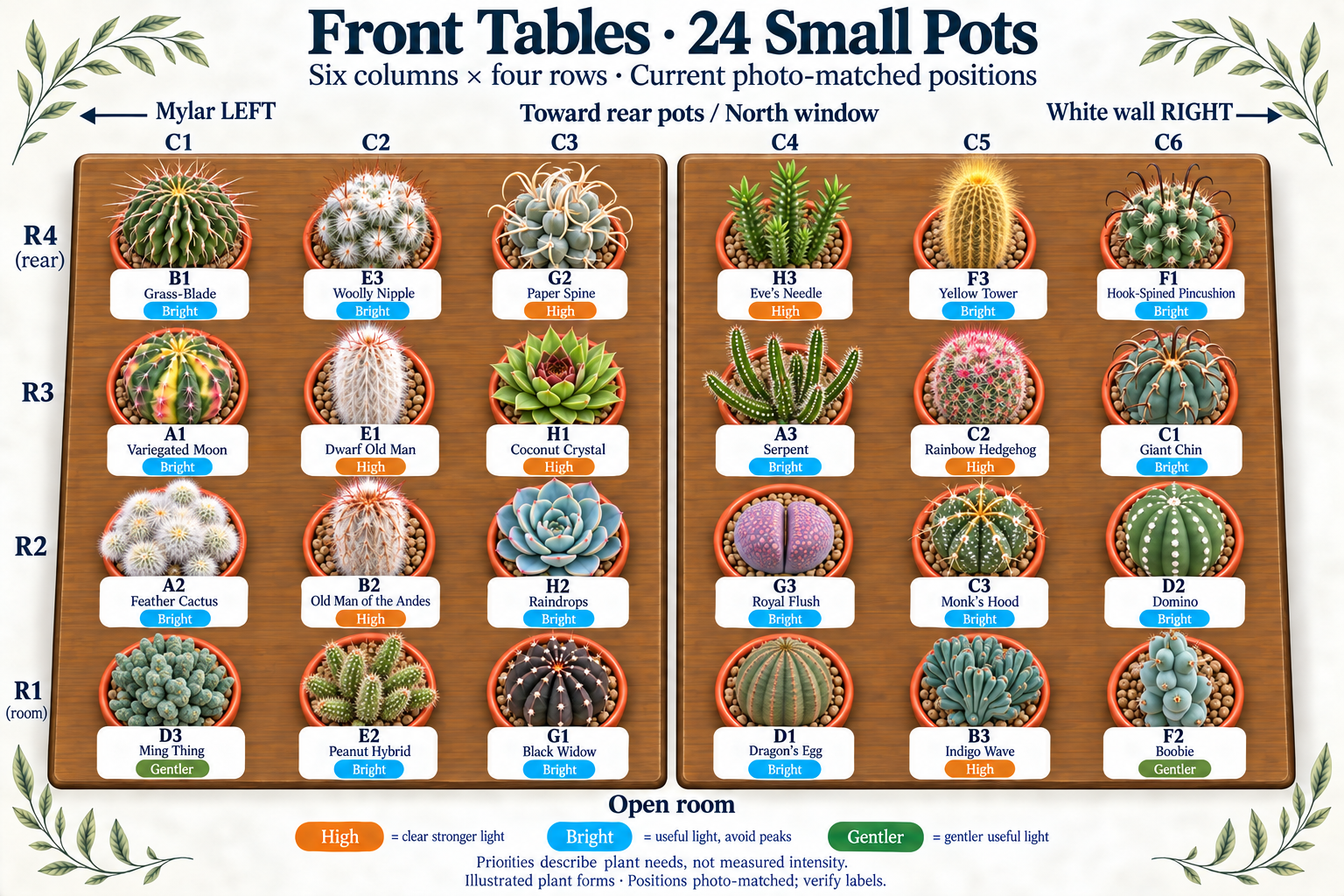
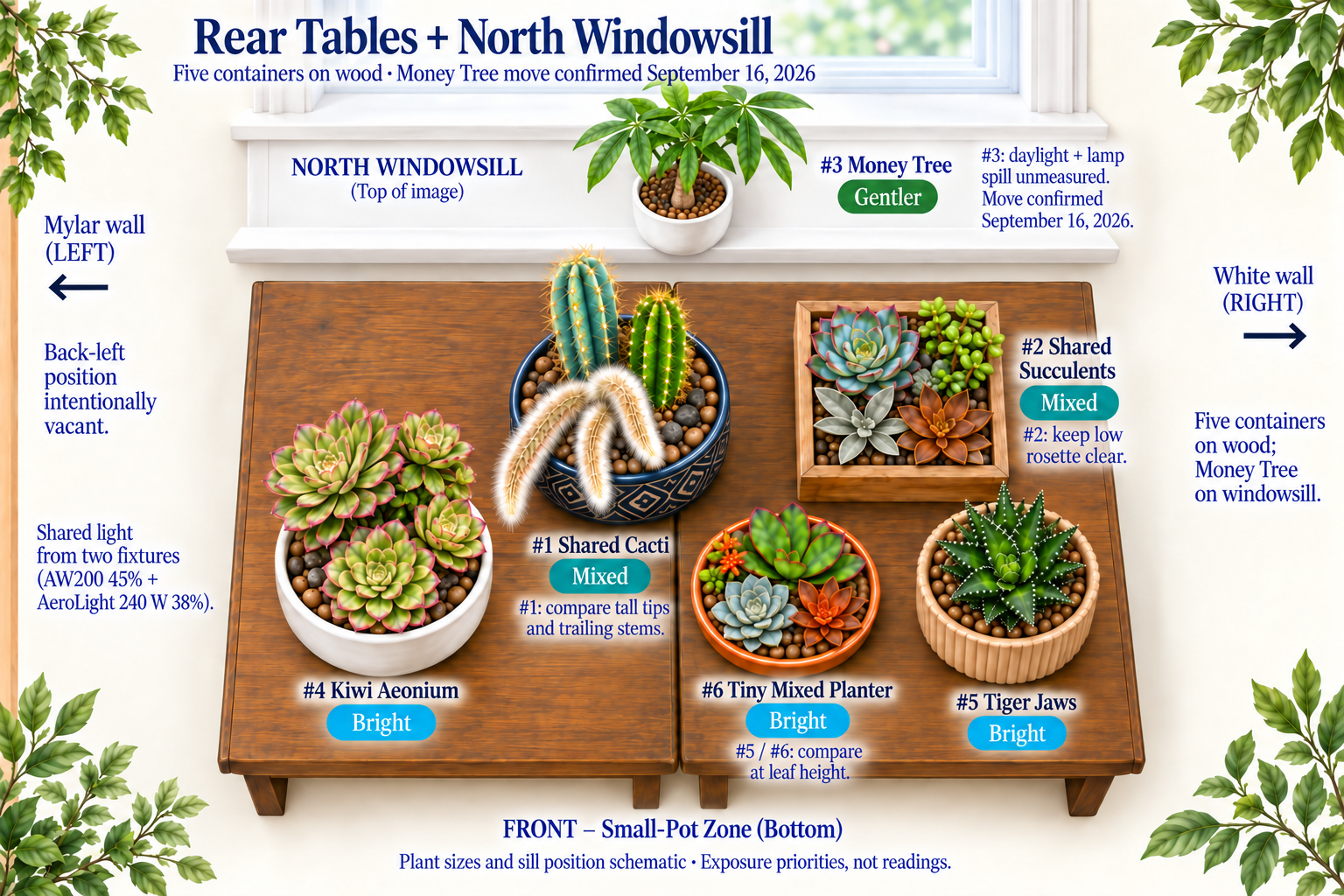
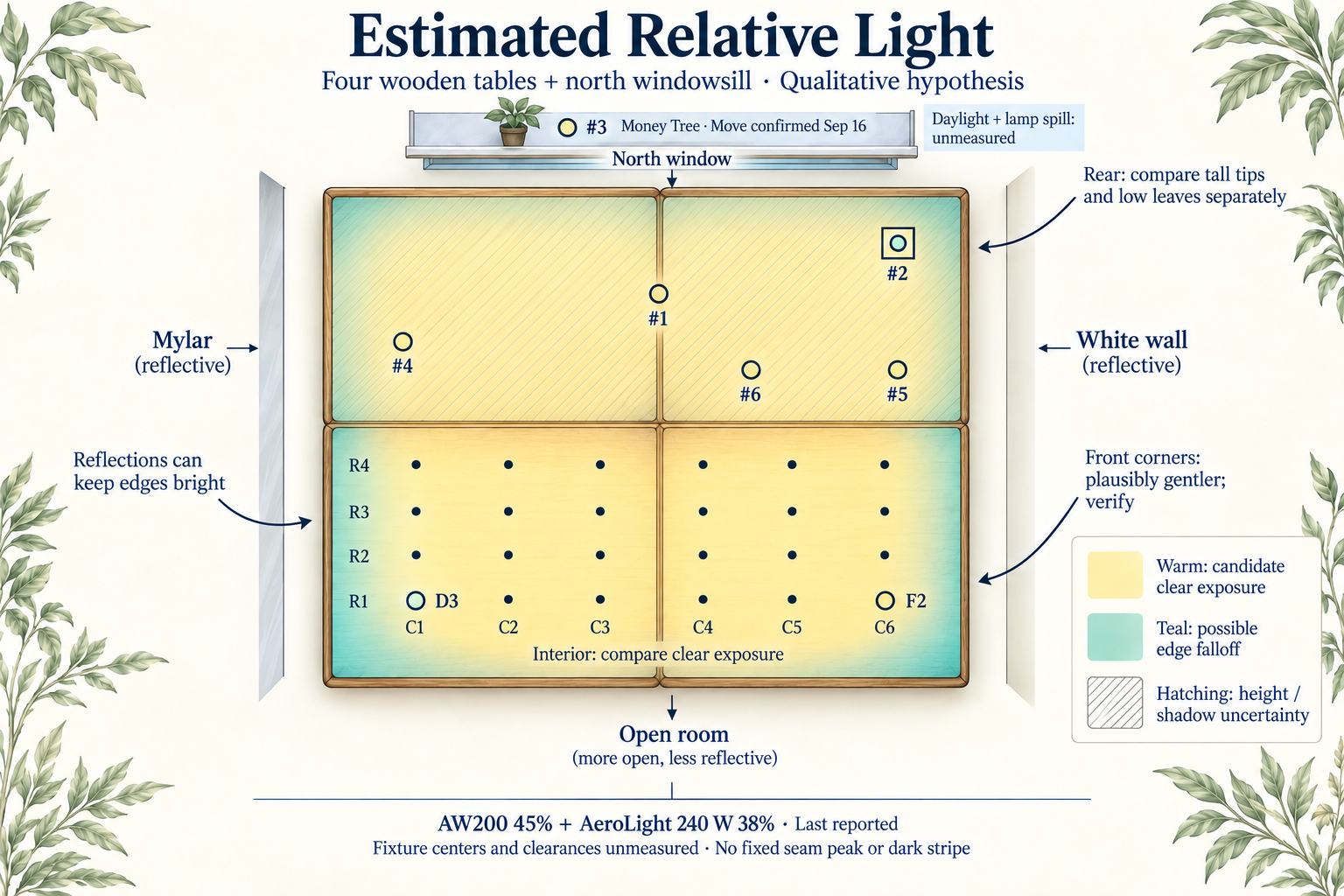
These illustrations show the four-table display and separate Money Tree windowsill. They predate the A3/F1 exchange; use the written grid below for current positions. Plant shapes and sizes are illustrative. Light-priority badges describe care needs, not measured intensity.
Illustrated Whole Display
Illustrated Front Pots
Illustrated Rear Pots and Windowsill
Illustrated Relative Light
The illustration notes and limits record the style references and current-data constraints. The original reference map and its transparent-background copy remain available as downloads.
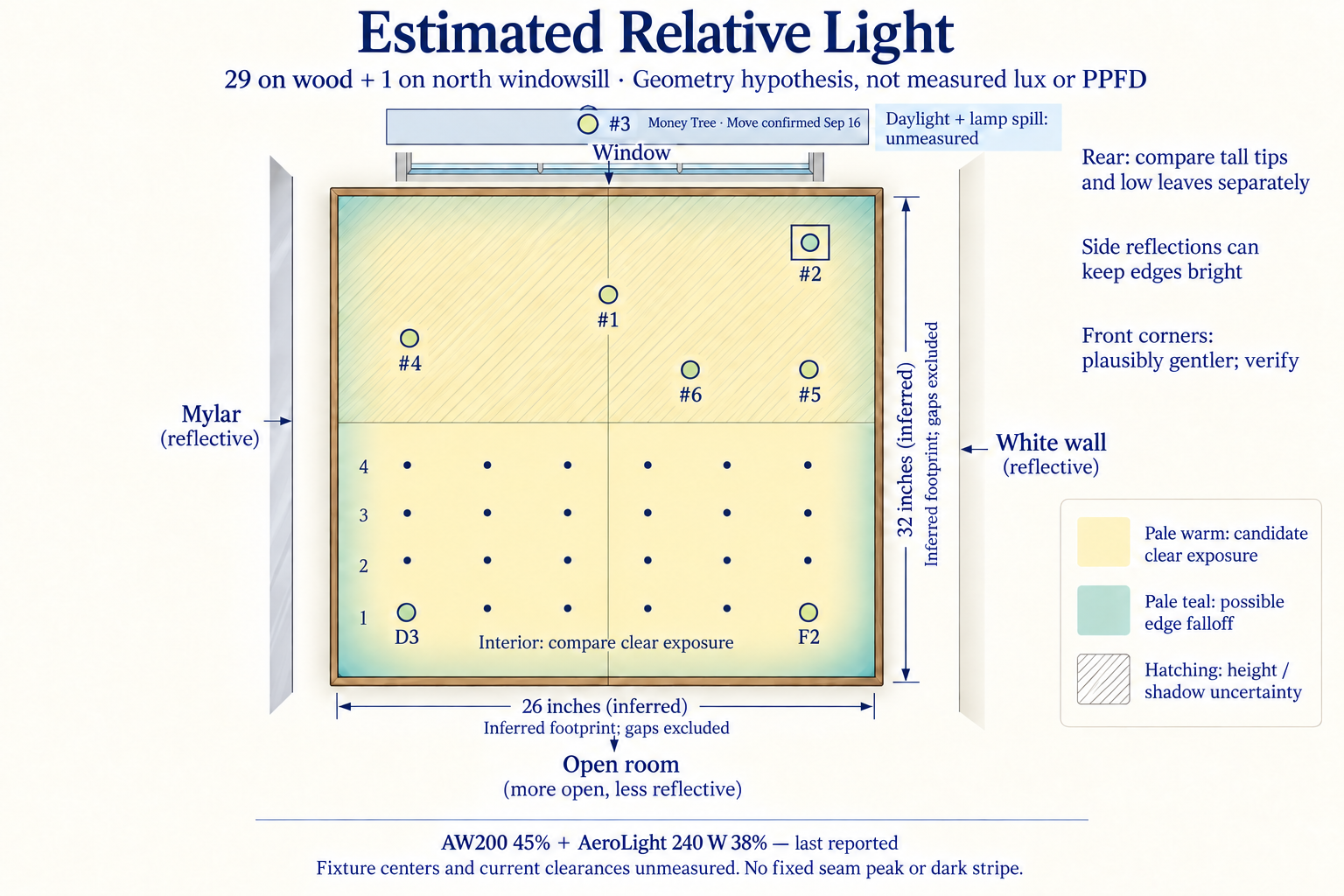
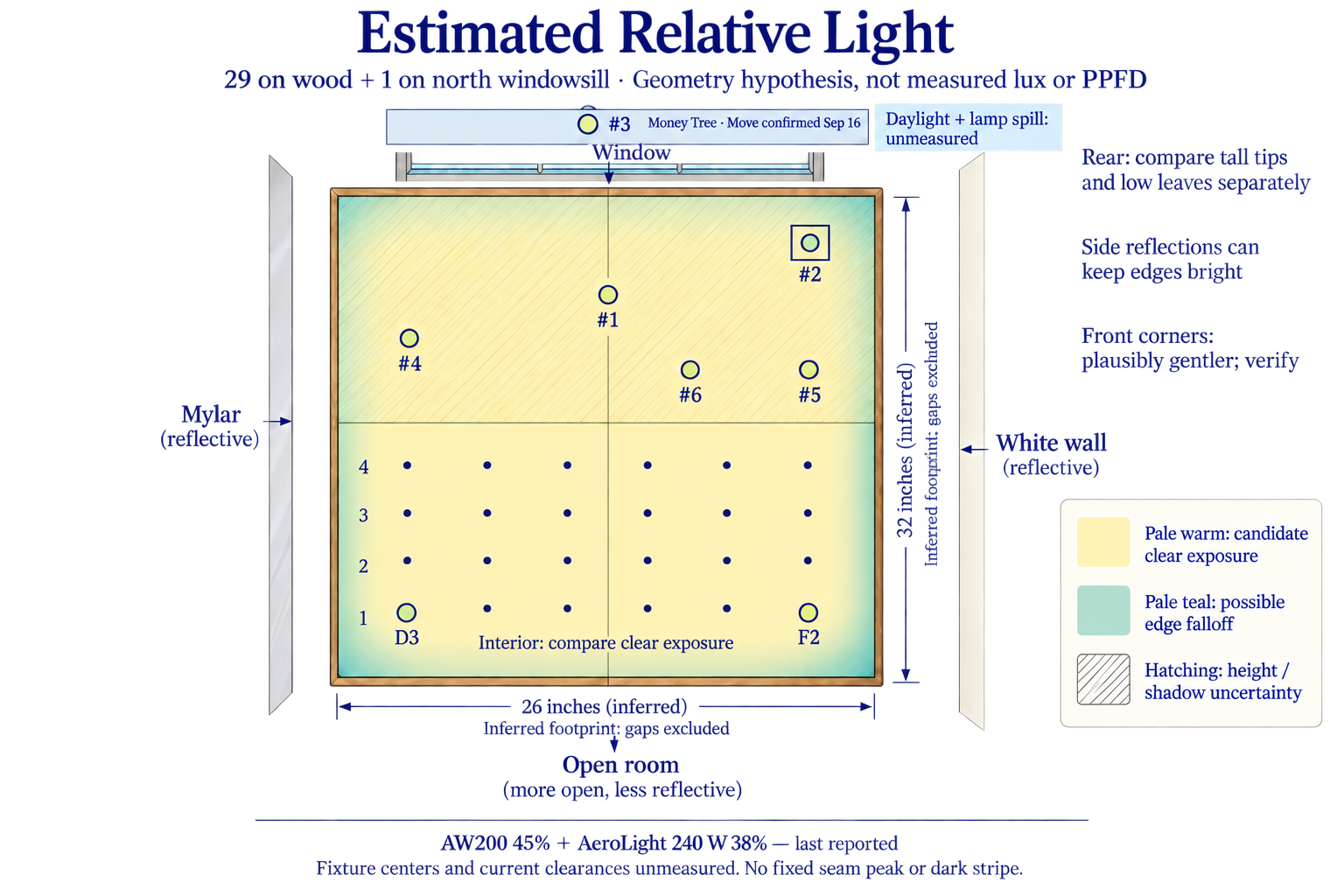
Reading the Light Map
The illustrated map shows an earlier qualitative light estimate. For the later 48 app-derived readings, use the measurement summary above; those values are not plotted on this illustration. Two panels can light the new block, but the larger wooden footprint does not create more light. Exact fixture alignment over it is not established by these cropped photographs.
| Area | Working Expectation | What to Compare |
|---|---|---|
| Interior small-pot area | Clear exposure is plausible where the lamps overlap the display; no precise peak is assumed | C2, B2, H1, H2 and G3 at a common height, then their actual growing surfaces |
| Front corners, D3 and F2 | Plausibly gentler than nearby interior positions, still potentially bright | Both corners against front-center G1/D1 and the middle of the display |
| Mylar and white-wall sides | Reflections may reduce edge falloff; neither side is guaranteed dim | Left and right readings at matching depth and height |
| Back row of small pots | Large rear plants may cast local shadows, independent of fixture coverage | B1, E3, G2, H3, F3 and A3; especially beneath trailing stems |
| Rear containers | Mixed heights and foliage matter more than a simple front/back gradient | Tall #1 tips, low #2 rosette, #4 canopy and low #5/#6 |
| North windowsill, #3 | Separate daylight and possible lamp spill; outside the table heatmap | Actual upper and lower leaf exposure, time and blinds; no assumed equivalent table height |
| Fixture join | Spill may fill a small gap; no dark stripe or hottest stripe is assumed | A short comparison across the actual join after locating it |
Keep the confirmed windowsill position for #3 and the A3/F1 exchange. The following comparison questions record the earlier reasoning; they are not additional move recommendations. The strongest placement question is whether B3 Indigo Wave at the front has sufficient clear light and whether H1 Coconut Crystal in the interior is shaded. Do not automatically exchange them: they have different heights and both need useful exposure. D3 and F2 occupy opposite front corners, rather than the two left corners of the old drawing. Their benefit is an inference to test.
Six nominal 4-inch rims span about 24 inches across the nominal 26-inch front width. Four rows span about 16 inches of nominal front-table depth, leaving little margin for rails, larger rims and foliage. Check that bases are fully supported and leave room to lift each pot without catching neighboring plants. The larger rear pot dimensions are not newly measured.
Whole Display
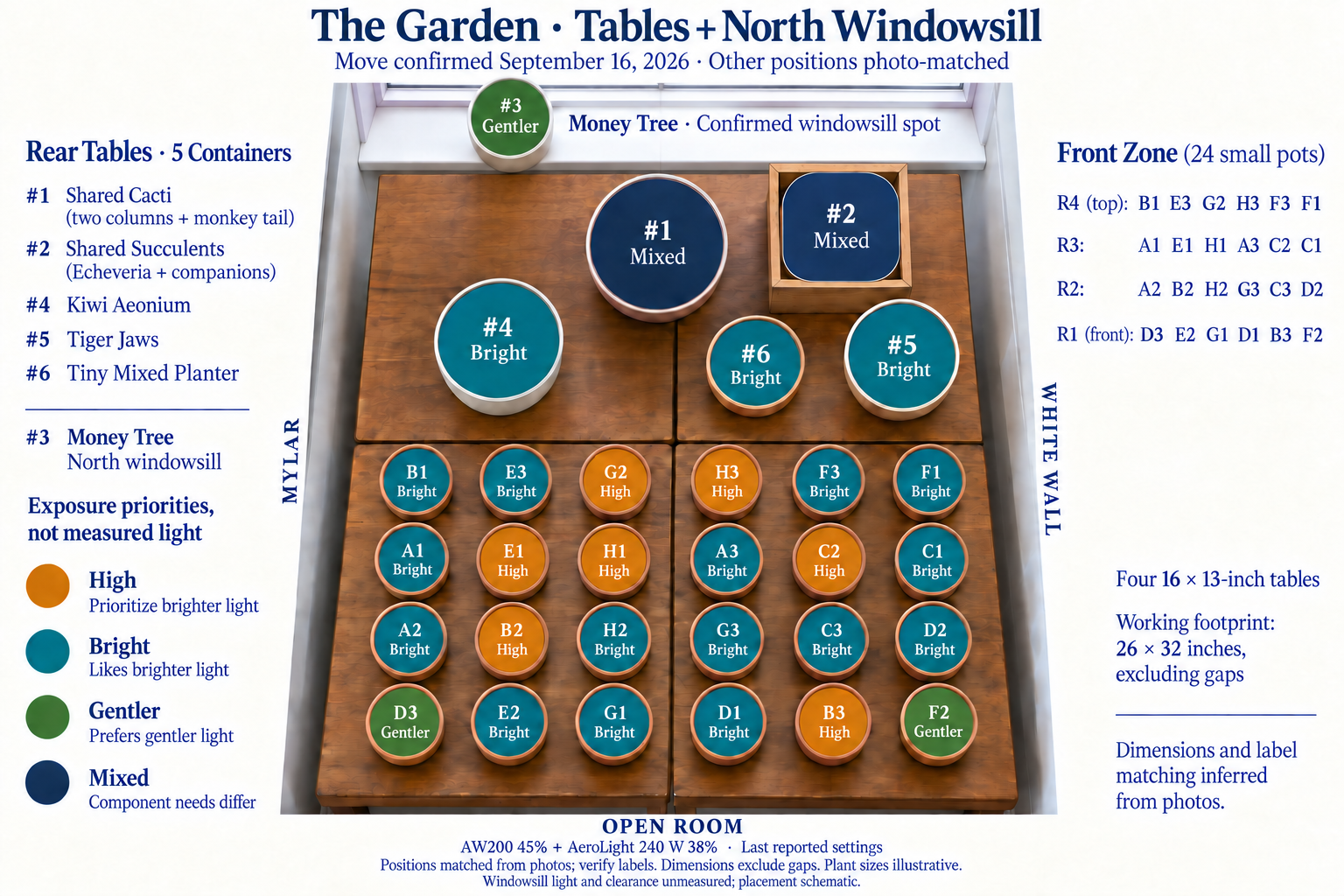
Positions below are matched visually from the owner's photographs, with the later owner-confirmed #3 windowsill move and A3/F1 exchange included. Check the label-to-slot transcription against the physical pots when using the grid.
Front Tables: Six Columns, Four Rows
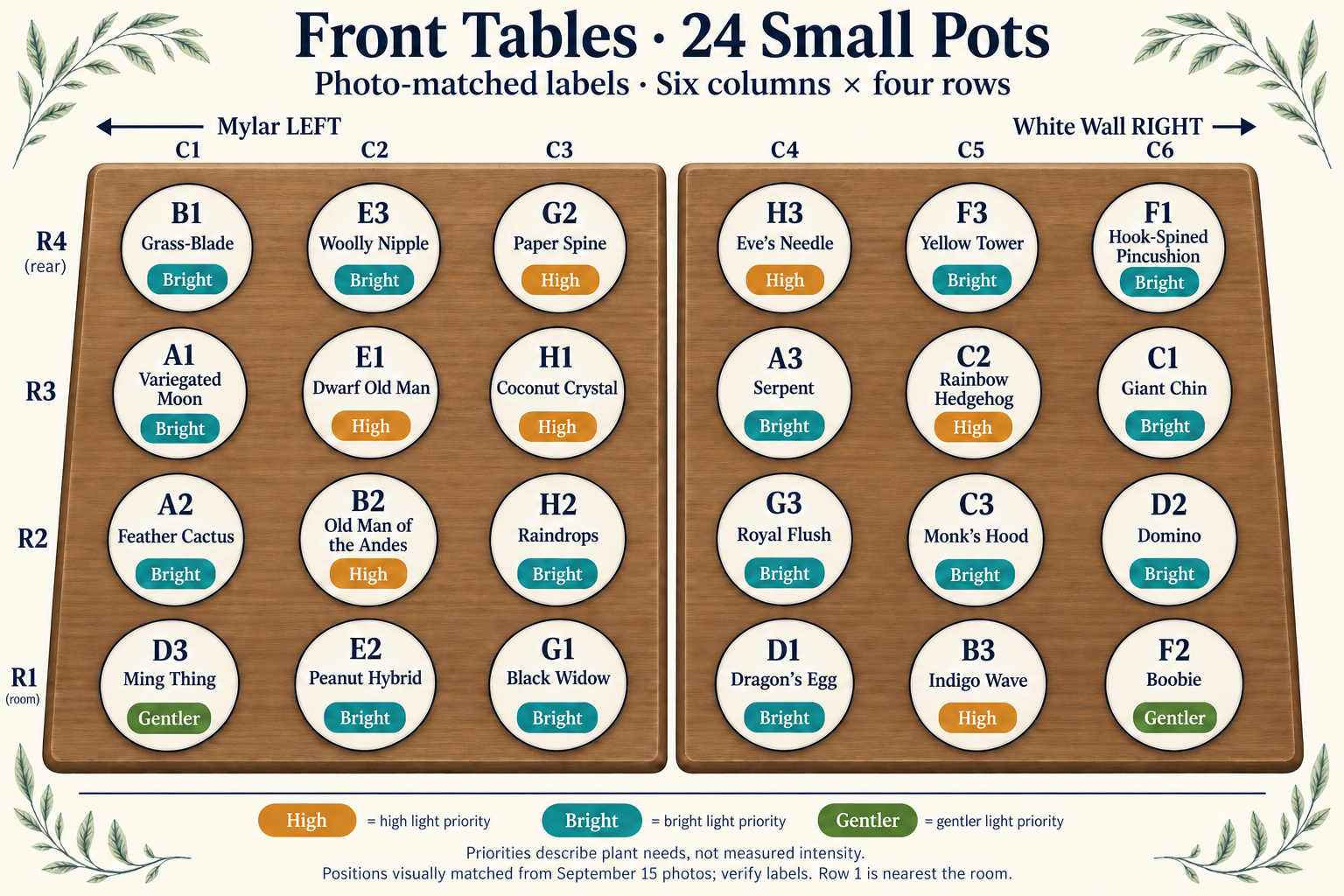
Columns run left/Mylar → right/white wall. Rows run front/room → back/window, so row 4 is above row 1 in the overhead image. These are the retained photo-grid coordinates, updated only for the confirmed A3/F1 exchange. They replace the old 4-column × 6-row coordinates; identical R/C text does not imply an unchanged position. They do not assign coordinates to the owner's separate 48-reading map.
| Row | C1 · Mylar | C2 | C3 | C4 | C5 | C6 · White Wall |
|---|---|---|---|---|---|---|
| 1 · Room edge | D3 · Ming Thing | E2 · Peanut Hybrid | G1 · Black Widow | D1 · Dragon's Egg | B3 · Indigo Wave | F2 · Boobie |
| 2 | A2 · Feather Cactus | B2 · Old Man of the Andes | H2 · Raindrops | G3 · Royal Flush | C3 · Monk's Hood | D2 · Domino |
| 3 | A1 · Variegated Moon | E1 · Dwarf Old Man | H1 · Coconut Crystal | F1 · Hook-Spined Pincushion | C2 · Rainbow Hedgehog | C1 · Giant Chin |
| 4 · Toward rear pots | B1 · Grass-Blade | E3 · Woolly Nipple | G2 · Paper Spine | H3 · Eve's Needle | F3 · Yellow Tower | A3 · Serpent |
Light Priorities
These overlapping priorities describe plant needs, not measured intensity bands. A High plant can be overexposed and a Bright plant may tolerate sun. The full plant-by-plant review retains the species evidence and identification limits.
| Priority | Pots | Practical Meaning |
|---|---|---|
| High · 7 | B2, B3, C2, E1, G2, H1, H3 | Preserve clear strong light; compare low H1 and front-row B3 rather than declaring every center best |
| Bright · 18 | A1, A2, A3, B1, C1, C3, D1, D2, E2, E3, F1, F3, G1, G3, H2; #4, #5, #6 | Useful bright exposure while avoiding excessive peaks; this is not a shade designation |
| Gentler · 3 | D3, F2, #3 | A bright position with less intense exposure when demonstrated; no assumption that an edge is automatically gentle |
| Mixed · 2 | #1, #2 | Consider each living component at its height while retaining one tracked container |
Every Small Pot
| Label | Plant and Retained Identification | Photo-Matched Spot and Light Priority |
|---|---|---|
| A1 | Variegated moon cactus · Gymnocalycium mihanovichii | R3C1 · Bright. Left shoulder between Feather and Grass-Blade. Preserve useful light for this rooted, chlorophyll-bearing variegated selection. |
| A2 | Feather cactus · Mammillaria plumosa | R2C1 · Bright. Left shoulder; its white covering does not mean it requires the strongest exposure. |
| A3 | Serpent cactus · Nyctocereus serpentinus | R4C6 · Bright. Owner-confirmed exchange into F1's former slot. Compare its own stem-height exposure; the previous occupant's reading does not establish this taller plant's new exposure. |
| B1 | Grass-blade cactus · Stenocactus phyllacanthus | R4C1 · Bright. Preserve clear bright exposure; a photo position is not a measured light level. |
| B2 | Old Man of the Andes · Oreocereus trollii | R2C2 · High. Interior-left position with clear exposure at its growing tip; do not compare only tabletop light. |
| B3 | Indigo Wave · Myrtillocactus geometrizans 'Indigo Wave' | R1C5 · High. Front row near the right. Keep clear exposure at its raised growing points. |
| C1 | Giant chin · Gymnocalycium saglionis | R3C6 · Bright. Preserve clear bright exposure; a photo position is not a measured light level. |
| C2 | Rainbow hedgehog · Echinocereus rigidissimus subsp. rubispinus | R3C5 · High. Interior-right stronger-light priority. Keep a clear overhead path rather than assuming this cell is the maximum. |
| C3 | Monk's hood · Astrophytum ornatum | R2C5 · Bright. Preserve clear bright exposure; a photo position is not a measured light level. |
| D1 | Dragon's Egg · probable Euphorbia obesa-type hybrid or selection | R1C4 · Bright. Front-center probable Euphorbia hybrid. A bright position is appropriate; its exact species and maximum tolerance remain uncertain. |
| D2 | Domino · Echinopsis subdenudata | R2C6 · Bright. Preserve clear bright exposure; a photo position is not a measured light level. |
| D3 | Ming Thing · Cereus forbesii 'Ming Thing' | R1C1 · Gentler. Front-left, where a gentler edge is plausible. Mylar can still return substantial light; this is not shade. |
| E1 | Dwarf old man · Espostoa sp., likely E. melanostele subsp. nana | R3C2 · High. Interior-left tall white cactus; retain the qualified Espostoa identification and avoid shading H1. |
| E2 | Peanut hybrid · Echinopsis hybrid, Chamaelobivia Group | R1C2 · Bright. Front row, second from the Mylar. Unknown hybrid parentage limits exact exposure claims. |
| E3 | Woolly nipple · probable Mammillaria mammillaris | R4C2 · Bright. Back row of small pots. Preserve the probable Mammillaria identification and check shadow from Kiwi or #1. |
| F1 | Hook-spined pincushion · Mammillaria cf. rekoi | R3C4 · Bright. Now in A3's former slot. Compare its own growing surface; the previous occupant's reading does not establish this shorter plant's new exposure. |
| F2 | Boobie cactus · Myrtillocactus geometrizans 'Fukurokuryuzinboku' | R1C6 · Gentler. Front-right corner. Compare its actual tip exposure before calling this gentler; small pot size does not prove juvenile age. |
| F3 | Yellow tower · Parodia leninghausii | R4C5 · Bright. Back-right taller cactus; compare its tip separately from nearby plants at their actual heights. |
| G1 | Black Widow · Gymnocalycium mihanovichii f. variegata 'Black Widow' | R1C3 · Bright. Front-center bright position; dark color and variegation do not establish a shade requirement. |
| G2 | Paper spine · Tephrocactus articulatus var. papyracanthus | R4C3 · High. Back row of small pots, close to the trailing shared cactus. Avoid shadow or contact from the monkey tail. |
| G3 | Royal Flush split rock · Pleiospilos nelii 'Royal Flush' | R2C4 · Bright. Low central split rock. Compare rosette-height exposure and retain its leaf-cycle watering restrictions. |
| H1 | Coconut Crystal · Sempervivum Colorockz® 'Coconut Crystal' | R3C3 · High. Low central rosette. Compare the growing surface for shadows from E1 and the rear shared cactus; strong light does not mean maximum heat. |
| H2 | Raindrops · Echeveria 'Raindrops' | R2C3 · Bright. Low interior-left rosette. Keep clear bright light, without automatically assigning it the strongest intensity. |
| H3 | Eve's needle · Austrocylindropuntia subulata | R4C4 · High. Back row of small pots, near the shared cactus; preserve clear light and separation from trailing stems. |
Rear Tables and North Windowsill
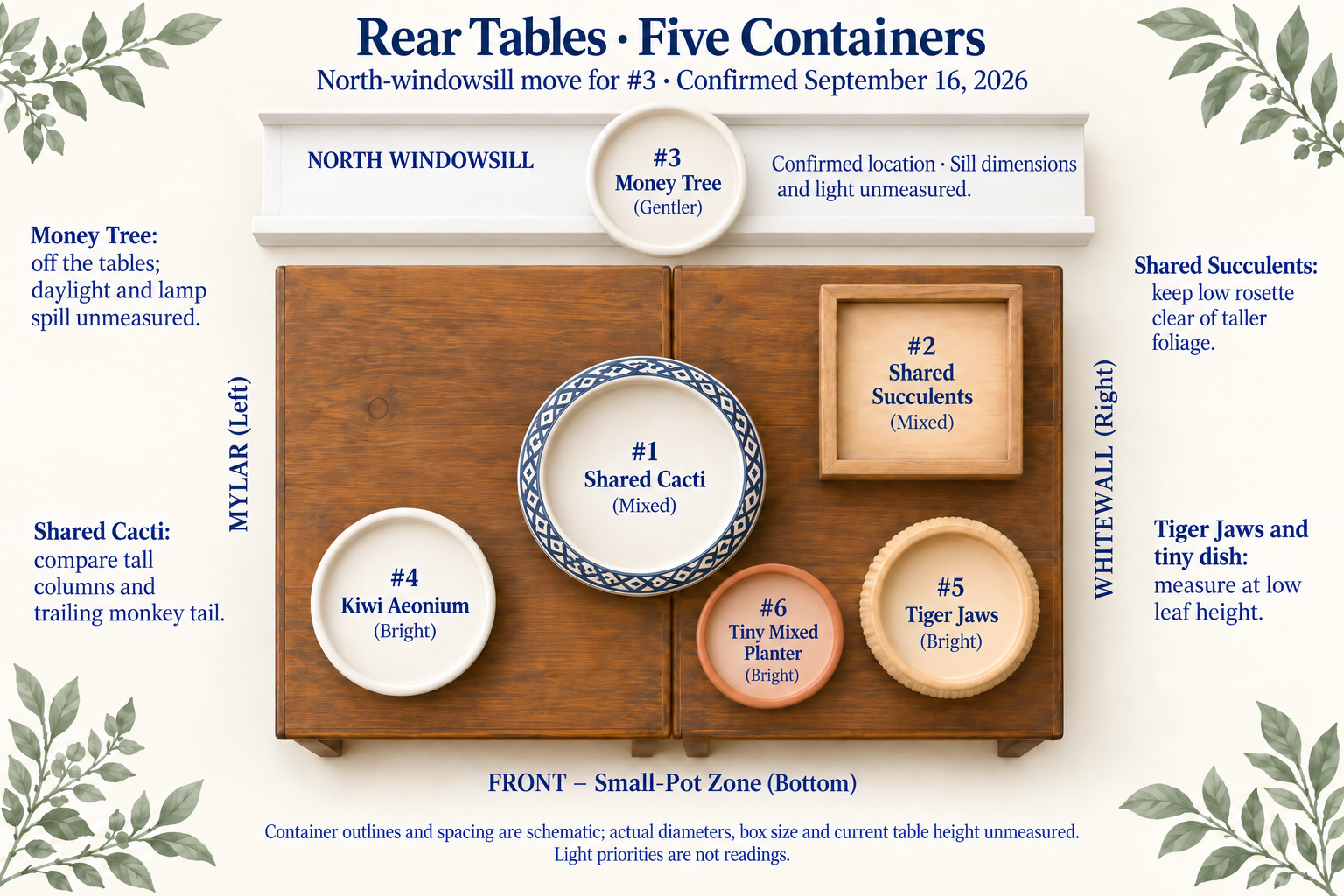
| Label / P-ID | Container | Position Record | Shape and Size Record | Exposure Priority |
|---|---|---|---|---|
| #1 / P19 | Shared Cacti | Rear center | Dark patterned round pot; current diameter unmeasured | Mixed. Compare both tall columns and trailing monkey tail; pale tissue and short neighbors need separate attention. |
| #2 / P20 | Shared Succulents | Rear right, toward window | Square wooden box with plastic liner; owner confirms one-inch hole through both bottoms; side lengths unmeasured | Mixed. Keep the low Echeveria exposed beneath the taller Portulacaria and Kalanchoe foliage. |
| #3 / P21 | Money Tree | Confirmed north windowsill, off tables | White round pot, previously recorded 6-inch class | Gentler. Compare actual leaf exposure on the sill; daylight and lamp spill are unmeasured. |
| #4 / P22 | Kiwi Aeonium | Rear left; unchanged after #3's move | White round pot, previously recorded about 5-inch class | Bright. Keep substantial lamp contribution without allowing its canopy to shade the small pots. |
| #5 / P29 | Tiger Jaws | Rear right, in front of the square box | Tan ribbed round pot; current repotted dimensions unmeasured | Bright. Retain probable Faucaria tuberculosa / seller F. tigrina qualifier; compare at leaf height. |
| #6 / P30 | Tiny Mixed Planter | Front of rear zone, between #1 and #5 | Shallow round terracotta dish, nominal 5-inch class | Bright. Compare the low rosettes and paddle leaves for shadows from the large pots. |
Shared cactus #1 retains probable variegated Pilosocereus pachycladus, Cleistocactus colademononis and probable Echinopsis spachiana. The removed historical Mammillaria is not a fourth living component. Shared box #2 retains probable Echeveria pulidonis/hybrid, Portulacaria afra (possible 'Aurea' unconfirmed), probable Kalanchoe bracteata and Kalanchoe orgyalis. The tiny mixed dish's Echeveria, Sedum and Kalanchoe identifications remain provisional. Each shared container is one weigh-in.
Money Tree: Confirmed North-Windowsill Spot
#3 / P21 remains the same tracked pot, with the working identification Pachira cf. glabra and its previously recorded white round 6-inch pot. The owner confirmed on September 16 that it is on the north-facing windowsill, outside the wooden display; the exact move time was not supplied. The drawing locates it schematically; it does not establish the sill's size, exact horizontal position, support or clearance. #4 Kiwi stays in its current rear-left spot; no replacement pot is assigned to the space #3 leaves.
The goal is useful indirect light with less direct fixture exposure. Assess daylight and any LED spill at the actual leaves on the windowsill. Keep foliage clear of cold glass and drafts, and keep the pot and drainage saucer fully supported.
Downward-pointing leaves are the owner's September 15 observation. Excess light is a possibility, not a confirmed cause. NC State's money-tree guidance supports indirect light but describes P. aquatica, so it is a comparison rather than a new identification. University of Maryland Extension notes that both too little and too much water can cause wilting; leaf angle alone cannot distinguish these causes or establish that watering is due. Preserve the existing money-tree watering rules and observation history.
Compare the Plan With a Phone Meter
For an optional future comparison, use the blank reading sheet. It contains 24 front coordinates, five rear-container points and one separate windowsill point. Record four rows of six values, with row 1 nearest the room, plus five rear points and the windowsill reading for #3. Repeat this comparison when a placement or lighting question needs answering.
- Use both fixtures at their usual steady settings, outside the sunrise/sunset ramps. Record which light is on which side, each spectrum mode, and the actual fixture positions. Keep blinds and daylight consistent, ideally with little daylight contribution.
- Use the same phone, app, upward sensor orientation and any diffuser required by that app. Avoid shading it with your body. Let readings settle and repeat several positions; clipping or erratic values invalidate a ranking.
- First compare the 29 table positions at one recorded common horizontal height, clear of obstructions where practical. Do not mix this pass with readings at different tip heights. Repeat R2C3 before, during and after the pass to check drift.
- Make a separate pass at actual growing-surface heights for D3, F2, A1, B3, C2, H1, H2, G3 and the five rear pots. For #1 compare the pale column, green column and trailing stems separately; for #2 compare low rosette and taller foliage. Record the height with each reading. Separately measure #3 at its actual leaves on the windowsill; use height above the sill as its reference and record daylight/blinds. Do not fold this different-height, mixed-daylight reading into the common-height table ranking.
- Compare corners, interior and rear shadows. If values repeat within a small range, preserve spacing instead of chasing small differences. The completed comparison led only to the confirmed A3/F1 exchange. Keep other placements and settings unchanged; a future comparison should answer a specific remaining question rather than trigger another automatic reshuffle.
Lux measures illuminance, not lumens. Lux-to-PPFD conversion depends on spectrum; with two potentially different spectra, even a repeatable lux ratio is only an approximate relative comparison of plant-useful light. Do not invent a conversion factor or treat uniformity as proof that absolute intensity is suitable. See Apogee's spectrum-dependent examples and University of Minnesota Extension.
Care and Record Boundaries
This is a physical placement change, not a repot or watering event. Keep the existing pot setups, wet/dry references and learned cycles. Observe changed drying through useful weights; moving pots alone does not justify watering or weighing every pot daily. Money tree, Royal Flush, seasonal Kiwi and shared-container restrictions still apply.
Sources
-
September 21–22 owner evidence: planned P31/P32 move to the living room and FECiDA six-tube purchase. The owner confirmed the north-facing double glass sliding door, adjacent plants, P32 closest to the glass, P31 on the smallest stool, and FECiDA clipped to a shelf on September 22. The September 22 links identify the two existing Juhefa fixtures and separate Diivoo; the owner may omit the Diivoo, updating the initial plan to use all existing lights. Receipt, installation, distances, and applied settings remain unconfirmed.
-
Juhefa B0D7V5MBBW and Diivoo B0CBVFLNMV, inspected September 22: exact seller model, controls, and electrical fields, with evidence limits maintained in the equipment inventory. The Juhefa 10 W consumption claim applies per fixture; the Diivoo maximum-compatible-wattage field does not establish its input power.
-
FECiDA Amazon listing, ASIN B0DHRHF2QV, matched through the owner's order on September 21: seller per-tube ratings, spectrum components, and repeating 4/8/12/16/20-hour timer choices. The order's September 23 arrival date is an estimate.
-
NC State: Peperomia obtusifolia and NC State: Tradescantia spathacea: bright-indirect species guidance, qualified low-light tolerance, and oyster-plant stretching/color response. Neither supplies these cultivars' DLI thresholds.
-
Iowa State Extension: supplemental-light considerations: generic foliage DLI bands, PPFD conversion, and distance/coverage tradeoffs.
-
University of Minnesota Extension: lighting for indoor plants: foliage-houseplant light duration and the distinction between wattage and light received.
-
Move evidence: September 15 owner report of downward-pointing money-tree leaves and a planned move to the north-facing windowsill, followed by owner confirmation on September 16 that the move is complete. The exact completion time and cause of the downward leaves were not established. The later confirmed table exchange was A3/F1.
-
Owner evidence: September 15 purchase of two additional 16 × 13-inch tables and three supplied setup photographs. The 2 × 2 orientation, nominal 26 × 32-inch block and label matching are photo-based inferences; current gaps, heights and exact fixture centers remain unmeasured. Later light evidence is the owner's approximate 48-reading comparison above, not a calibrated PAR map.
-
Later owner evidence, measurement date not supplied: 48 app-converted readings at individual plant heights, whole mapped rectangle range 145–677 estimated PPFD and 13-hour app DLI 6.8–31.7; includes the intentionally unlit far edge. Owner confirmed only the A3/F1 exchange.
-
Operating record: September 13 installed lights, AW200 45%, AeroLight 240 W 38%, 18-inch tip reference and the shared 13 h 15 m cycle. See the equipment record, AW200 manual and AeroLight manual. These are the last reported settings.
-
Plant evidence: the source-by-source review, plant profiles, inventory, NC State Ming Thing, RHS Feather Cactus, RHS Rainbow Hedgehog, RHS Monk's Hood, NC State Sempervivum and SANBI split rock.
-
Illustrations: generation prompts and evidence limits. The September 14 image set is historical and does not represent this new furniture arrangement.