


Cactus collection
Plant 15 / 45 Cactus collection
 Plant 15 / 45


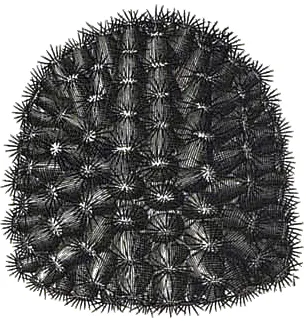
Species reference · Leonard Plukenet · Public domain · Photo Source ↗
 Collection Record
- Cactus-03
 Permanent Label
E3 Identification
 Status
 Acquired From
- Carlsons' Greenhouse, Torrey Road, Fenton, Michigan
 Acquired On
- 2026-08-10
 Google Sheets ID
- P15 ↗
 Photo History
- 3 captures · newest ↓
Measurements and Care History
 Measurements and Care History
Weights, watering, events, and charts for P15.
Spot it
 Spot it
What it looks like
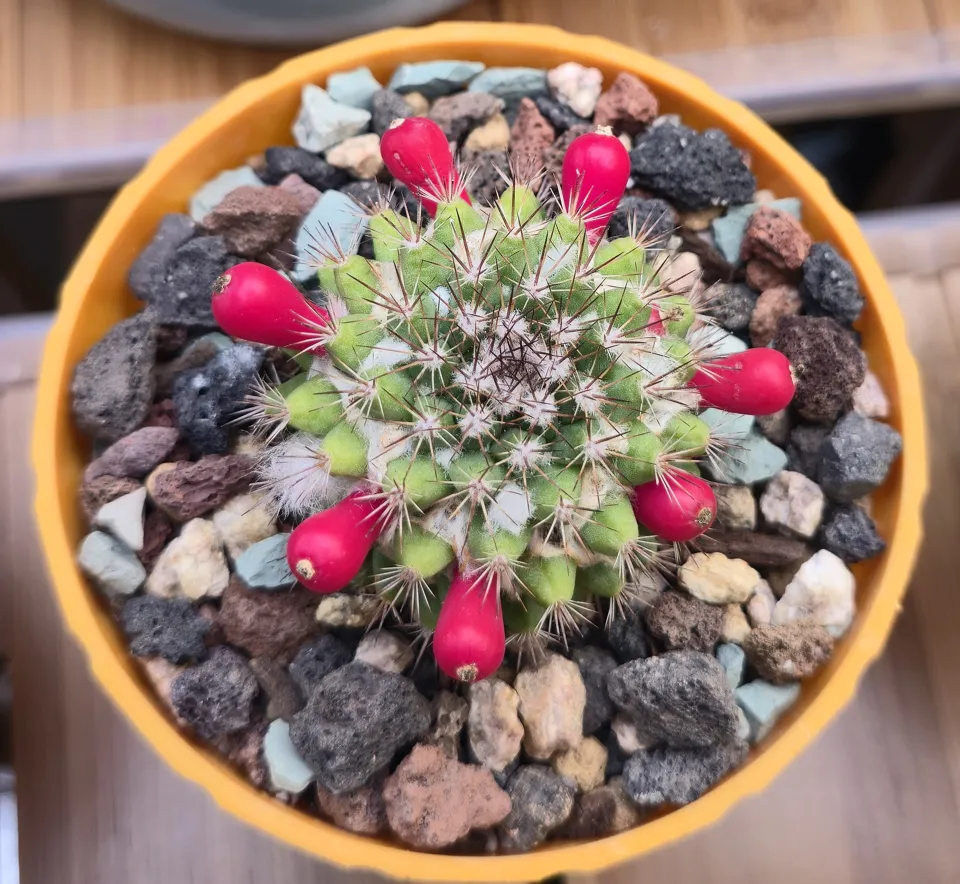
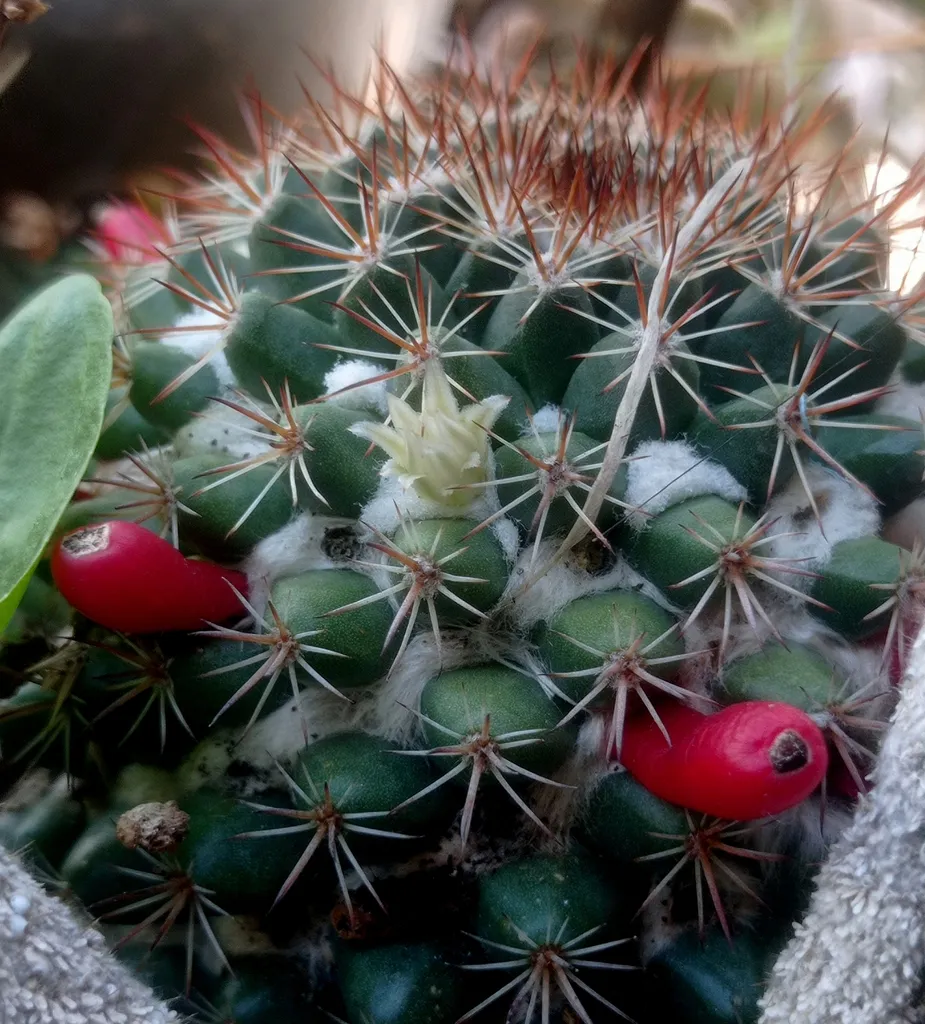
A woolly green globe built from large rounded tubercles, each carrying a star of pale radial spines and a few stronger dark central spines; a red club-shaped fruit stands out near the crown.
One curious thing
 One curious thing
Did you know?
The conspicuous red projection on this plant is a fruit rather than a flower—evidence of an earlier bloom that can remain visible long after the petals are gone.
Explore This Plant
A closer look
How this plant works
 How this plant works
Spines sit at the tubercle tips, while flowers emerge from the spaces between these raised green mounds.
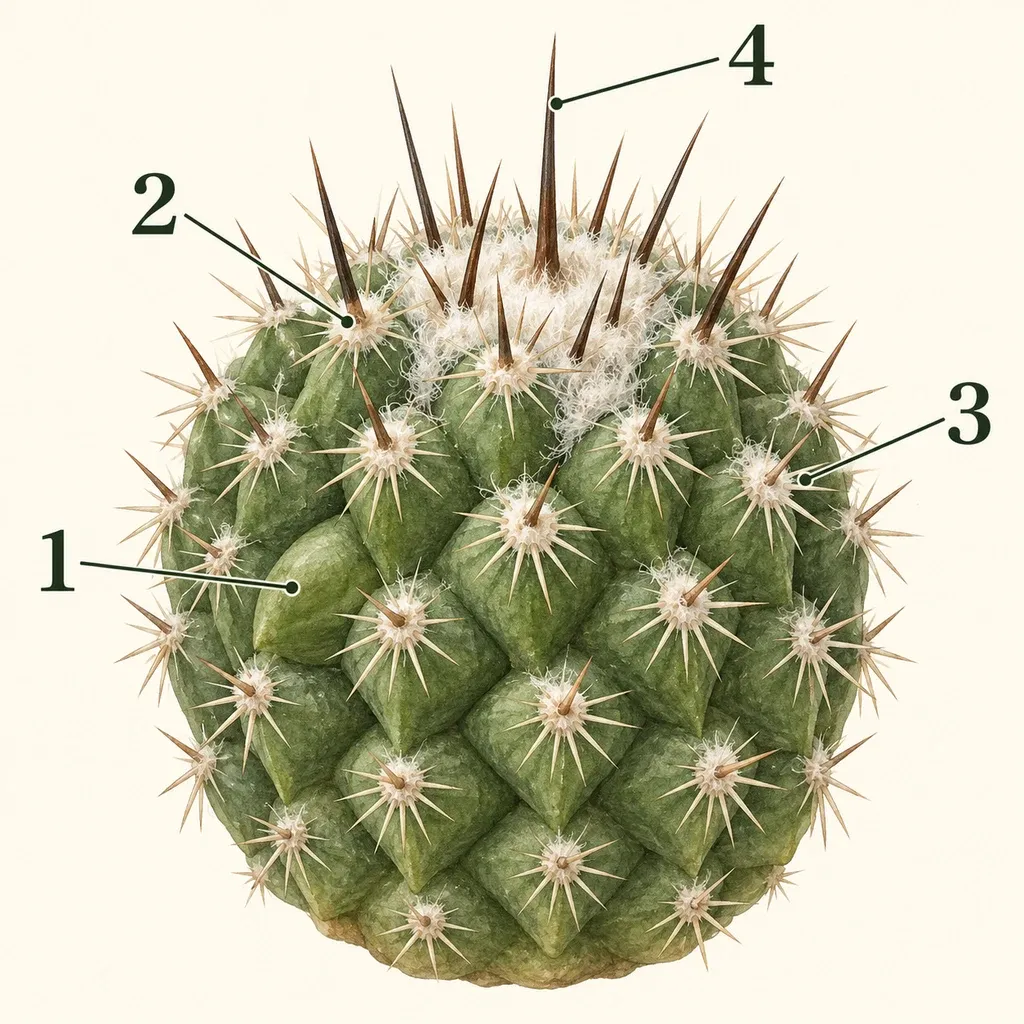
Tubercle
Each projecting green mound is part of the succulent, photosynthetic stem.
Areole
The cushion at a tubercle's tip bears its spine cluster.
Radial spines
Shorter outward-spreading spines form a protective star around the areole.
Central spine
The stronger spine projects beyond the radial spokes.
Habitat and origins
 Habitat and origins
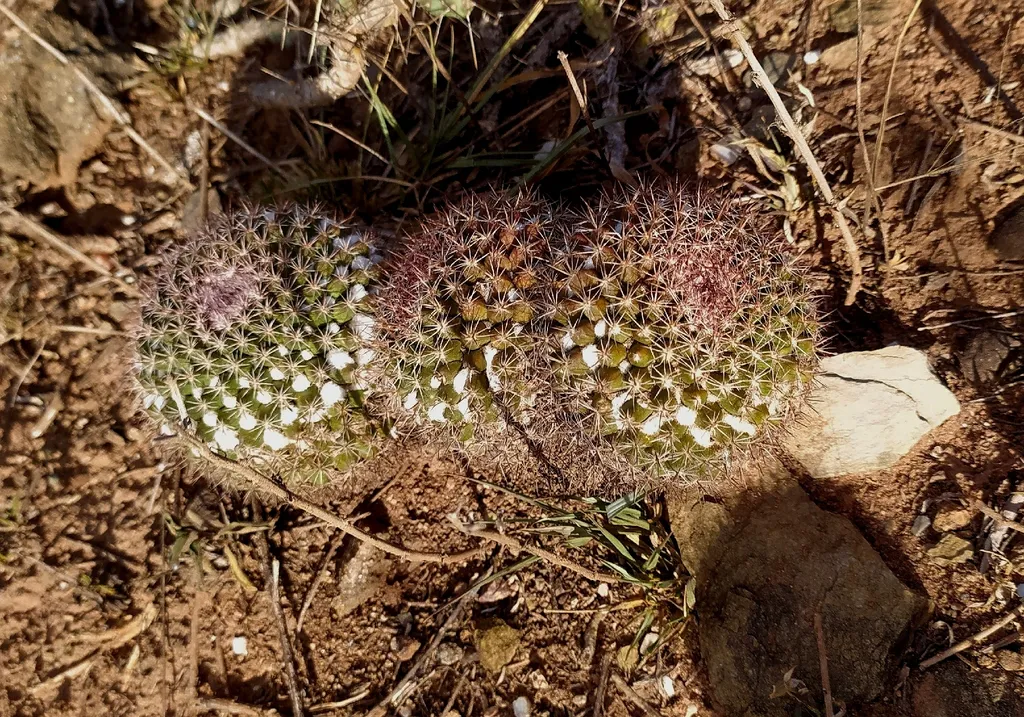
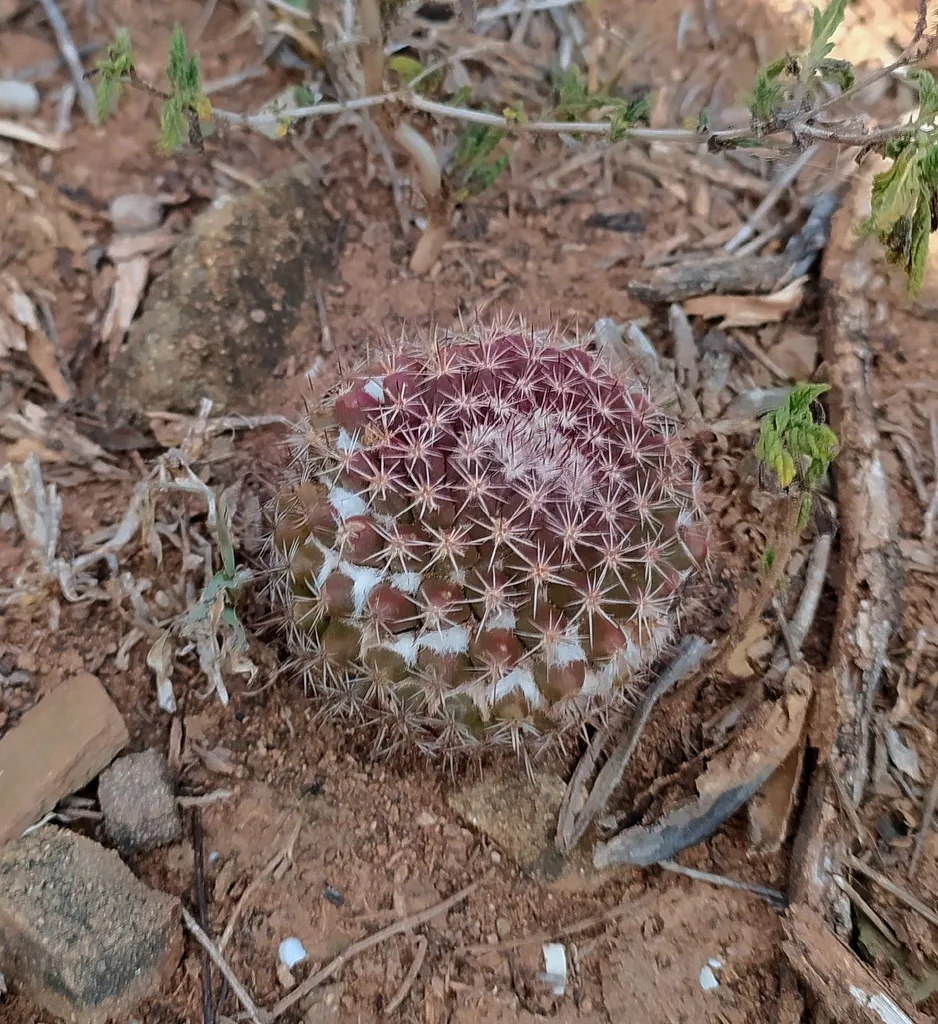
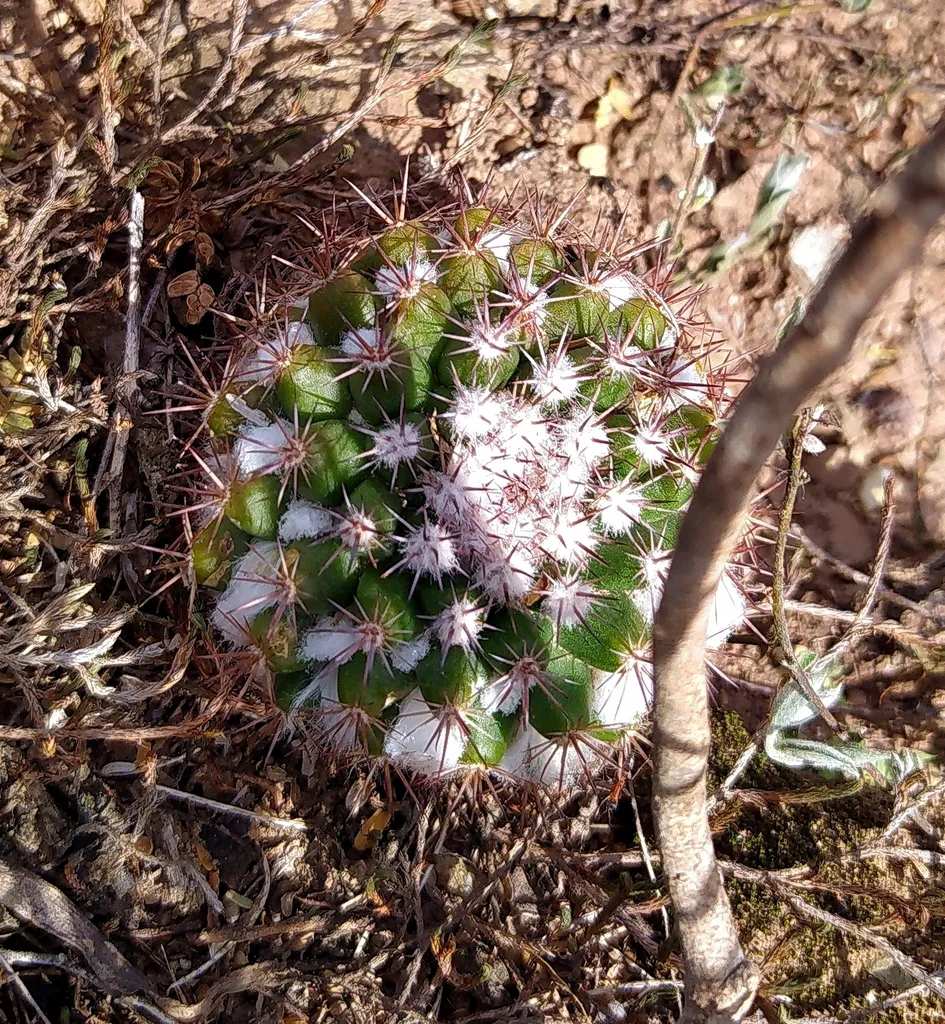
Mammillaria mammillaris occurs in the southern Caribbean and northern South America, including northeastern Colombia and northern Venezuela. It grows in seasonally dry tropical vegetation.
Habitat sources: [1]
What growth can look like
 What growth can look like
- Stage 1
Rounded juvenile
The green body is organized into spirals of tubercles.
- Stage 2
Broadening body
Established stems become larger globes or short cylinders.
- Stage 3
Flower and fruit
Small pale flowers can be followed by conspicuous red club-shaped fruits.
Look closely at the tubercles: their intersecting spiral rows organize the body, with flowers appearing in the spaces between them.
Flowers
Tiny cream, pale green, or yellowish flowers nestle between tubercles. The conspicuous red club-shaped projection recorded on this plant is a fruit from an earlier bloom.
As it matures
Rounded to short-cylindrical stems reach about 8–20 cm across, growing alone or sometimes in clumps.
Sources: [2]
Behind the name
Linnaeus published Cactus mammillaris in 1753; Kew dates the present Mammillaria combination to 1886.
Sources: [1]
Similar plants, useful clues
Probable Mammillaria rekoi ↗
The rekoi candidate has finer, denser pale radial spines and conspicuous hooked central spines; this plant's larger exposed tubercles and pale flowers support a different ID.
This plant in the collection
Its story so far
Identification observations
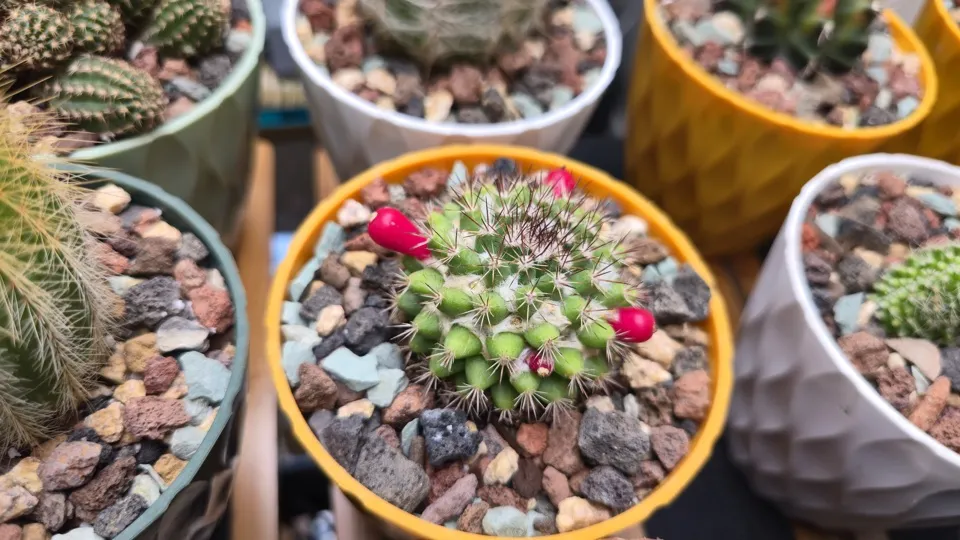
Close photographs showed large tubercles, dark-tipped spines, tiny cream flowers or buds, and a red club-shaped fruit.
Collection record ↗
Then and now
Explore the sources
 Explore the sources
Names and identity
| Kind | Name |
|---|---|
| Working identification | Mammillaria mammillaris |
| Common name | Woolly nipple cactus |
| Permanent-label form | PROB. M. mammillaris |
| Former identification | Mammillaria cf. melanocentra |

Close photographs reviewed on August 11, 2026 showed a shiny green body with large rounded tubercles, sparse dark-tipped central spines, tiny cream flowers or buds, and a red club-shaped fruit. These features favor Mammillaria mammillaris over the earlier possibilities M. cf. melanocentra and M. mystax. Those diagnostic close-ups are no longer available.
Origin, form, and publication
Kew accepts Mammillaria mammillaris (L.) H.Karst., published in its current combination in 1886. The species occurs along the Venezuelan coast and on nearby Caribbean islands. LLIFLE describes shiny globose to short-cylindrical stems, ovoid to conical tubercles, small cream-to-greenish flowers, and scarlet club-shaped fruit.
Care in this collection

| Topic | Practical approach |
|---|---|
| Grow-light position | Photo-matched R4C2 · Bright. September 15, 2026 photo reference: six-column/four-row front grid, facing the window. Back row of small pots. Check for shade from the neighboring Kiwi or shared cactus planter. See the current placement guide. |
| Water | Soak, drain, and allow the 4-inch pot to dry completely; keep the crown dry when the room is cool. |
| Pot and mix | Keep the current pot until the body or roots crowd it; do not bury the lower tubercles. |
| Fruit | Leave attached fruit until it loosens naturally unless rot or pests appear around it. |


Rotation, propagation, and watch points
- Rotate 90° clockwise during the normal Sunday rotation.
- Seed can be collected from fully ripe fruit; offsets, if produced, can be rooted.
- Inspect the axils for mealybugs without forcing the tubercles apart.
- Photograph the next open flower beside a ruler because it is useful identification evidence.
Sources

Through the seasons
Plant Photo History
Recent photographs of this plant. Open a photo or its collection for the complete history.
Botanical reference photos
Reference Gallery
Form and growth


Look closer


In the landscape
Research Trail
- Collection Notes on GitHub
- Complete Photo Archive and Credits
- iNaturalist Observations — Species comparisons