


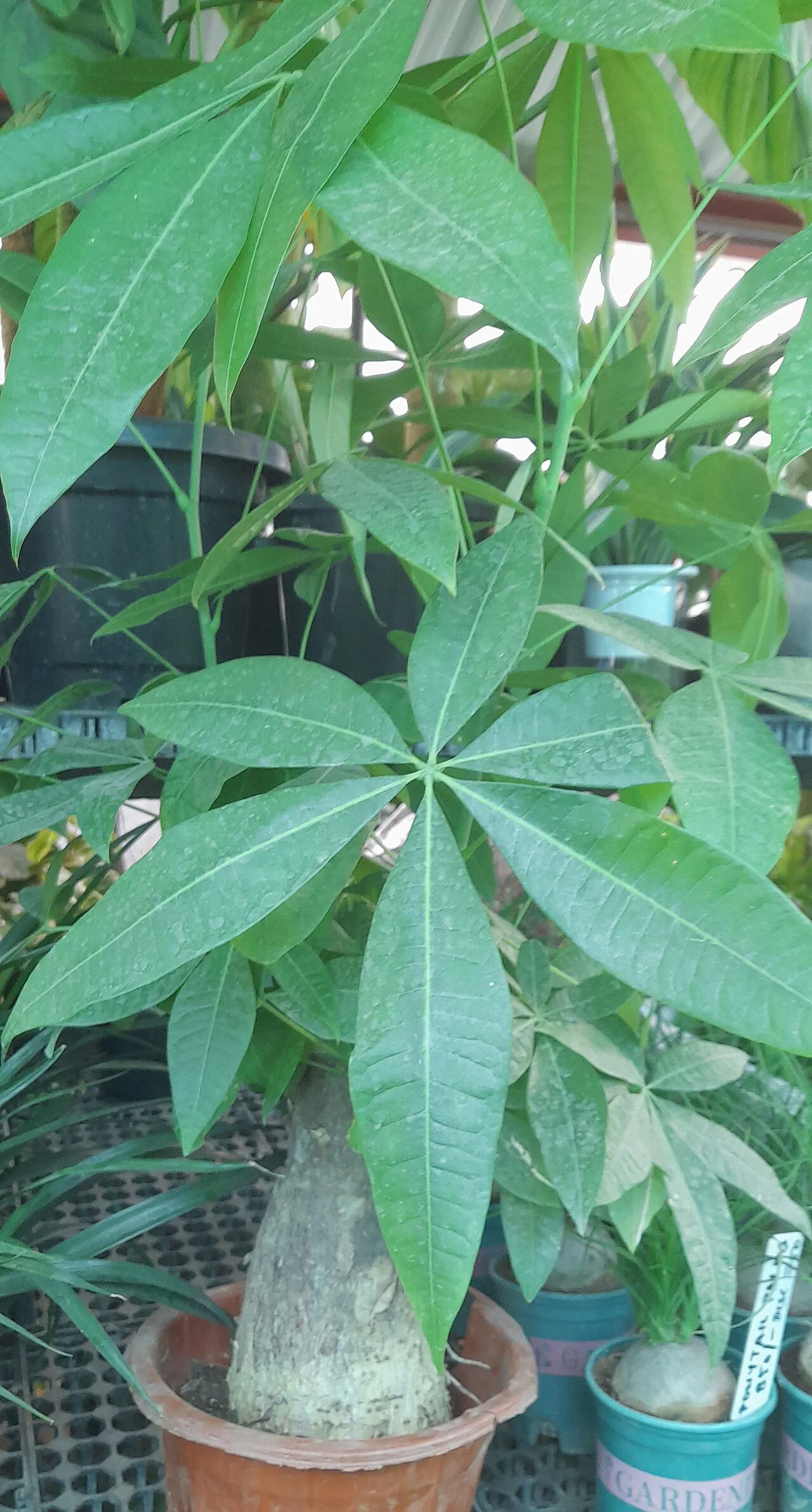
Houseplant collection
Plant 43 / 45 Plant 43 / 45


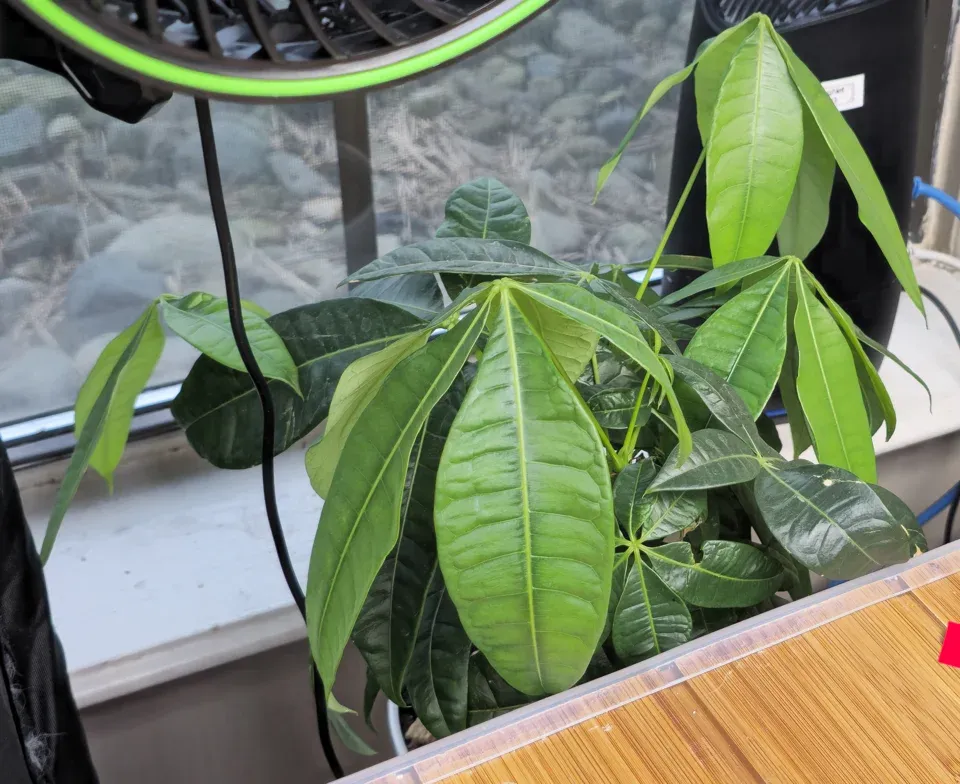
Species reference · Yercaud-elango · CC BY 4.0 · Photo Source ↗
 Collection Record
- Houseplant-01
 Permanent Label
#3 Identification
 Status
 Acquired From
- Home Depot, Howell, Michigan
 Acquired On
- 2026-07-29
 Google Sheets ID
- P21 ↗
 Photo History
- 3 captures · newest ↓
Measurements and Care History
 Measurements and Care History
Weights, watering, events, and charts for P21.
Spot it
 Spot it
What it looks like
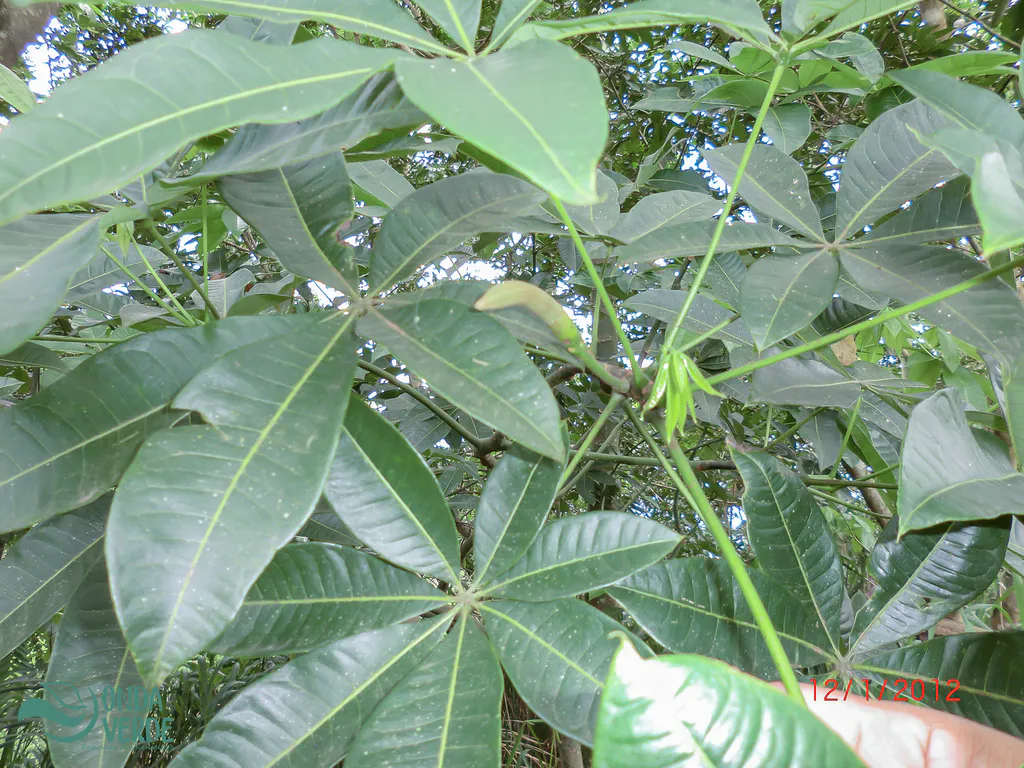
A young tropical tree with a smooth green trunk and long leaf stalks ending in glossy, hand-shaped fans of narrow leaflets; its open canopy reads very differently from the compact succulents nearby.
One curious thing
 One curious thing
Did you know?
Each hand-shaped fan is one compound leaf made of several leaflets, all meeting at the end of a single long stalk. Follow that stalk back to the branch to see where one complete leaf begins.
Explore This Plant
A closer look
How this plant works
 How this plant works
Follow one complete compound leaf from its separate blades to the stalk that joins the branch.
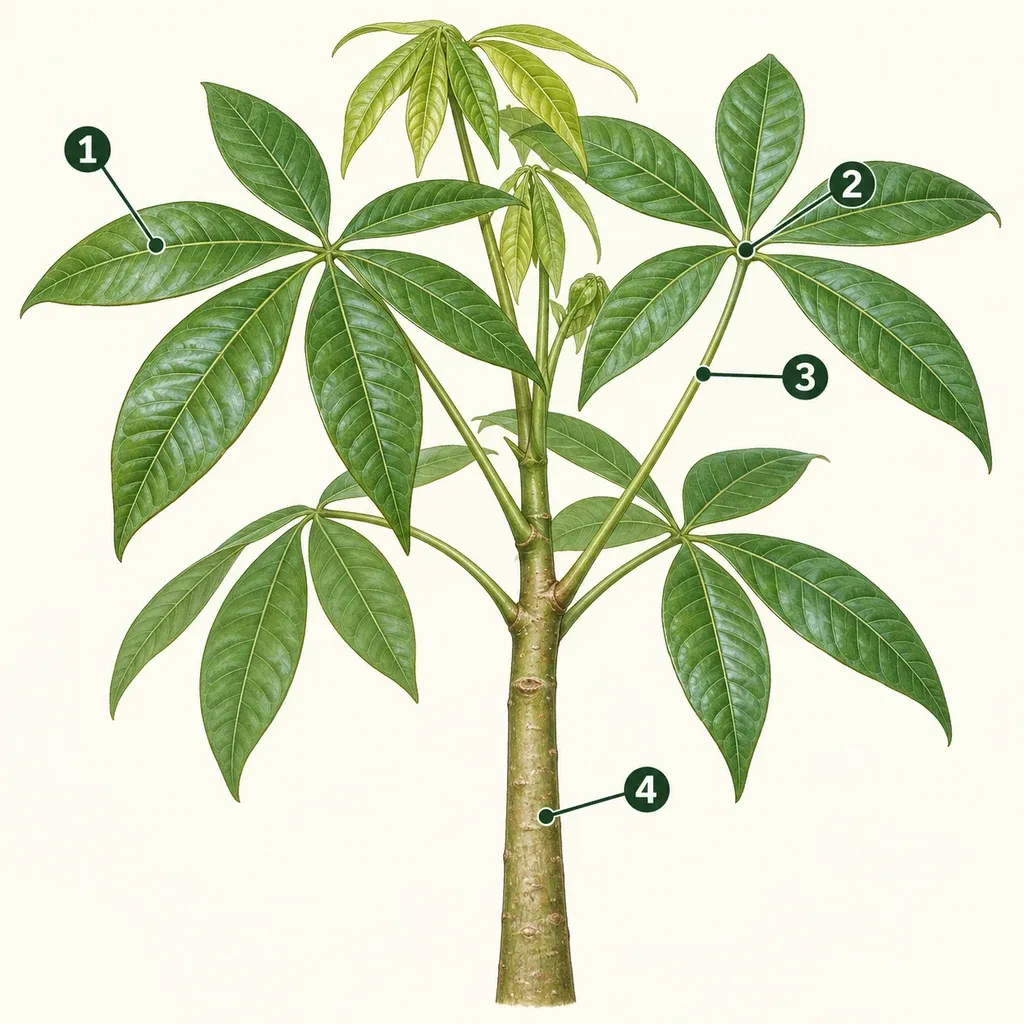
Leaflet blade
The broad blade catches light; its side veins loop together inside the margin.
Leaflet junction
Several leaflets meet at one point, forming the hand-shaped leaf.
Petiole
The long leaf stalk holds the entire compound leaf away from the trunk.
Trunk
The upright woody axis supports the canopy as the tree develops.
Anatomy sources: [1]
Habitat and origins
 Habitat and origins
Pachira glabra comes from southeastern and southern Brazil and grows in the wet tropical biome. Its leafy tree form brings a different growth pattern to this collection: an expanding woody framework carries an open canopy of compound leaves, rather than a compact water-storing cactus body.
Habitat sources: [1]
What growth can look like
 What growth can look like
- Stage 1
Leaf expansion
Young shoots carry developing compound leaves whose separate leaflets unfold.
- Stage 2
Canopy building
Successive shoots and branches enlarge the tree's leaf-bearing framework.
- Stage 3
Reproductive growth
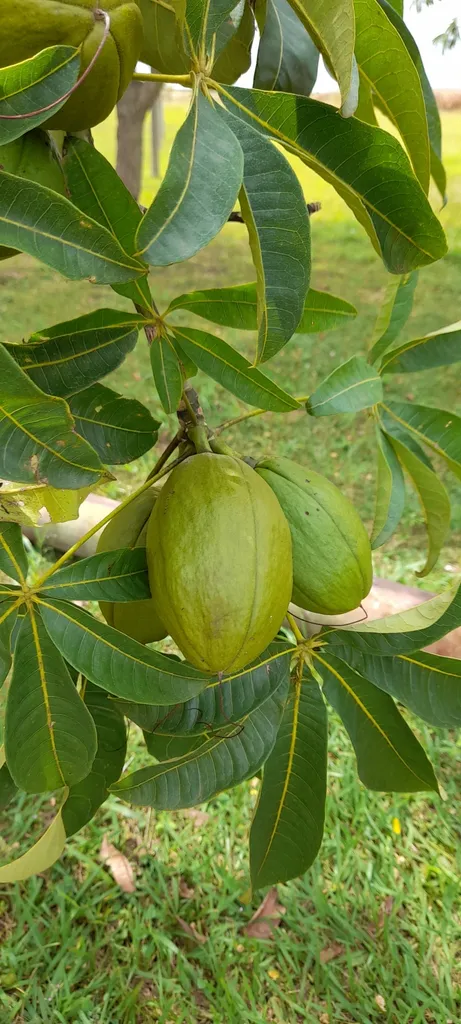
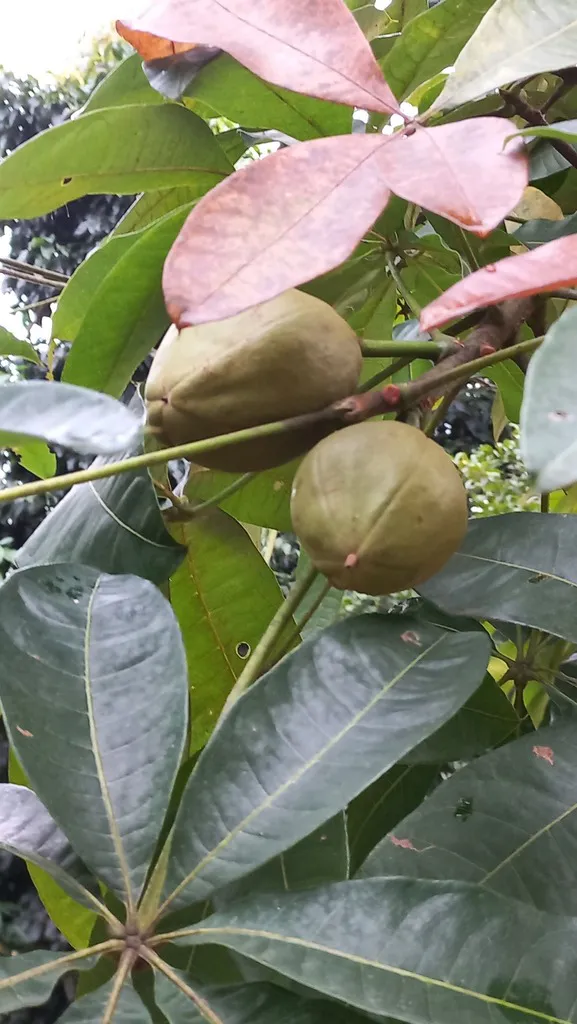
Flowers form at leaf axils and can develop into smooth seed capsules.
Watch shoot tips for unfolding leaflets and follow the shared stalk to distinguish a new leaf from a new branch. NParks describes the species as fast-growing.
Flowers
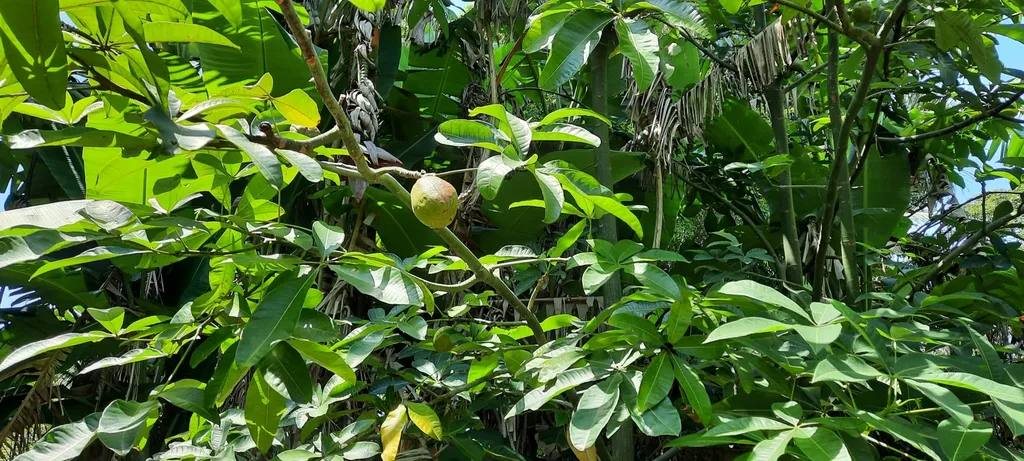
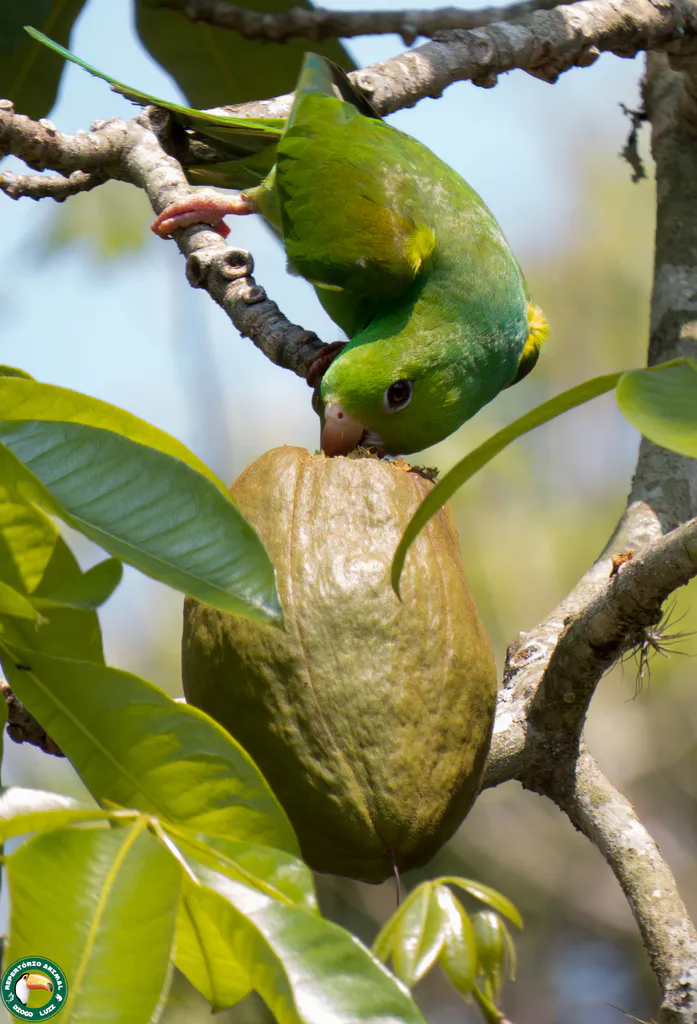
Pachira glabra bears pale green to whitish flowers in leaf axils. Narrow petals curl backward, exposing a brush of long stamens. The smooth, egg-shaped capsule contains many large seeds.
Sources: [1]
As it matures
Flora Zambesiaca describes a 3–5 m tree with compound leaves on stalks reaching about 15 cm. Leaflets spread from a shared point, giving the canopy its open, hand-shaped outline.
Sources: [1]
Behind the name
Kew traces the accepted P. glabra name to an 1868 publication and includes older descriptions under Bombacopsis glabra and Bombax oleagineum. Those historical names help explain why reference sources can look inconsistent.
Sources: [1]
Similar plants, useful clues
Pachira aquatica
The Florida flora key distinguishes P. aquatica by red-tipped stamens and rough brown fruit. P. glabra has white stamens and smooth green fruit; these reproductive details are more useful than the shared money-tree name.
Comparison sources: [3]
This plant in the collection
Its story so far
Windowsill placement confirmed
The owner confirmed the north-facing windowsill location; the exact move time was not recorded.
Collection record ↗Top dressing recorded
Dry dressing added 108 g, taking the pot from 1,638 g to 1,746 g without starting a new setup.
Collection record ↗
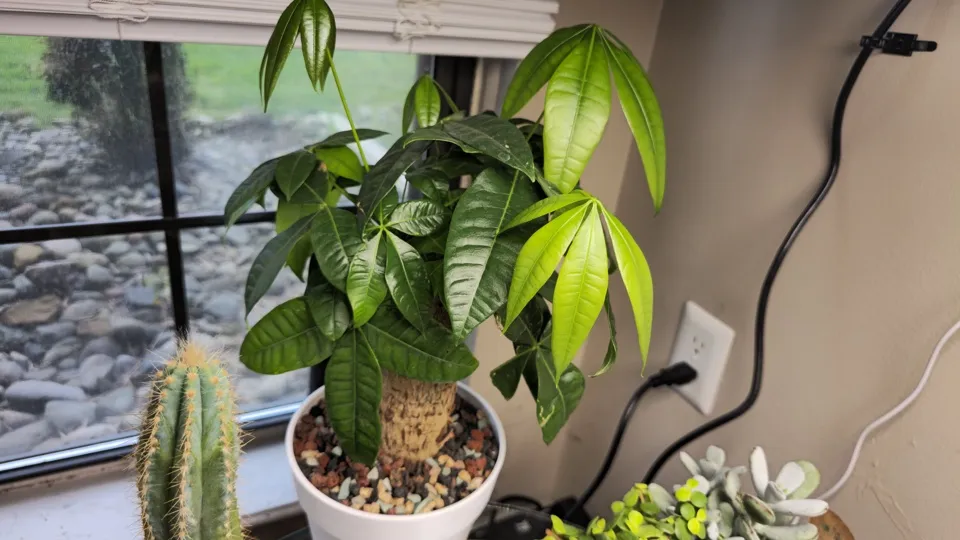
Then and now
Explore the sources
 Explore the sources
Names and identity
| Kind | Name |
|---|---|
| Working species record | Pachira cf. glabra; retail tag reads only Pachira |
| Common name | Money tree |
| Common confusion | Pachira aquatica is also widely sold under the same common name |
“Money tree” is a trade name shared by P. glabra and P. aquatica. Flowers and fruit offer useful distinguishing features: the Florida flora key contrasts P. glabra's white stamens and smooth green fruit with P. aquatica's red-tipped stamens and rough brown fruit.
Retail label evidence
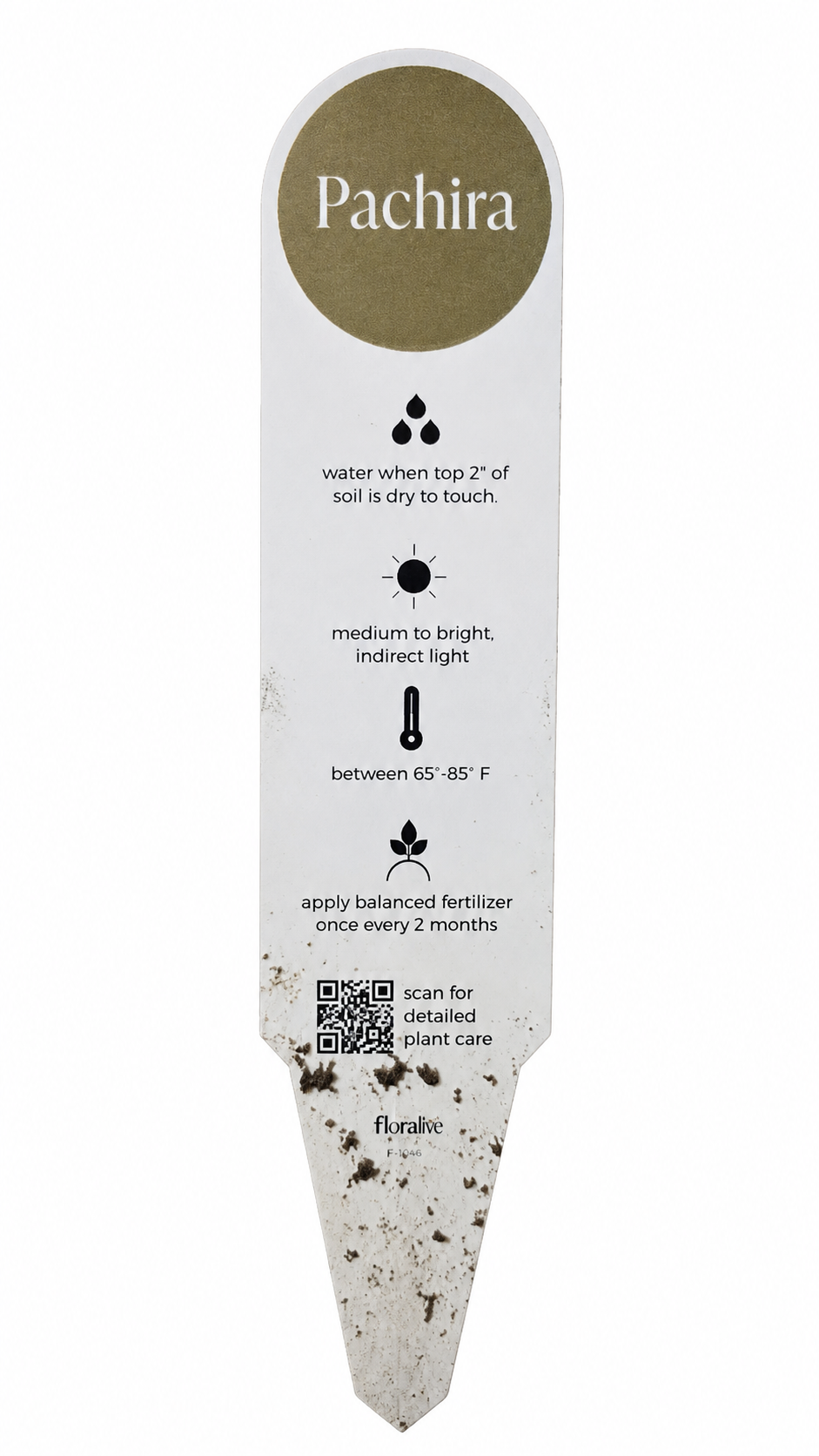
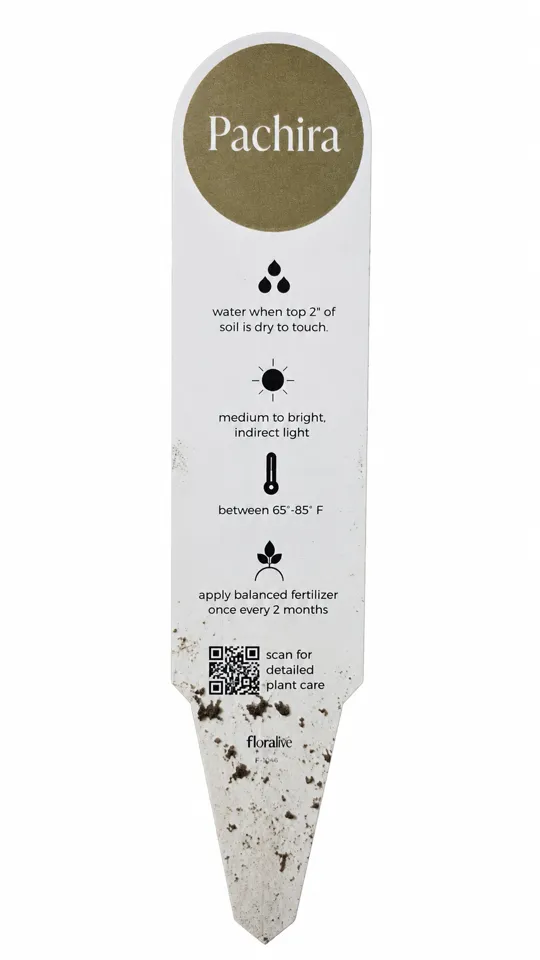
The white front of the tag reads “Pachira” and gives general packaging guidance: water when the upper two inches are dry, use medium-to-bright indirect light, keep it between 65-85 °F, and apply balanced fertilizer once every two months. The black reverse identifies LiveTrends as the supplier brand.
The tag gives general seller guidance. For this pot, combine root-ball moisture, weight trends, and room conditions with the collection's low-dose MSU schedule.
Origin, form, and publication
Kew places Pachira glabra, first published in 1868, in the wet tropics of southeastern and southern Brazil. Its long leaf stalks spread hand-shaped fans through an open canopy. On a leaflet, the side veins curve toward one another inside the edge; they are more prominent beneath the blade. This tropical tree needs moisture checks separate from the cactus dry-down routine.
Care in this collection

| Topic | Practical approach |
|---|---|
| Light | Provide bright indirect light and acclimate gradually when increasing exposure. Keep foliage clear of cold glass and drafts. |
| Grow-light position | North-facing windowsill, off the tables · Gentler, recorded September 16. Daylight and lamp spill at leaf height are unmeasured. See the current placement guide. |
| Shade cloth | Leave it off while foliage remains normally colored; add it if the window-facing leaves bleach or develop crisp tan patches. |
| Water | Water when the upper portion of the mix has dried, then drain. Do not wait for the entire 6-inch root ball to become cactus-dry. |
| Pot | Keep the current 6-inch pot until roots justify the purchased 8-inch pot; moving up again immediately would retain unnecessary water. |
| Temperature | Keep warm and away from cold window glass or drafts; this tropical tree is less cold-tolerant than the cacti. |


The current 6-inch Amazon Basics pot is lightweight polypropylene with drainage. The stored 8-inch version is 7.9 inches in diameter and 6.7 inches high with its saucer; reserve it for a later root-led repot rather than using calendar age alone.
Downward-pointing leaves were reported September 15; the north-windowsill placement was confirmed September 16, with the exact move time unrecorded. Excess light is a possible cause, but leaf angle alone is inconclusive. NC State's P. aquatica guidance supports indirect light as a comparison for this genus-tagged plant. University of Maryland Extension notes that both under- and overwatering can cause wilting. Check moisture before watering and support the entire pot and saucer clear of cold glass and drafts; sill dimensions remain unmeasured.
Recorded pot changes

Bone-dry top dressing added September 16, 2026 increased the pot's weight from 1,638 g to 1,746 g, a 108 g addition. The 30 earlier P21 weights include that offset for comparison with the dressed pot; their original readings remain preserved. This is still setup 1. Record future weights directly from the scale.
September 25 growth observation
The owner's September 25, 2026 Check at 4:27 p.m. EDT records firm new growth, large new leaves, and three new branch buds below the top branch. The owner clarified that the buds emerge from the trunk, each on a different face. The Check notes describe them as approximately 1–4 mm; no separate dimension measurement was logged. Soil moisture was recorded as Slightly moist at that check.
This is dated, owner-reported growth evidence. The existing History entry is the observation record; the later clarification does not represent another inspection, watering, or feeding event.
Rotation, propagation, and watch points
- Rotate the pot 90° weekly if it leans toward the window.
- Watch new leaves for bleaching, crispy margins, persistent droop, or rapid yellowing after the transplant.
- Empty the saucer after watering. A larger plastic pot dries more slowly than the 4-inch nursery pot.
- Stem cuttings and seed are possible, but stable post-transplant growth is the priority now.
Sources

- Owner Check recorded September 25, 2026, 4:27 p.m. EDT in the Garden Plant Tracker History, with same-day clarification in chat: new leaves and three small branch buds on different faces of the trunk below the top branch; firm new growth and slightly moist soil.
- Kew Plants of the World Online: Pachira glabra
- Kew's reproduced flora descriptions: compound leaves, leaflets, and long petioles of the working species candidate.
- University of Florida Herbarium: Flora of Florida, Pachira key: flower and fruit distinctions between P. glabra and P. aquatica.
- International Plant Names Index record
- GBIF Backbone Taxonomy record
- Amazon Basics 6-inch pot
- Amazon Basics 8-inch pot
- Archived LiveTrends retail-tag front
- Archived LiveTrends retail-tag reverse
Through the seasons
Plant Photo History
Recent photographs of this plant. Open a photo or its collection for the complete history.
From the nursery
Nursery Labels
Original nursery labels and packaging.
Botanical reference photos
Reference Gallery
Pachira glabra species comparisons
Look closer


In the landscape

Research Trail
- Collection Notes on GitHub
- Complete Photo Archive and Credits
- iNaturalist Observations — Pachira glabra comparisons