


Older planter and archive
Plant 40 / 45 Older planter and archive
 Plant 40 / 45

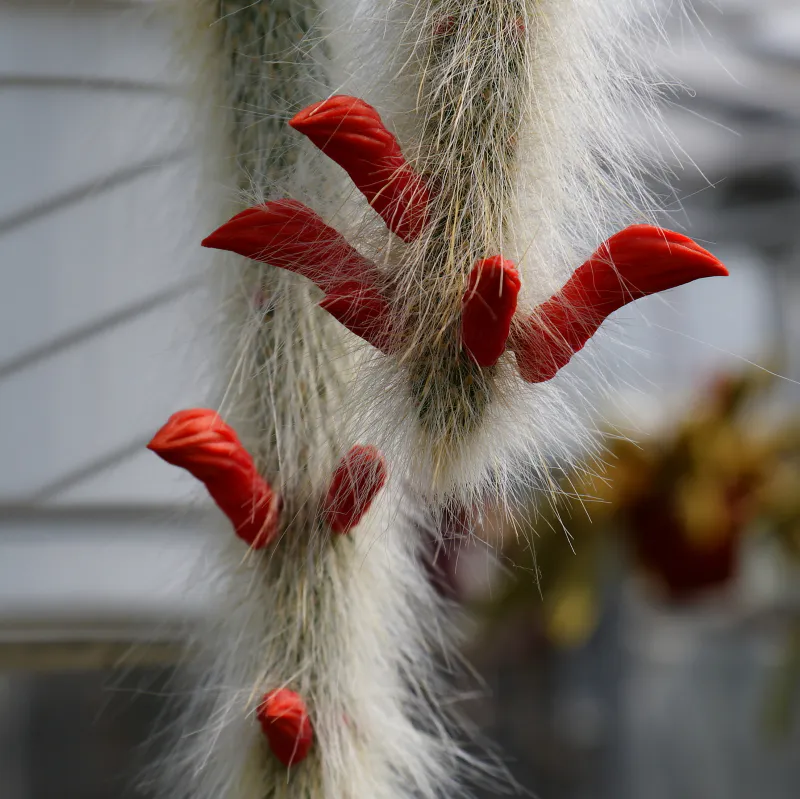
Species reference · C T Johansson · CC BY 3.0 · Photo Source ↗
Shared container · P19 · #1
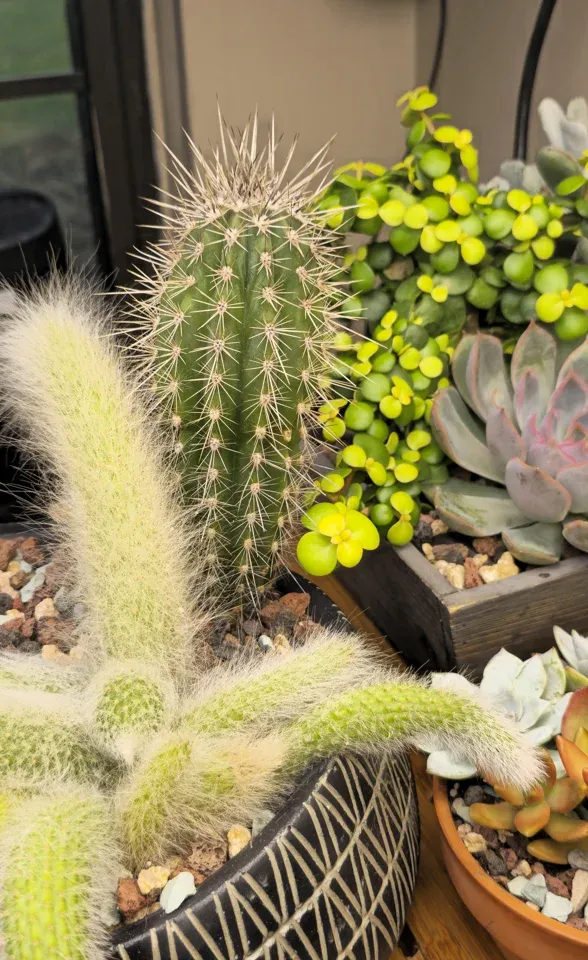
Shared rehab cactus planter · P19
 Shared rehab cactus planter · P19
3 botanical profiles · one container history
 Variegated blue torch cactusprobable variegated Pilosocereus pachycladusLikely Match
 Monkey tail cactusCleistocactus colademononisStrong MatchThis profile
 Golden torch cactusprobable Echinopsis spachianaLikely Match
Three cactus profiles share one root volume and one watering and weight history. Inspect each cactus, then judge the whole container before watering; a concern with one member is not a separate watering instruction.
One care record: log watering, feeding, weighing, and repotting once for P19. Include a plant's name when an observation concerns just that member.
 Collection Record
- Rehab-02
 Permanent Label
#1 Identification
 Status
 Acquired From
- Gerych's Design, Fenton, Michigan, as part of the shared cactus planter
 Acquired On
- 2023-06-21
 Google Sheets ID
- P19 ↗
 Photo History
- 5 captures · newest ↓
Measurements and Care History
 Measurements and Care History
Weights, watering, events, and charts for P19.
Spot it
 Spot it
What it looks like
Long fingerlike stems trail over the planter edge beneath a dense coat of soft white hairs, turning each green cylinder into a shaggy silver tail.
One curious thing
 One curious thing
Did you know?
Its bright flowers carry a swollen nectar-holding spur at the base; Huntington describes that nectar reward as an attraction for hummingbirds.
Explore This Plant
A closer look
How this plant works
 How this plant works
Long hairlike spines surround the flexible stems, with growing tips at the ends of the hanging tails.
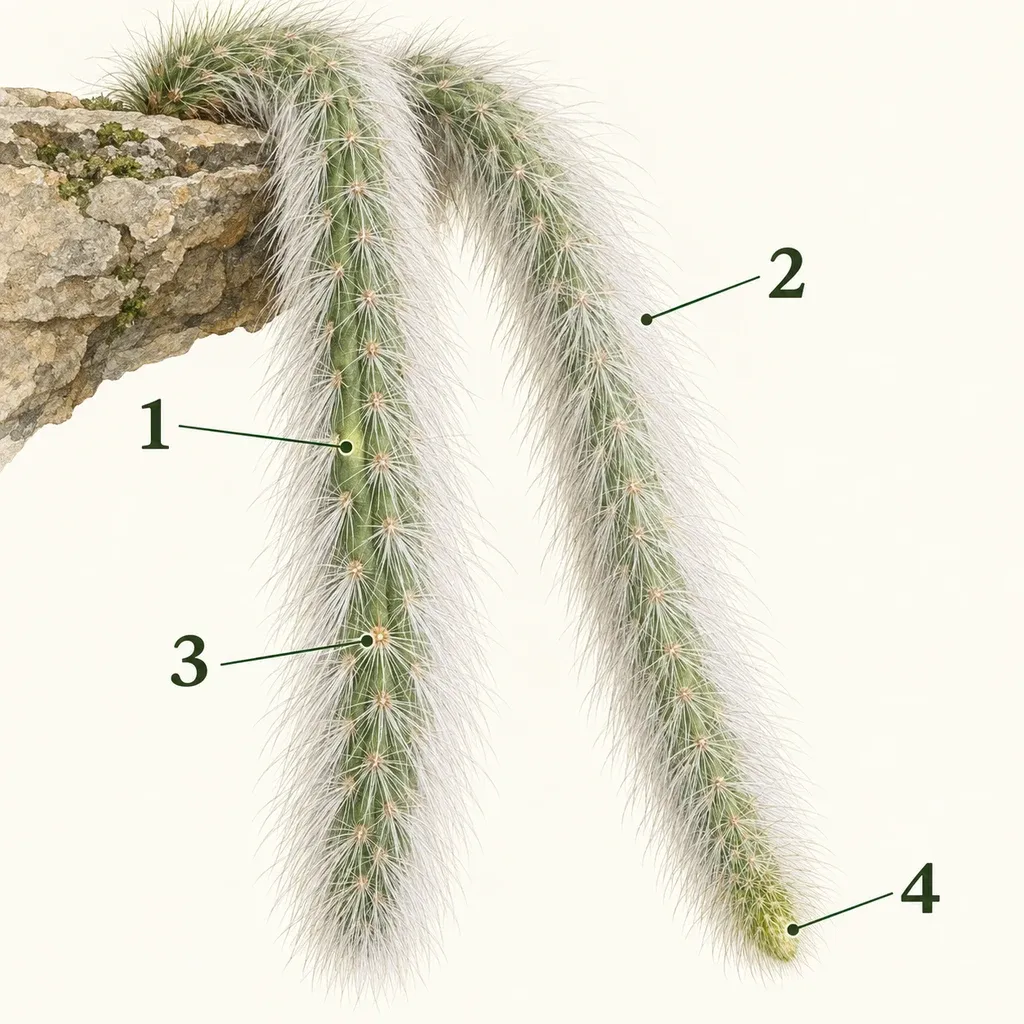
Pendant stem
The green cylinder stores water and carries the trailing growth.
Hairlike spines
Long pale spines create the shaggy surface around the stem.
Areole
Repeated growth points bear spines and can produce flowers.
Growing tip
New tissue extends the lower end of the hanging stem.
Habitat and origins
 Habitat and origins
Monkey tail cactus grows on Bolivian rock faces. Huntington records the type locality at Cerro El Fraile, Florida Province, at 2,000 m. Its pendant stems naturally hang into the open space below their rooting points.
Habitat sources: [1]
What growth can look like
 What growth can look like
- Stage 1
Short stem
Young growth initially makes a compact fingerlike shoot.
- Stage 2
Trailing tail
Lengthening stems arch over an edge and hang downward.
- Stage 3
Flowering cascade
An established plant can carry side-borne flowers among the hairs.
Track recovery by the diameter, hair density, and spacing of spines on the newest tips.
Growth sources: [2]
Flowers
Red to pink flowers emerge from the stem sides; the collection has an observed red-orange bloom. Their asymmetrical base holds nectar in a swollen spur, attracting hummingbirds.
As it matures
Cultivated stems can trail about 1 m, creating a hanging curtain that needs clear space below the pot.
Sources: [2]
Behind the name
Residents near Samaipata already called it cola de mono, or monkey's tail, before its botanical description in 2003.
Sources: [1]
Similar plants, useful clues
Compact woolly Espostoa ↗
Espostoa stays upright with dense wool around a column; monkey tail naturally hangs and has long hairlike spines.
This plant in the collection
Its story so far
Arrived in the shared planter
Acquired from Gerych's Design as part of the cactus planter now tracked as P19.
Collection record ↗
Then and now
Explore the sources
 Explore the sources
Names and identity
| Kind | Name |
|---|---|
| Accepted botanical name | Cleistocactus colademononis (Diers & Krahn) Mottram |
| Common and original vernacular name | Monkey tail cactus; cola de mono |
| Original botanical name | Hildewintera colademononis Diers & Krahn |
| Sometimes sold as | Cleistocactus winteri subsp. colademononis |
Long pendant stems, dense white hairs, and side-borne red flowers distinguish the monkey tail. Fine spines remain among the hairs; handle it by the pot.
Discovery, habitat, and flowers
The species is endemic to Santa Cruz, Bolivia. Huntington's International Succulent Introductions account says local residents near Samaipata already called it cola de mono—monkey's tail—when botanists documented it. Huntington records its type locality at Cerro El Fraile, Florida Province, at 2,000 m. Its pendant growth suits a rock-dwelling cactus with room to hang over an edge.
Diers and Krahn described it in 2003 as Hildewintera colademononis. Roy Mottram published the accepted Cleistocactus combination in 2006.
RHS describes cultivated stems trailing to roughly 1 m. Bright red to orange-red, asymmetrical flowers emerge directly from the sides of hanging stems and can be followed by rounded fruits. A red-orange bloom observed on this collection plant matched the description; its photograph is no longer available.
Rehabilitation and grow-light care

| Topic | Practical approach |
|---|---|
| Current progress | Several trims removed stretched growth. Before the indoor move, about a month in bright outdoor shade with brief direct sun produced better new tips. It now grows in the indoor shared P19 planter. |
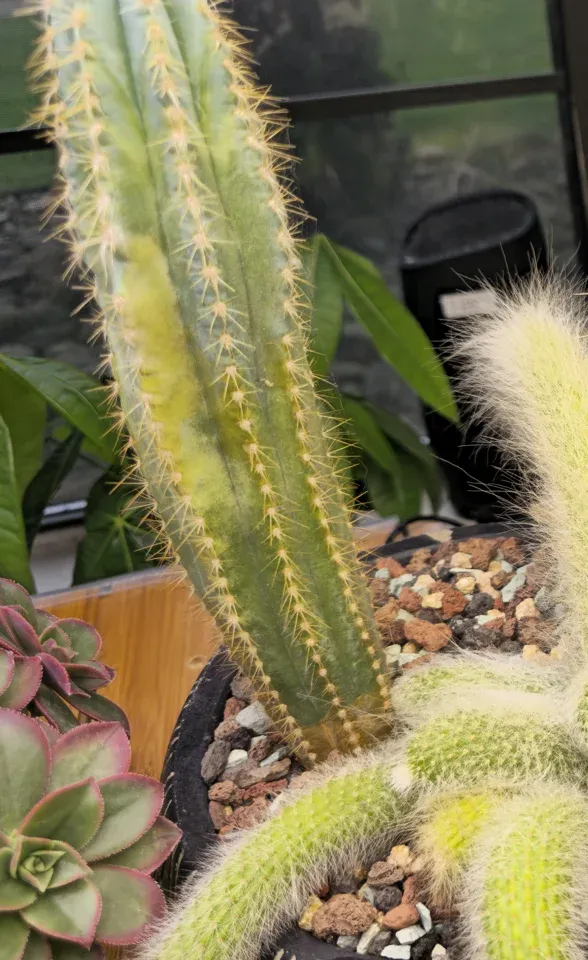
| Grow-light position | Photo-matched rear center · Mixed. September 15, 2026 photo reference: rear wooden tables, facing the window. Compare both tall columns and trailing monkey tail; pale tissue and short neighbors need separate attention. See the current placement guide; exact exposure remains unmeasured. |
| Water | In warm active growth it may use water sooner than the upright cacti, but the shared planter still needs to dry between soaks. |
| Habit | Let stems trail over a protected edge or move the plant eventually to a hanging pot. Forcing every stem upright fights its normal form. |
| Winter | Bright, cooler, and drier—without hard frost—gives a useful rest and may support flowering. |


Old stretched sections remain part of the plant's shape. Judge recovery by the diameter, hair density, and spine spacing of each new tip under its current indoor lighting.
Pruning, propagation, and watch points

- Make future cuts with a clean blade, let sections callus, and root healthy pieces in an airy mix.
- Branching after a cut is normal and can create a fuller hanging plant.
- Avoid frequent small waterings just because the stems are long. Root-zone dryness still controls the schedule.
- Check the shaded base beneath the decorative moss for softness and mealybugs.
- Red buds can be hidden by the hairs. During bud development, avoid repeatedly relocating or rotating the planter.
- Support long stems while moving the pot; a heavy tail can tear at a narrow attachment.
Sources

Through the seasons
Plant Photo History
Recent photographs of this plant. Open a photo or its collection for the complete history.
Botanical reference photos
Reference Gallery
Form and growth


Look closer

Flowers and buds


Research Trail
- Collection Notes on GitHub
- Complete Photo Archive and Credits
- iNaturalist Observations — Species observations