


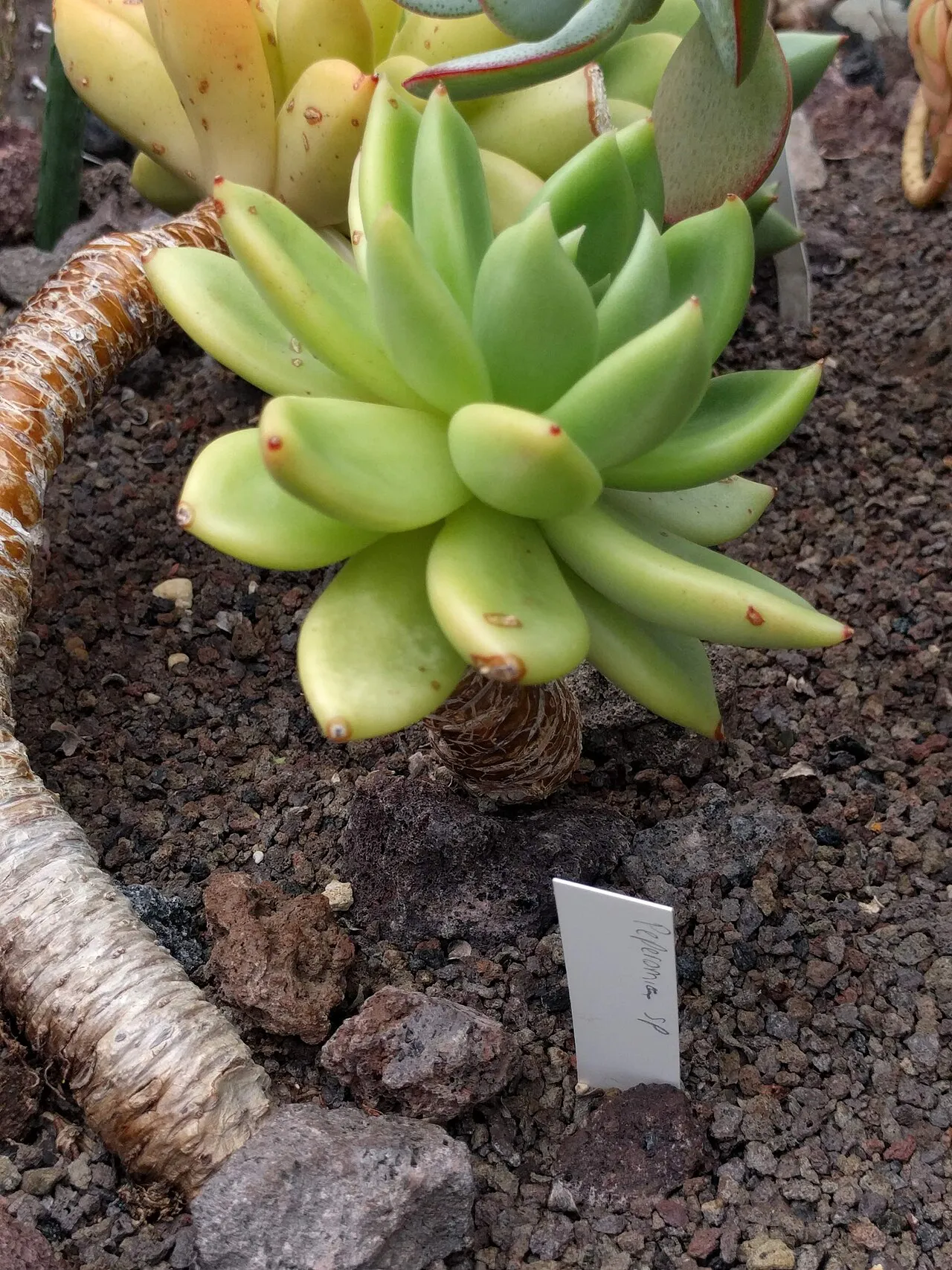
Shared planter and individual succulents
Plant 28 / 45 Shared planter and individual succulents
 Plant 28 / 45


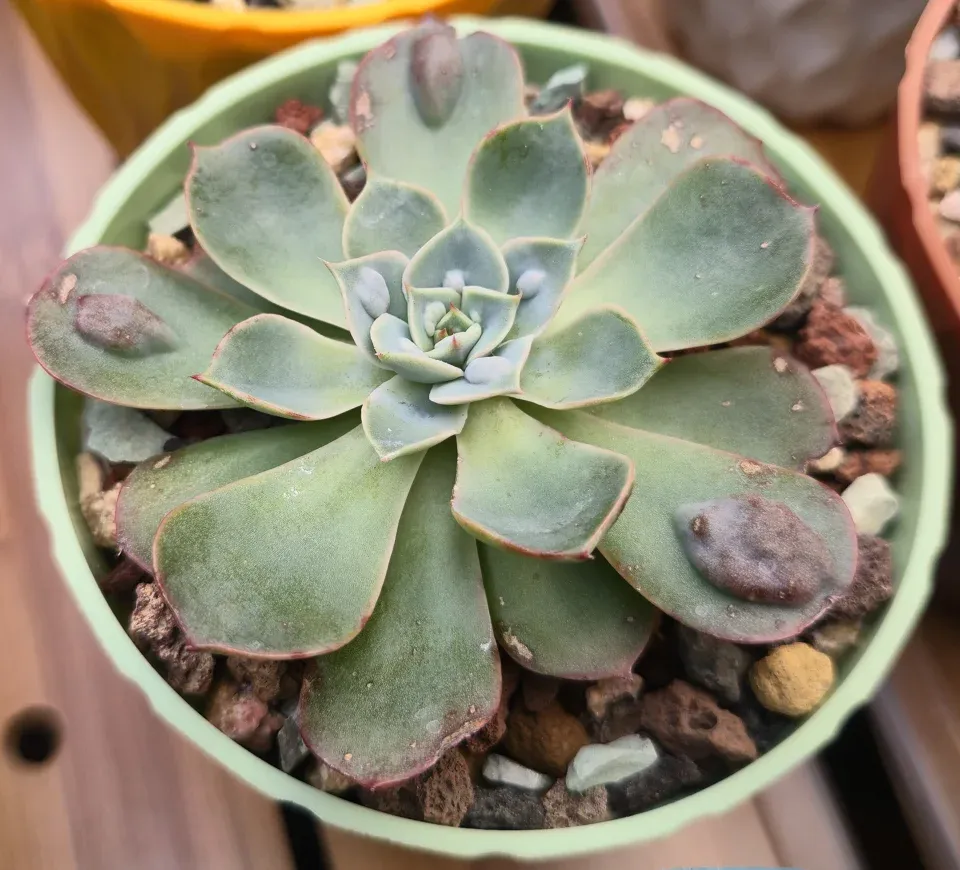
Species reference · Rudolphous · CC BY-SA 4.0 · Photo Source ↗
 Collection Record
- Succulent-07
 Permanent Label
H2 Identification
 Status
 Acquired From
- Mountain Crest Gardens
 Acquired On
- 2026-08-28 — received
 Google Sheets ID
- P25 ↗
 Photo History
- 8 captures · newest ↓
Measurements and Care History
 Measurements and Care History
Weights, watering, events, and charts for P25.
Spot it
 Spot it
What it looks like
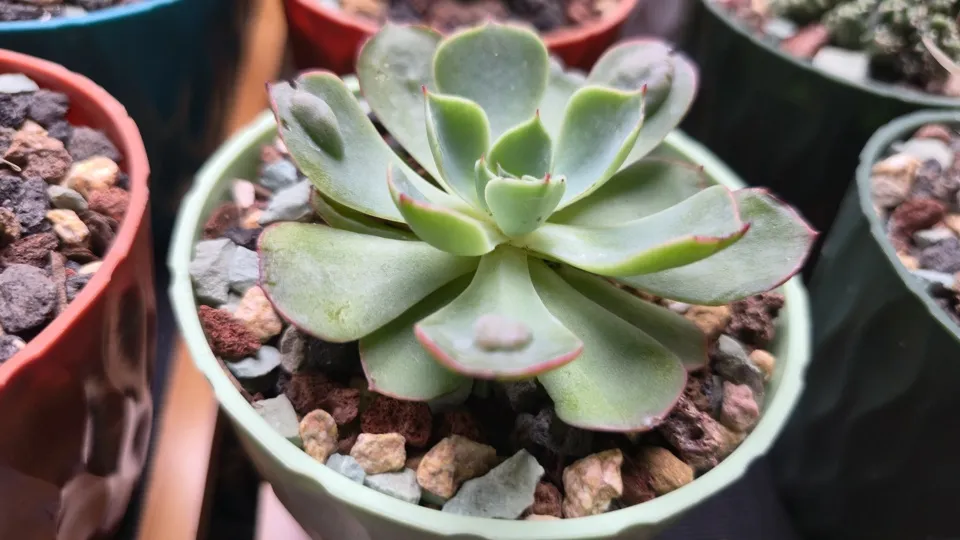
The current young plant is a compact blue-green rosette with broad rounded leaves; as the cultivar matures, rounded raised bumps develop on the upper leaf surfaces.
One curious thing
 One curious thing
Did you know?
Those firm “raindrops” are intentional cultivar structures called caruncles, not edema, insect damage, or a symptom that should be scraped away.
Explore This Plant
A closer look
How this plant works
 How this plant works
Rounded leaf bumps develop on a powdery blue-green rosette as it matures.
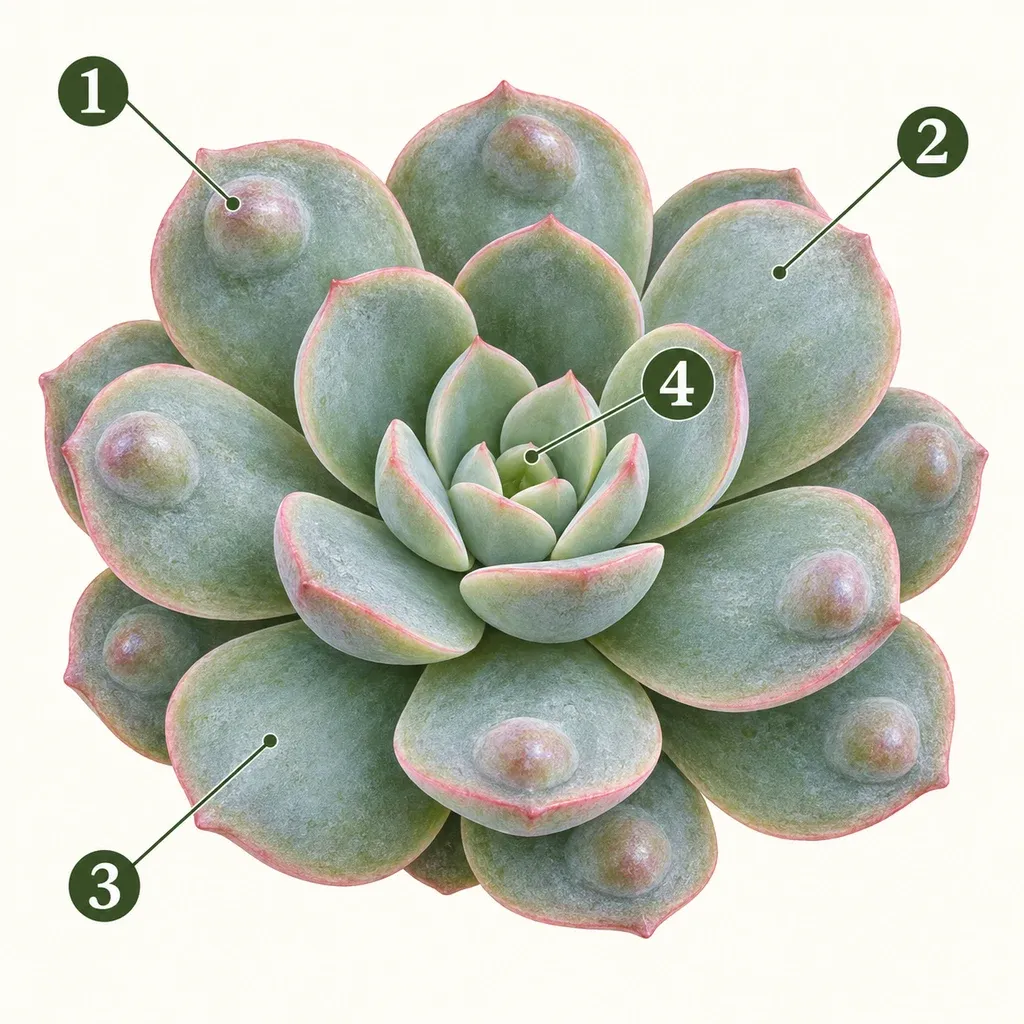
Caruncle
The raised rounded bump is part of the leaf, not a water droplet or insect.
Farina
A dusty wax layer gives the leaf its pale matte finish.
Fleshy blade
The broad leaf stores water and supports photosynthesis.
Young center
The smallest new leaves may not yet show the cultivar's bumps.
Habitat and origins
 Habitat and origins
'Raindrops' is a cultivated Echeveria. The genus ranges from the southwestern United States into South America; its thick rosette leaves store water through dry periods. This selection combines broad blue-green leaves, a waxy surface and raised rounded bumps that become more conspicuous as the leaves mature.
What growth can look like
 What growth can look like
- Stage 1
Grow young leaves
A small rosette may initially have few or no bumps.
- Stage 2
Develop raindrops
Maturing leaves show the rounded structures characteristic of the cultivar.
- Stage 3
Broaden the crown
The rosette expands; offsets may be infrequent.
The smallest leaves can be smooth before their bumps develop; compare successive mature leaves to follow that change.
Growth sources: [1]
Flowers
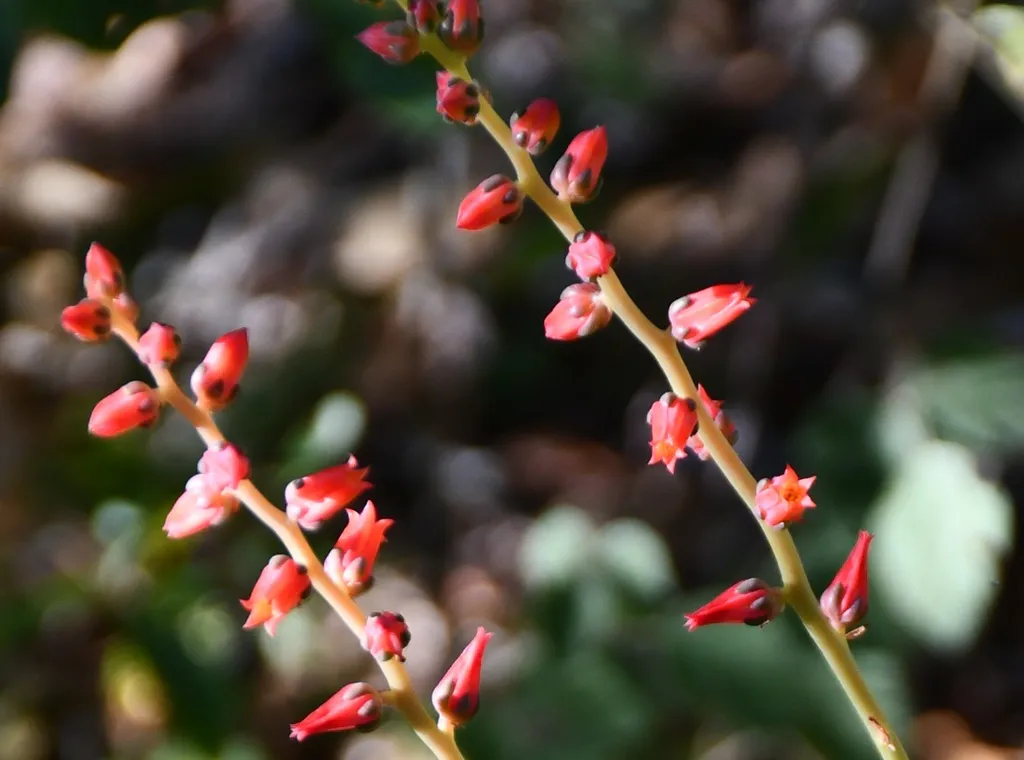
Echeverias raise clusters of tubular, bell-like flowers above their foliage. NC State notes that the genus attracts bumblebees and hummingbirds. Mountain Crest Gardens lists pink blooms for 'Raindrops'.
As it matures
The nursery describes a rosette reaching about 6 inches across and producing few offsets. Give the expanding outer leaves room to spread without rubbing neighboring pots.
Sources: [1]
Behind the name
The nursery credits hybridizer Dick Wright. The name describes its droplet-like leaf bumps; they are normal cultivar growth and should not be scraped off.
Sources: [1]
Similar plants, useful clues
Echeveria pulidonis ↗
Pulidonis has smooth pointed leaves with fine red margins. Mature 'Raindrops' has broader rounded blades carrying conspicuous bumps, though small new leaves can be smooth.
This plant in the collection
Its story so far
Arrived and repotted
Received from Mountain Crest Gardens and moved into a 4 × 4 × 3.7-inch round pot.
Collection record ↗Early size record
Measured 1.35 inches high × 2.75 inches wide, with a recorded pot weight of 344 g.
Collection record ↗
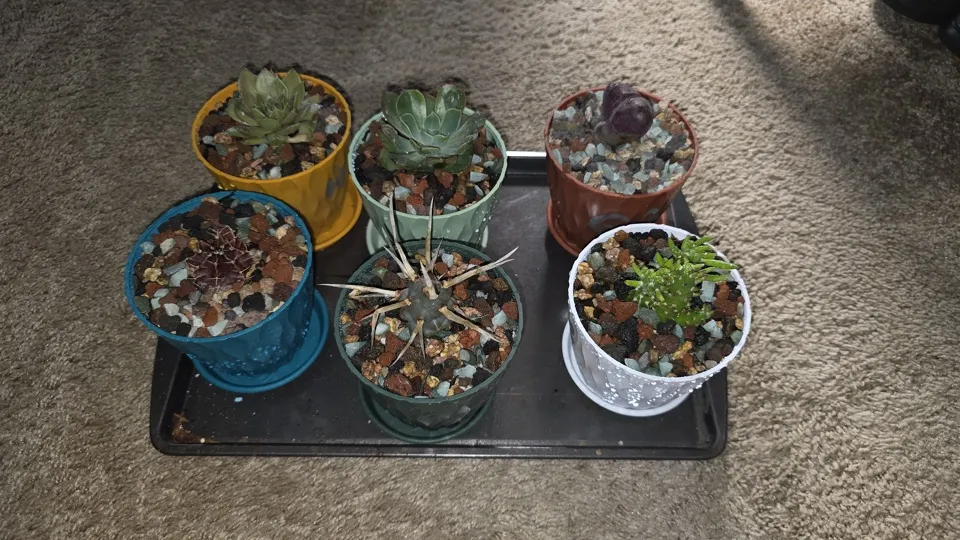
Then and now
Explore the sources
 Explore the sources
Names and identity
| Kind | Name |
|---|---|
| Cultivar | Echeveria 'Raindrops' |
| Seller attribution | Dick Wright |
| Parentage | Not published or independently verified |
| Working common name | Raindrops echeveria |
| Wild range | None; it is a horticultural cultivar. |
Mature leaves develop a rounded, droplet-like bump near the tip. Those stable bumps are a cultivar trait, not edema or pest damage. The smallest young leaves can be smooth before their bumps develop.
Arrival and repotting

Ordered from Mountain Crest Gardens on August 25, 2026, this plant arrived on August 28 in a 2-inch nursery pot. Its roots were inspected by hand, and approximately 95% of the nursery soil was removed before repotting into the current 4 × 4 × 3.7-inch round pot. The arrival mix was slightly moist. On August 29, the complete pot weighed 344 g, and the plant measured 1.35 in high × 2.75 in wide with a ruler.
The mix is Molly's Succulent Mix with added perlite. The owner estimated 80% Molly's / 20% perlite on September 20; this is a recollection rather than a measured recipe.
The shipment was described as outdoor-grown in California sun and carried an agricultural inspection sticker. It was not quarantined after the initial hand inspection; routine pest checks remain useful.
Seller listing snapshot

Mountain Crest Gardens listing, inspected 2026-08-26:
| Seller field | Listing value |
|---|---|
| SKU | S2JN3225 |
| Product size | 2.0-inch pot |
| Current / seasonal color | Blue or blue-green / pink |
| Bloom / season | Pink / spring |
| Hardiness | Zone 10; seller threshold 30 °F |
| Recommended light | Bright indoor light; filtered or partial sun |
| Maximum height / rosette size | 3–5 inches / 5–6 inches |
| Growth habit | Rosette |
| Special characteristics | Easy to propagate; pet safe — seller fields |
The seller attributes the cultivar to Dick Wright, describes few offsets and a mature rosette up to about 6 inches, and notes that young plants may not yet show the characteristic bumps. It says outdoor shade favors bump development, while direct sun can color bumps and margins pink. The seller recommends 50%–70% mineral grit. The collection's current pot and mix are recorded below.
Origin, form, and cultivar history
'Raindrops' is a cultivated Echeveria attributed by the seller to hybridizer Dick Wright. The genus ranges from the southwestern United States through Mexico into South America. Its thick leaves store water, while tall stalks present tubular flowers above the rosette. NC State notes that these flowers attract bumblebees and hummingbirds.
Care in this collection

| Topic | Practical starting approach |
|---|---|
| Grow-light position | R2C3 · Bright. September 15 six-column/four-row front grid, facing the window. Low interior-left rosette. Keep clear bright light, without automatically assigning it the strongest intensity. See the current placement guide. |
| Water | Use medium dryness, plant response, and pot-weight trend as evidence. |
| Pot and mix | The current pot is a 4 × 4 × 3.7-inch round pot. The owner recalls Molly's Succulent Mix with approximately 20% added perlite (September 20 report; ratio estimated); keep the crown above the medium. |
| Surface | Avoid touching or wiping the powdery farina; fingerprints and rubbed patches do not grow back on the same leaf. |


Rotation, propagation, and watch points
- Rotate as needed for even exposure under the fixed grow light.
- Distinguish the cultivar's firm, organized bumps from new translucent, blistered, or collapsing tissue.
- Remove only fully dry lower leaves that release without pulling live tissue.
- Healthy mature leaves may propagate, although offspring can vary.
Sources

-
Owner arrival and repot observations, August 28–29, 2026; medium description, September 20: Molly's Succulent Mix with approximately 20% added perlite, an estimated proportion.
Through the seasons
Plant Photo History
Recent photographs of this plant. Open a photo or its collection for the complete history.
From the nursery
Nursery Labels
Original nursery labels and packaging.


Botanical reference photos
Reference Gallery
Echeveria species and cultivar comparisons
Form and growth

.jpg)
Flowers and buds
.jpg)
_(49674371781).jpg)
_cactus_flowers_(49495258666).jpg)
.jpg)
In the landscape


