


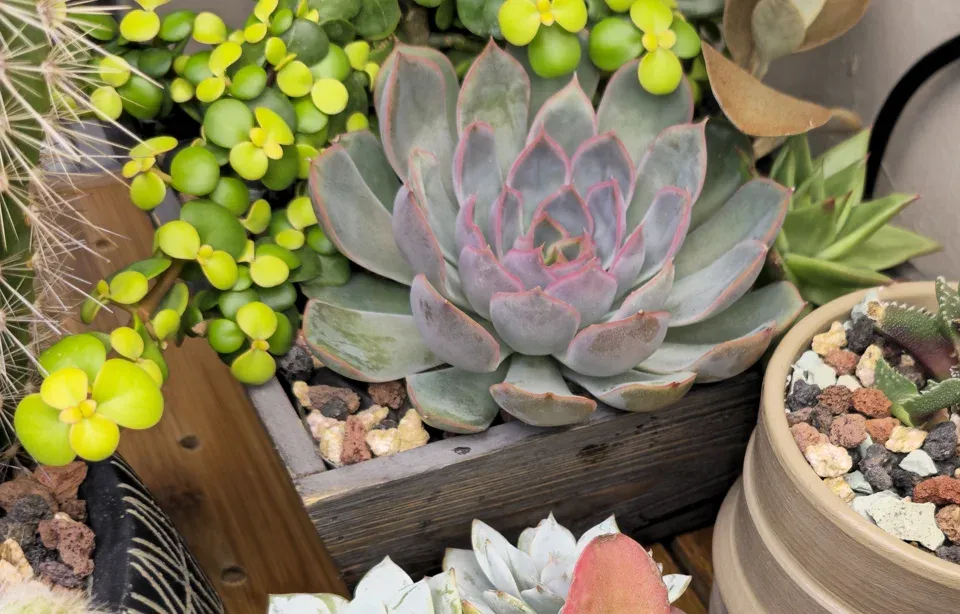
Shared planter and individual succulents
Plant 22 / 45 Shared planter and individual succulents
 Plant 22 / 45
 probable Echeveria pulidonis or close hybrid
Pulido's echeveria


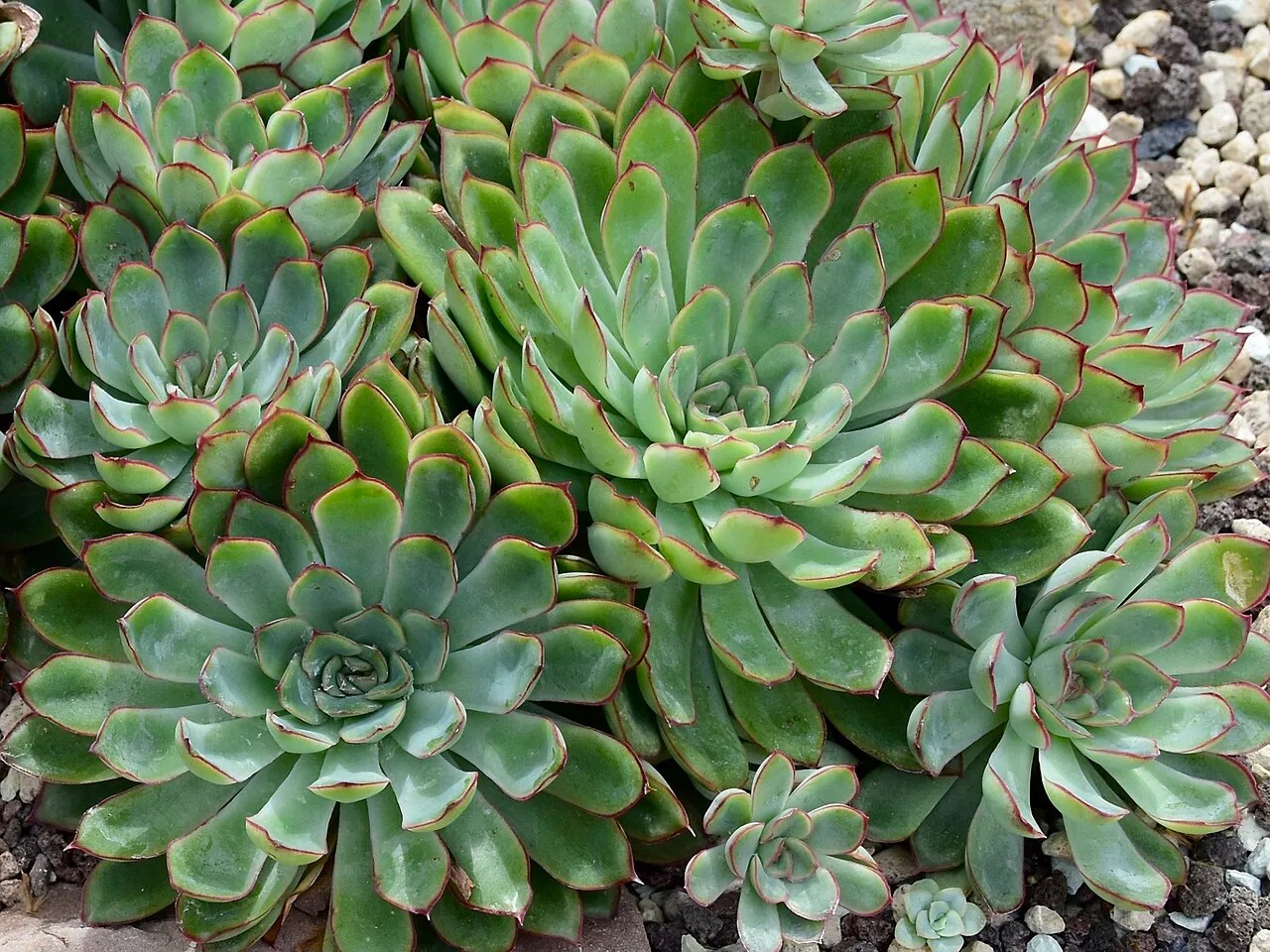
Species reference · NasserHalaweh · CC BY-SA 4.0 · Photo Source ↗
Shared container · P20 · #2
Shared succulent planter · P20
4 botanical profiles · one container history
- Pulido's echeveriaprobable Echeveria pulidonis or close hybridLikely MatchThis profile
 Silver teaspoonsprobable Kalanchoe bracteataLikely Match
 Copper spoonsKalanchoe orgyalisStrong Match
 Elephant bushPortulacaria afraStrong Match
The echeveria, two kalanchoes, and elephant bush have separate identity and care profiles but receive water through one shared root volume. Compare all four members and the whole-pot dry-down before watering.
One care record: log watering, feeding, weighing, and repotting once for P20. Include a plant's name when an observation concerns just that member.
 Collection Record
- Succulent-01
 Permanent Label
#2 Identification
 Status
 Acquired From
- Gerych's Greenhouse, as part of the mixed succulent planter
 Acquired On
- 2026-07-27
 Google Sheets ID
- P20 ↗
 Photo History
- 5 captures · newest ↓
Measurements and Care History
 Measurements and Care History
Weights, watering, events, and charts for P20.
Spot it
 Spot it
What it looks like
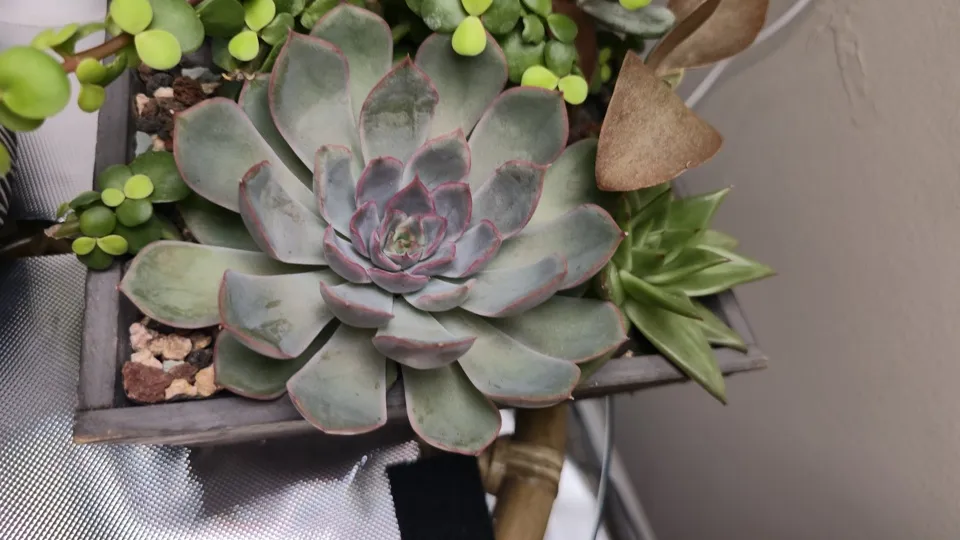
A symmetrical rosette of thick, pointed blue-green leaves, each carrying a fine powdery bloom and a narrow red outline that is strongest near the tip.
One curious thing
 One curious thing
Did you know?
The low rosette sends up long curved stalks of nodding yellow flowers, lifting its blooms well above the thick leaf crown.
Explore This Plant
A closer look
How this plant works
 How this plant works
A low rosette combines fleshy leaves, a growing center and smaller offsets.
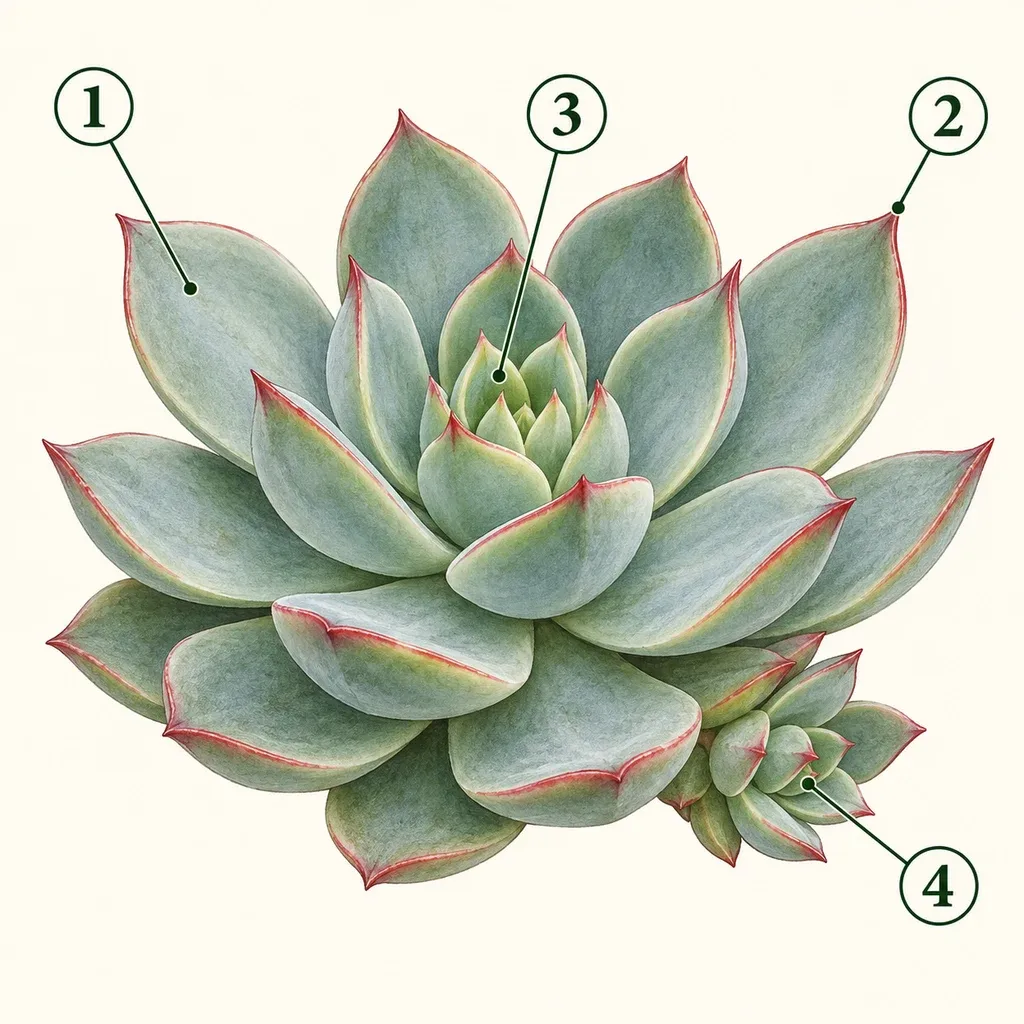
Fleshy leaf
The thick blade stores water and carries out photosynthesis.
Red margin
The narrow colored edge outlines each leaf and may intensify with stronger light.
Rosette center
Successive young leaves expand from the center.
Basal offset
A daughter rosette can develop beside the original plant.
Habitat and origins
 Habitat and origins
Echeveria pulidonis comes from Hidalgo, Puebla and Veracruz in Mexico, in desert or dry shrubland. Thick leaves hold a water reserve within a low, compact rosette. In the shared planter, its short crown needs an open view of the light beneath the taller branching succulents.
Habitat sources: [1]
What growth can look like
 What growth can look like
- Stage 1
Build a rosette
New central leaves enlarge while older leaves form the outer tiers.
- Stage 2
Add offsets
Side rosettes can gradually turn one crown into a small group.
- Stage 3
Raise a flower stalk
An established rosette may send an arching stalk above its leaves.
Offsets widen the planting while the original crown keeps adding leaves at its center.
Flowers
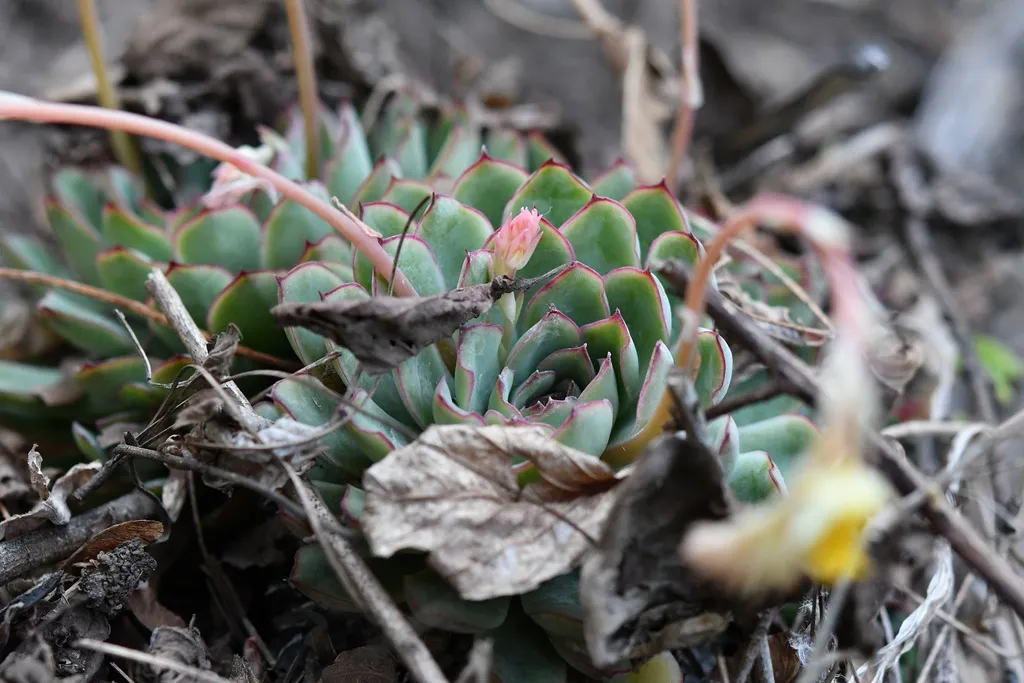
Small yellow, urn-shaped flowers hang from long curved stalks above the rosette. Their nodding shape and bright color make the flowering silhouette very different from the tight, nearly stemless leaf crown.
Sources: [2]
As it matures
Individual rosettes reach about 12 cm across. Basal offsets can broaden the group, while the long flowering stems extend well above the leaf crown.
Sources: [2]
Behind the name
The genus honors Mexican botanical artist Atanasio Echeverría y Godoy. Kew records E. Walther’s publication of the species name in 1972.
Similar plants, useful clues
Echeveria 'Raindrops' ↗
Both form blue-green rosettes, but mature 'Raindrops' develops rounded raised bumps; pulidonis has smooth blades with a narrow red outline.
This plant in the collection
Its story so far
Joined the collection
Acquired at Gerych's Greenhouse in the shared square succulent planter, now tracked as P20 / #2.
Collection record ↗
Then and now
Explore the sources
 Explore the sources
Names and identification
| Kind | Name |
|---|---|
| Best working ID | Echeveria pulidonis E.Walther, or a hybrid derived from it |
| Common name | Pulido's echeveria |
| Genus history | Echeveria honors Mexican botanical artist Atanasio Echeverría y Godoy |
Look for powdery blue-gray leaves, pointed tips and a fine red line around the margins. A flowering stalk adds useful detail: its branching pattern, bracts and yellow urn-shaped flowers help distinguish similar rosettes.
Origin, form, and flowers
Kew accepts E. pulidonis as a Mexican species first described by Edward Walther in 1972. Its native range includes Hidalgo, Puebla, and Veracruz, where it grows in seasonally dry shrubland.
The species forms a compact stemless-looking rosette roughly 12 cm across, eventually making offsets. Mature plants send up arching stalks carrying nodding, urn-shaped yellow flowers. The small blooms hang downward, giving the flowering stalk a graceful curved outline.
The pale coating is epicuticular wax, commonly called farina. It reflects light and reduces water loss. Fingerprints remove it from old tissue, so handle the pot or lowest leaves rather than polishing the rosette.
Care in the shared planter

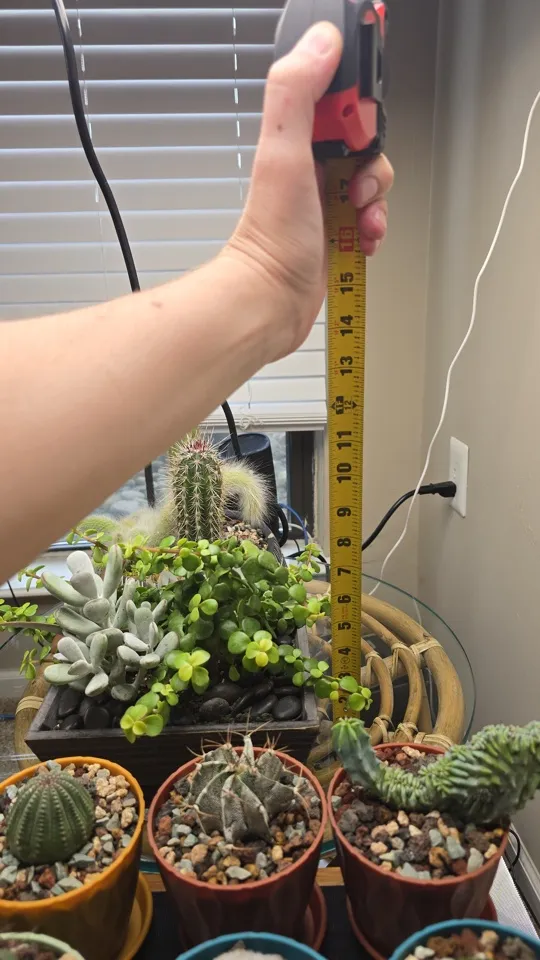
The square wooden planter has a plastic liner and an approximately one-inch drainage hole through both the bottom and liner, documented September 20, 2026. Keep the opening clear and let the shared root zone dry before watering.
| Topic | Practical approach |
|---|---|
| Grow-light position | Rear right, toward window · Mixed. September 15 rear wooden tables, facing the window. Keep the low Echeveria exposed beneath the taller Portulacaria and Kalanchoe foliage. See the current placement guide. |
| Evidence behind the range | A 2026 study on other Echeveria cultivars found 12.8 mol/m²/day produced more compact, better-performing plants than 4.8; it is guidance, not a species-specific threshold. |
| Water | Soak the shared root zone only after it has dried. Keep water out of the rosette in cool, still conditions. |
| Competition | Prevent the elephant bush and kalanchoes from shading or physically crowding the rosette. |
| Feeding | Light dilute feeding in active growth. Excess fertilizer plus weak light opens the rosette. |


Red margins can intensify with useful light and normal mild stress. That is not the same as a bleached tan patch, translucent tissue, or a sharply scorched leaf surface. Judge the center: closely stacked new leaves indicate adequate light; a raised center and widening gaps indicate stretch.
Propagation and watch points
- Offsets are the easiest true-to-type propagation. Stem and intact leaf cuttings can also root after the wound dries, although success varies by hybrid.
- Lower leaves are a normal water reserve and may be reabsorbed one at a time. Several translucent leaves at once suggest excess moisture.
- Mealybugs hide at leaf bases; aphids may appear on flower stalks.
- Do not repeatedly add small sips because the echeveria looks less plump than its woody planter companions. A shared soak-and-dry cycle is safer.
- If it repeatedly stretches while the others thrive, raising its side of the planter or separating it is simpler than overlighting every plant.
Sources

-
Owner observations, September 20, 2026: P20 / #2 wooden planter with a plastic liner and an approximately one-inch drainage hole through both layers.
-
Horticulturae: daily light integral responses in Echeveria cultivars
Through the seasons
Plant Photo History
Recent photographs of this plant. Open a photo or its collection for the complete history.
Botanical reference photos
Reference Gallery
Form and growth


.jpg)
Flowers and buds


In the landscape

Research Trail
- Collection Notes on GitHub
- Complete Photo Archive and Credits
- iNaturalist Observations — Species comparisons