


Cactus collection
Plant 20 / 45 Cactus collection
 Plant 20 / 45


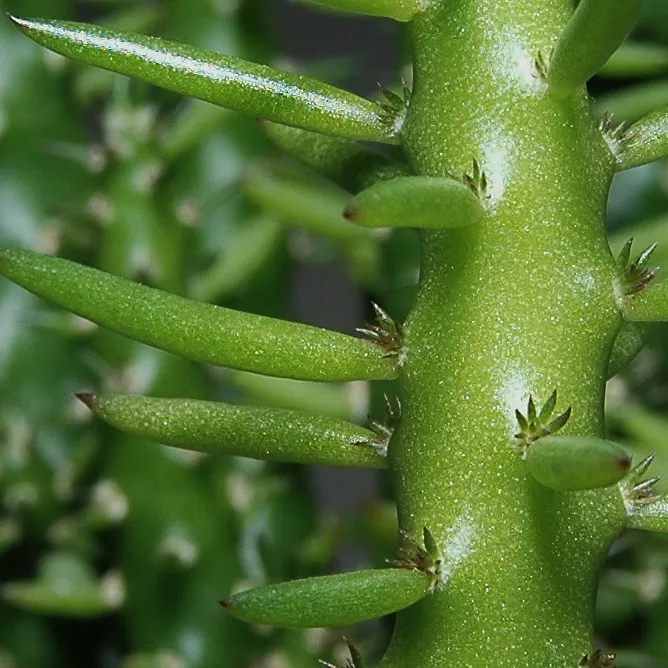
Species reference · Christer Johansson · CC BY-SA 2.5 · Photo Source ↗
 Collection Record
- Cactus-07
 Permanent Label
H3 Identification
 Status
 Acquired From
- Mountain Crest Gardens
 Acquired On
- 2026-08-28
 Google Sheets ID
- P26 ↗
 Photo History
- 9 captures · newest ↓
Measurements and Care History
 Measurements and Care History
Weights, watering, events, and charts for P26.
Spot it
 Spot it
What it looks like
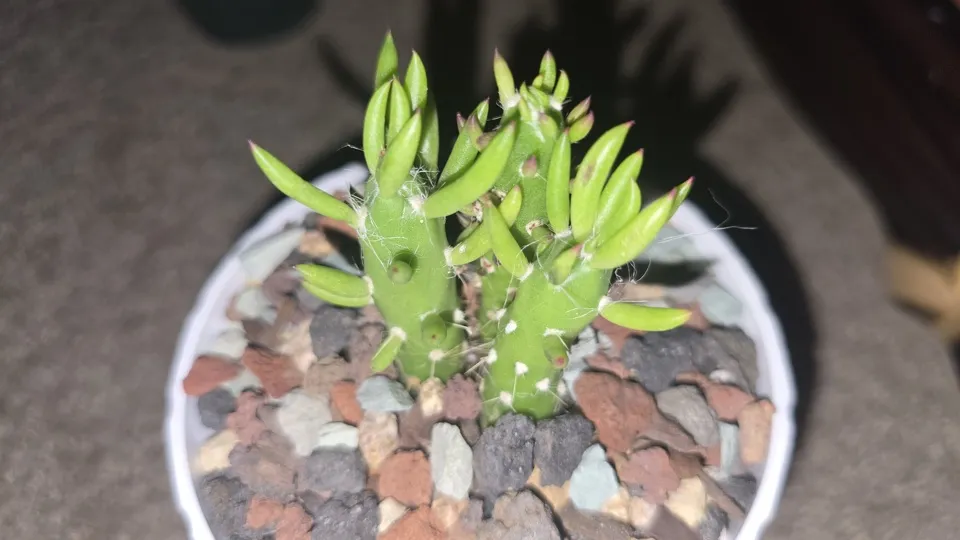
Upright, branching green cylinders carry narrow awl-shaped leaves between pale areoles and sharp spines, giving the plant a leafy silhouette that is unusual for a cactus.
One curious thing
 One curious thing
Did you know?
Unlike most adult cacti, Eve's needle keeps conspicuous succulent leaves on its young growth—the feature behind both the common name and the species epithet subulata.
Explore This Plant
A closer look
How this plant works
 How this plant works
Fleshy leaves, spiny cushions, and cylindrical branches give Eve's needle its unusually leafy outline.
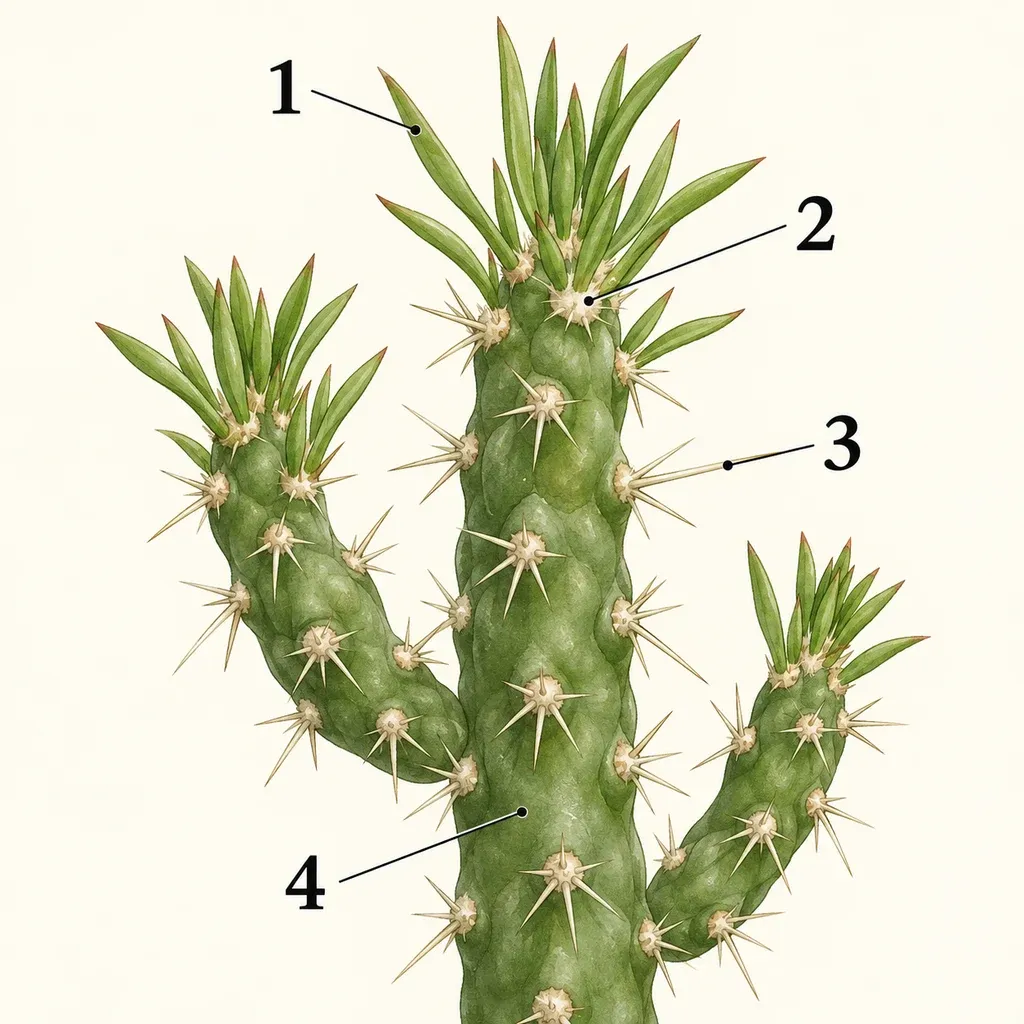
Awl-shaped leaf
A fleshy, pointed leaf adds photosynthetic surface to young growth.
Areole
This specialized cactus growth point bears the spines beside the leaf.
Spine
The sharp spine protects the soft, water-storing tissues.
Cylindrical stem
The green stem stores water and supports successive branches.
Habitat and origins
 Habitat and origins
Eve's needle comes from the Peruvian Andes. Its branching, spiny framework provides shelter for small animals and birds, while its roots help stabilize soil in dry landscapes.
Habitat sources: [1]
What growth can look like
 What growth can look like
- Stage 1
Leafy tip
New stem growth carries soft-looking pointed leaves.
- Stage 2
Branching shrub
Side shoots extend the upright framework.
- Stage 3
Woody base
Older plants develop a stronger trunk beneath the succulent branches.
Older stems develop dark brown bark and a woody trunk beneath the younger green branches.
Growth sources: [2]
Flowers
Tubular flowers reach about 2–3 inches long, in yellow-green, orange-red, or red. Container-grown plants rarely bloom.
Sources: [2]
As it matures
In habitat it can reach roughly 13 ft (4 m), with a trunk up to 4 inches across; plants in cultivation usually stay much smaller.
Sources: [2]
Behind the name
The epithet subulata refers to an awl shape: the long pointed leaves provide the clue to the name.
Sources: [2]
Similar plants, useful clues
Paper spine cactus ↗
Paper spine builds stacks of short detachable segments with flat, papery spines; Eve's needle has leafy, cylindrical branches.
This plant in the collection
Its story so far
Arrived and repotted
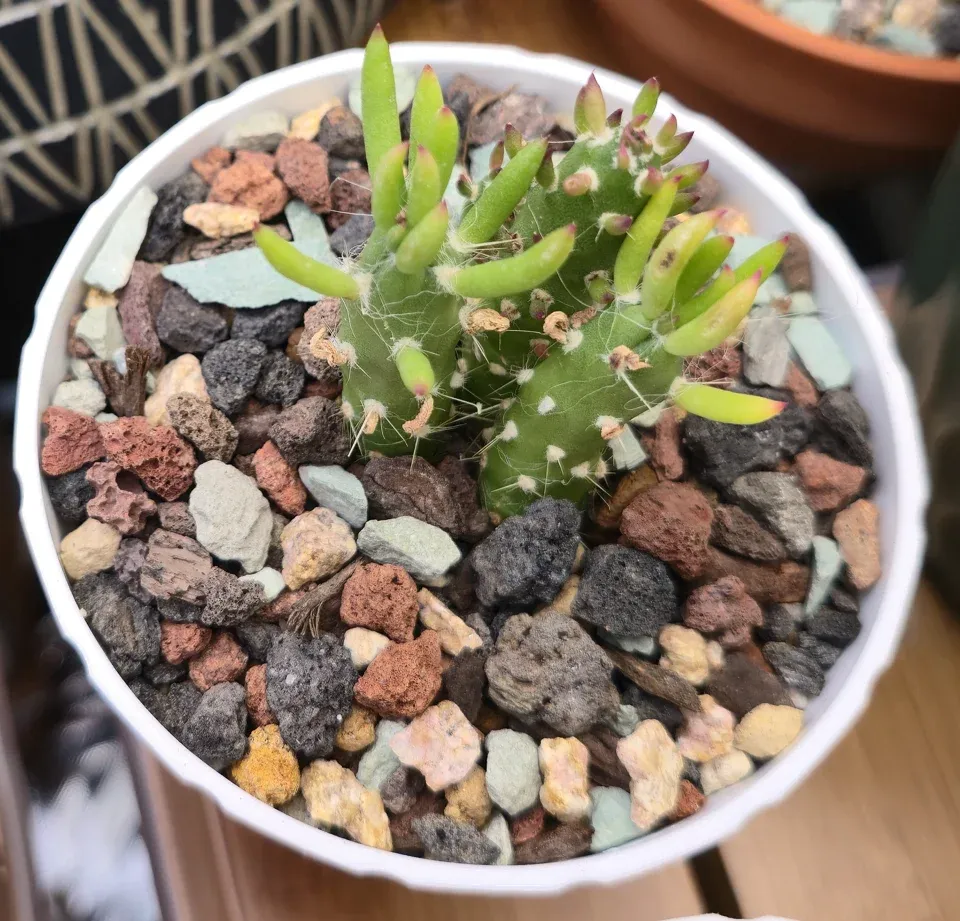
Received from Mountain Crest Gardens and moved from its 2-inch nursery pot into the 4 × 4 × 3.7-inch pot.
Collection record ↗
Then and now
Explore the sources
 Explore the sources
Names and identity
| Kind | Name |
|---|---|
| Accepted botanical name | Austrocylindropuntia subulata |
| Seller name | Austrocylindropuntia subulata — Eve's Needle |
| Other common name | Eve's pin cactus |
The long, awl-shaped leaves are carried on young green branches; older stems develop a woody trunk with dark brown bark.
Collection history

Ordered from Mountain Crest Gardens on August 25, 2026, this plant arrived rooted on August 28 in a 2-inch nursery pot. It was inspected and repotted that day into a 4 × 4 × 3.7-inch round pot, with approximately 95% of the nursery soil removed according to the owner. The substrate was slightly moist at inspection.
The August 29 measurements were 357.5 g for the potted plant and 1.8 in high × 1.6 in wide for the plant itself, measured with a scale and ruler. Collection photographs include side and overview views.
The mix is Molly's Succulent Mix with added perlite. On September 20, the owner estimated the blend as approximately 80% Molly's / 20% added perlite. See the current placement guide for the indoor arrangement. Individual lamp clearance has not been measured.
Nursery description
Mountain Crest Gardens' specifications, recorded August 26, 2026:
| Seller field | Listing value |
|---|---|
| SKU | C2KY2600 |
| Product size | 2.0-inch pot |
| Current / bloom color | Green / red |
| Hardiness | Zone 10; seller threshold 30 °F |
| Recommended light | Bright indoor light; full sun |
| Maximum-height category | Over 12 inches |
| Growth habit | Vertical grower / tall stem |
| Special characteristics | “Hard to kill”; slow grower — seller fields |
The seller describes a tree-like cactus that can reach about 13 feet in the wild, with tubercled stems, spined areoles, awl-shaped leaves up to about 5 inches on mature growth, red-to-orange flowers, and reddish fruit. NC State Extension also records its historical use in Peru for fencing and for needles made from the spines.
Origin, form, and growth
The species comes from the Andean region of western South America. NC State Extension describes it as a shrub- or tree-like cactus with cylindrical, tubercled stems, awl-shaped leaves, sharp spines, and irritating glochids on the fruit. A container plant stays smaller than a mature plant in habitat but can eventually outgrow a compact tabletop display.
GBIF treats A. subulata as an accepted species. The current combination was published in 1942; older references may place it in Opuntia or Cylindropuntia.
Care in this collection

| Topic | Practical starting approach |
|---|---|
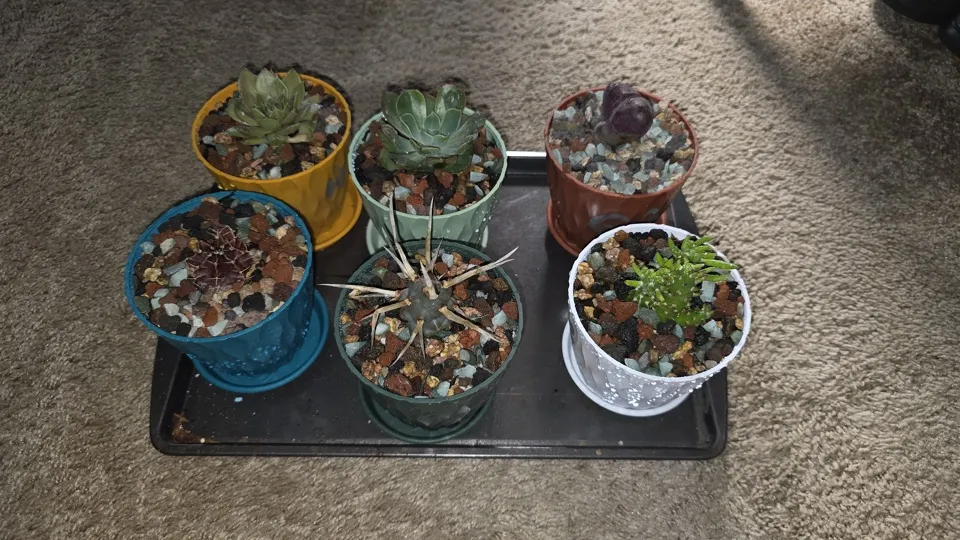
| Grow-light position | Photo-matched R4C4 · High. September 15, 2026 photo reference: six-column/four-row front grid, facing the window. Back row of small pots, near the shared cactus; preserve clear light and separation from trailing stems. See the current placement guide. |
| Water | Let the root zone dry before watering, using pot-weight trends and plant firmness together. The larger pot can remain damp below a dry surface. |
| Pot and mix | 4 × 4 × 3.7-inch round pot with Molly's Succulent Mix and approximately 20% added perlite (owner estimate). Keep drainage clear and avoid persistent moisture around the base. |
| Long-term size | Keep it where future height and branching will not crowd the fixture or snag nearby plants. |


Rotation, propagation, and watch points
- When rotating the pot, use the
H3label as an orientation reference and keep its spines clear of neighboring plants. - Healthy stem segments can be rooted after the cut surface calluses.
- Treat the glochids and longer spines as hazardous even when the green leaves make the plant look soft.
- Watch for mealybugs or scale around tubercles and stem joints.
Sources

-
Owner observations, August 28–29 and September 20, 2026: receipt, repotting, substrate condition, scale/ruler measurements, and estimated Molly's Succulent Mix/perlite blend.
Through the seasons
Plant Photo History
Recent photographs of this plant. Open a photo or its collection for the complete history.
From the nursery
Nursery Labels
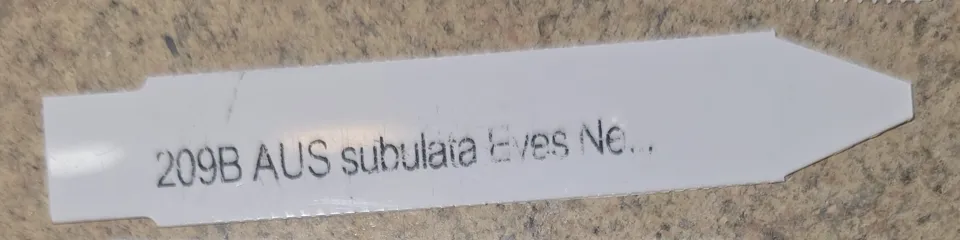
Original nursery labels and packaging.
Botanical reference photos
Reference Gallery
Form and growth


.JPG)
Look closer


In the landscape

 Mountain Crest Gardens: seller listing for Eve's Needle