


Cactus collection
Plant 13 / 45 Cactus collection
 Plant 13 / 45
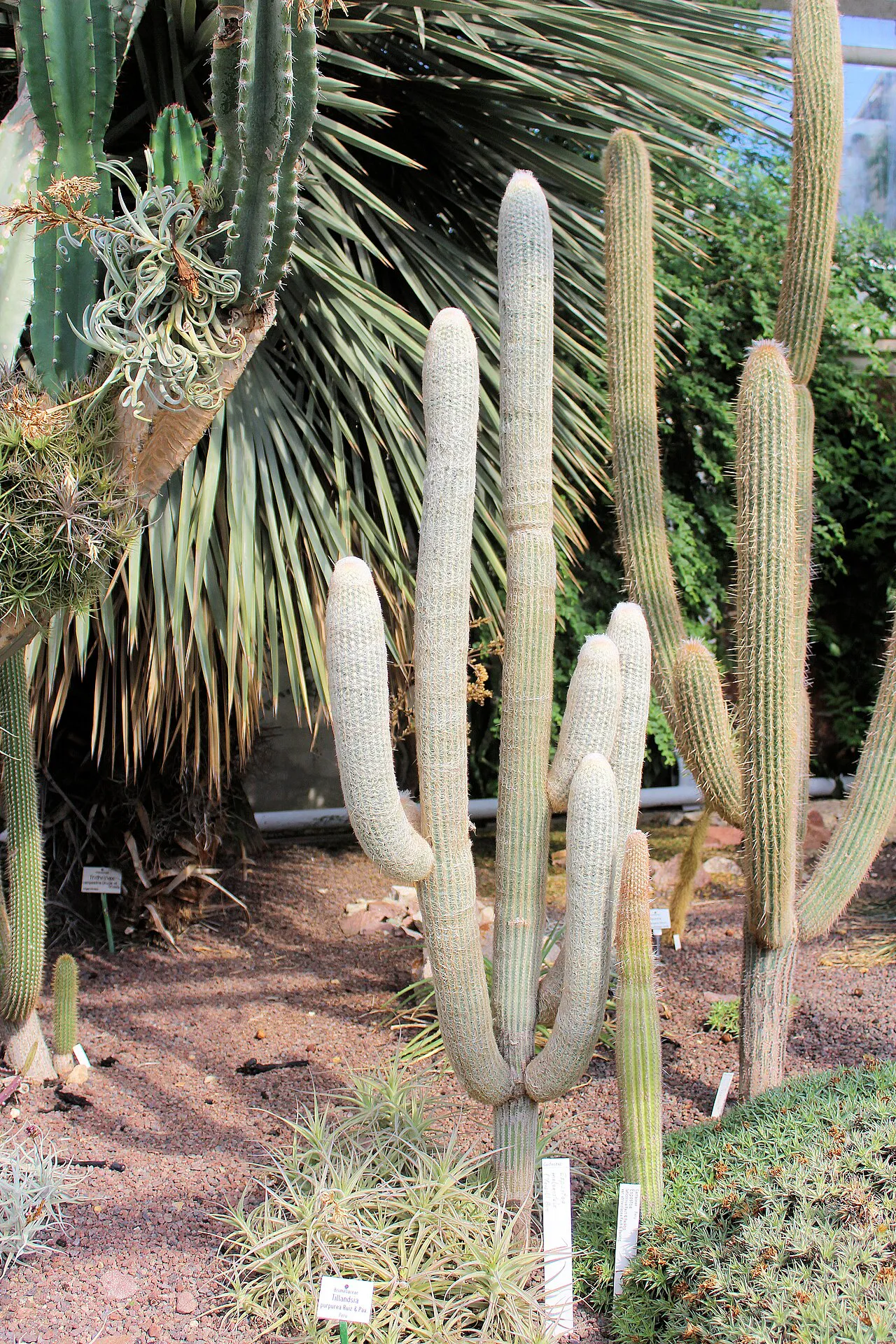
 Espostoa sp., likely Espostoa melanostele subsp. nana
Dwarf old man cactus


Species reference · Dguendel · CC BY 3.0 · Photo Source ↗
 Collection Record
- Cactus-01
 Permanent Label
E1 Identification
 Status
 Acquired From
- Carlsons' Greenhouse, Torrey Road, Fenton, Michigan
 Acquired On
- 2026-08-10
 Google Sheets ID
- P13 ↗
 Photo History
- 4 captures · newest ↓
Measurements and Care History
 Measurements and Care History
Weights, watering, events, and charts for P13.
Spot it
 Spot it
What it looks like
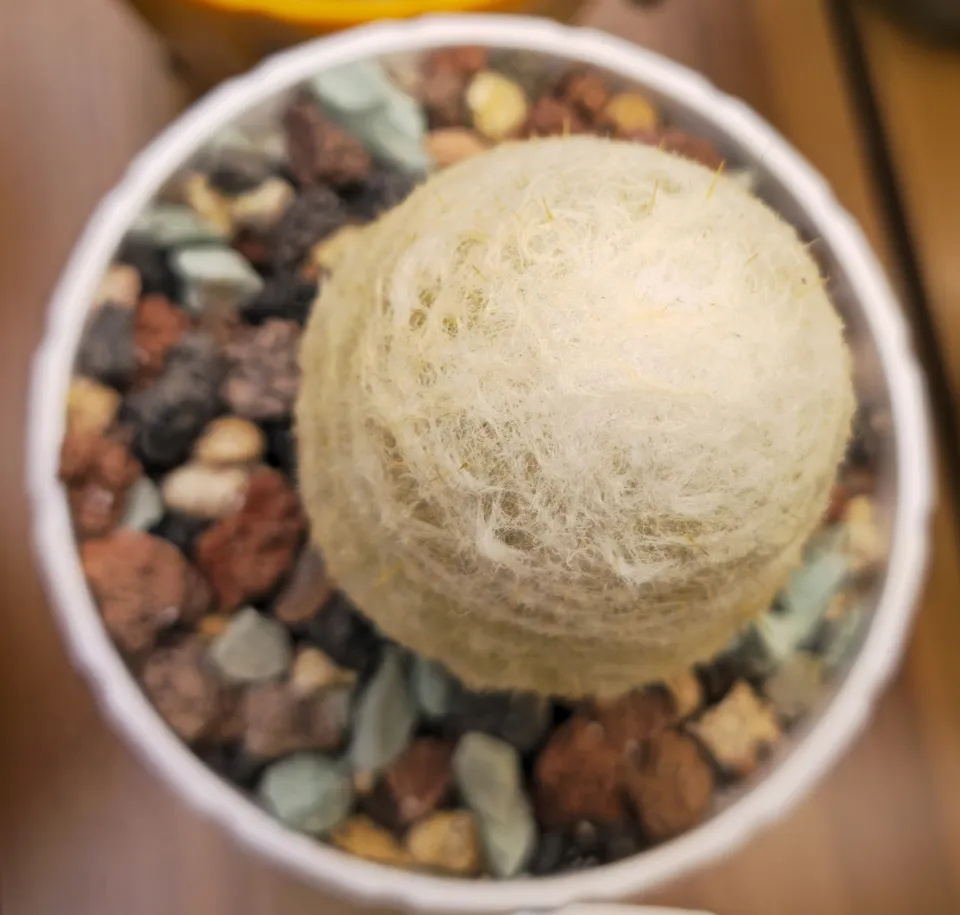
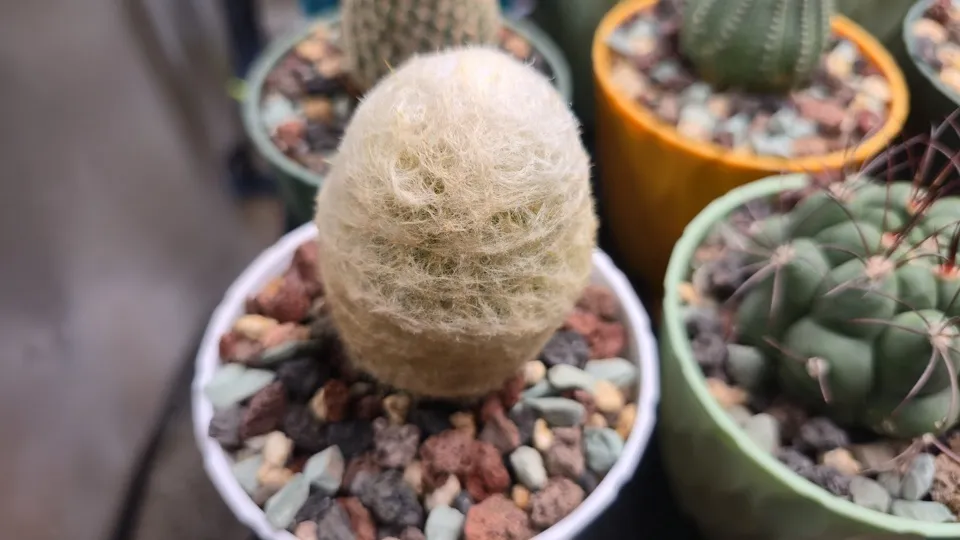
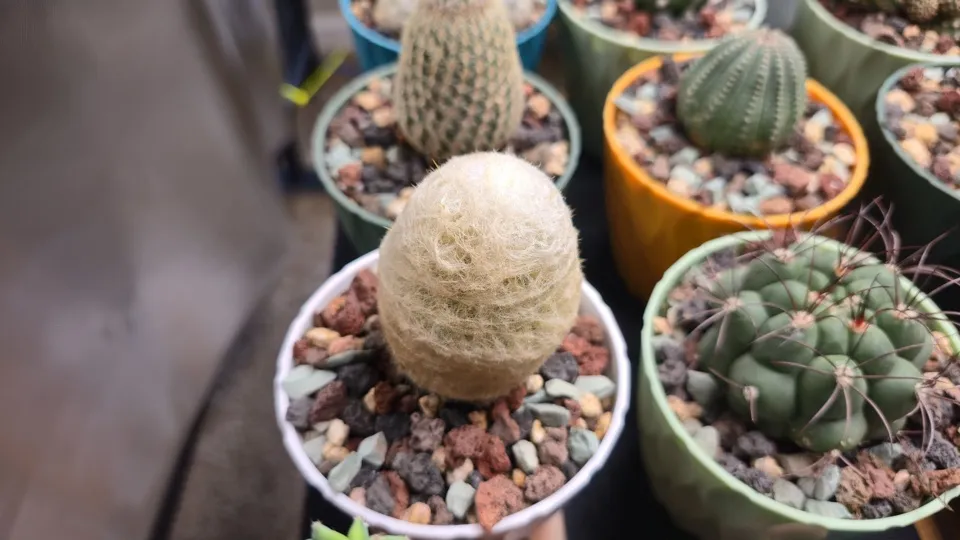
A compact upright column almost completely wrapped in cream-white wool, with the darker stem and fine spines only peeking through where the fibers separate.
One curious thing
 One curious thing
Did you know?
The white coat hides a repeated structure: rows of spine-bearing cushions follow the ribs of the green column beneath.
Explore This Plant
A closer look
How this plant works
 How this plant works
Beneath the white wool is a ribbed green column with organized rows of spine-bearing cushions.
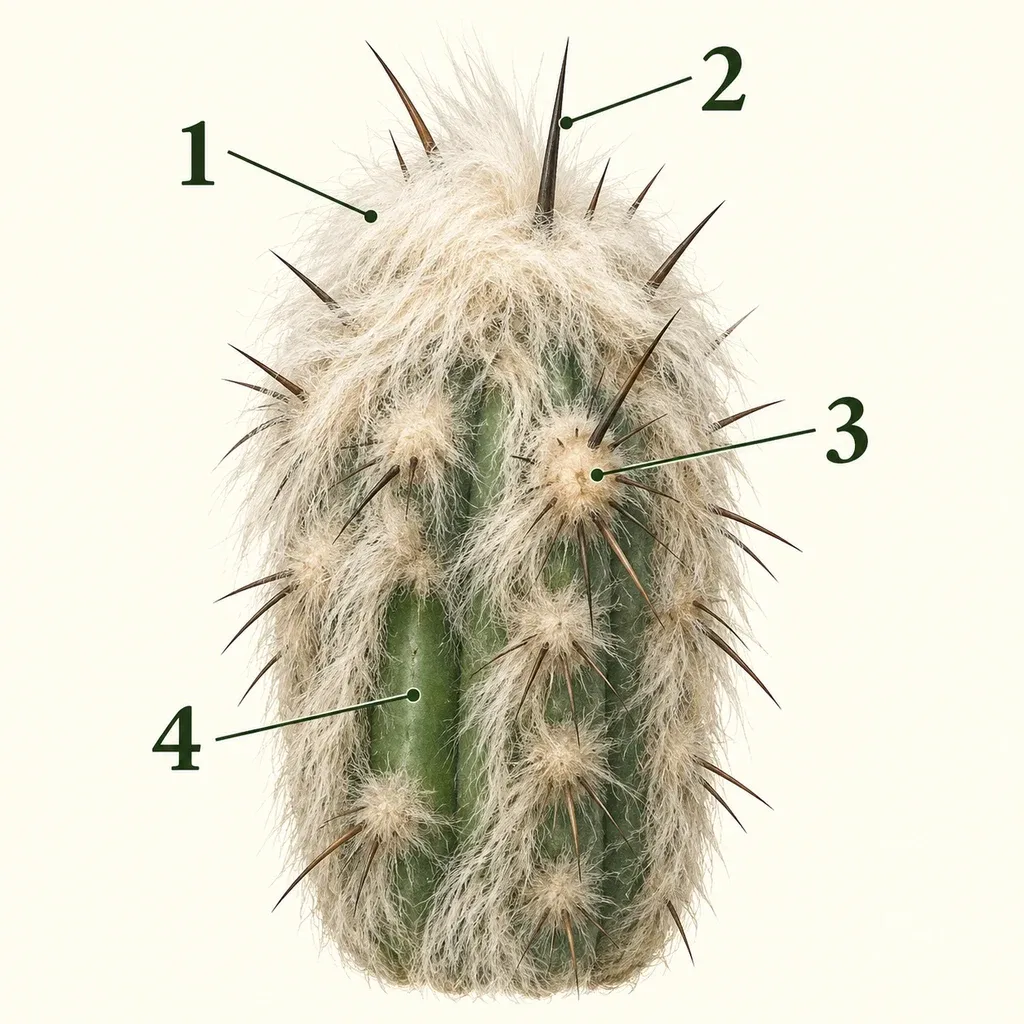
Woolly covering
Fine pale hairs screen the green surface beneath.
Central spine
A sharp projecting spine remains hidden among the soft-looking hairs.
Areole
The spine-bearing cushion organizes the wool and spines along the stem.
Green ribbed stem
The living stem stores water and photosynthesizes beneath its covering.
Habitat and origins
 Habitat and origins
Espostoa melanostele subsp. nana comes from Ancash, Peru, in desert and dry shrubland. Its upright stems carry a dense white covering that partly screens the green surface.
What growth can look like
 What growth can look like
- Stage 1
Compact juvenile
A short woolly column establishes its ribbed body.
- Stage 2
Taller stem
Fresh tissue and new wool appear at the growing tip.
- Stage 3
Older branching plant
The parent species can form a clump of upright columns.
Look through naturally thin patches of wool to follow the ribs and the repeating spine cushions beneath.
Growth sources: [2]
Flowers
Espostoa flowers generally open at night and are bell- or cup-shaped, usually white and occasionally red.
Sources: [3]
As it matures
The parent species forms clumps of upright columns with 20–30 ribs. The dense wool partly hides this repeated structure.
Sources: [2]
Behind the name
Kew recognizes nana as a subspecies under a combination published in 2002; it was first described as Espostoa nana in 1964.
Sources: [1]
Similar plants, useful clues
Golden ball cactus ↗
Parodia leninghausii has golden bristles rather than the thick white wool characteristic of this plant.
This plant in the collection
Its story so far
Joined the collection
Purchased at Carlsons' Greenhouse in a 4-inch individual pot.
Collection record ↗
Then and now
Explore the sources
 Explore the sources
Names and identity
| Kind | Name |
|---|---|
| Working identification | Espostoa melanostele subsp. nana |
| Common name | Dwarf old man cactus |
| Main alternative | Espostoa lanata |
| Permanent-label form | PROB. Espostoa melanostele subsp. nana |


The dense wool partly hides the ribbed green column. Look through natural gaps to see the repeating spine cushions without disturbing the coat.
Origin, form, and publication
Kew accepts Espostoa melanostele subsp. nana and places its native range in Ancash, Peru, in desert and dry-shrubland habitat. Friedrich Ritter published the taxon as Espostoa nana in 1964; Graham Charles published the accepted subspecies combination in 2002.
Care in this collection

| Topic | Practical approach |
|---|---|
| Grow-light position | Photo-matched R3C2 · High. September 15, 2026 photo reference: six-column/four-row front grid, facing the window. Interior-left tall white cactus; keep its growing tip exposed and avoid shading nearby low plants. See the current placement guide. |
| Water | Soak the root ball, drain fully, and wait for a complete dry-down. Keep the wool and crown dry when practical. |
| Pot and mix | The current 4-inch pot is suitable while the base remains uncrowded; keep the neck visible above top dressing. |
| Airflow | Gentle moving air helps wet wool dry; do not aim either pole fan hard enough to flatten it. |


Rotation, propagation, and watch points
- Rotate 90° clockwise during the ordinary Sunday rotation, using
E1as the orientation reference. - Seed is the normal propagation route; offsets can be rooted if the plant produces suitable basal growth.
- Inspect wool for irregular cotton, sticky residue, or root-zone insects. Natural wool repeats consistently; mealybug material usually does not.
- Do not dig through the wool with bare fingers to check the hidden spines.
Sources

Through the seasons
Plant Photo History
Recent photographs of this plant. Open a photo or its collection for the complete history.
Botanical reference photos
Reference Gallery
Form and growth
,_botanischer_Garten,_Espostoa_melanostele.jpg)
.JPG)

Look closer


Flowers and buds


In the landscape


Research Trail
- Collection Notes on GitHub
- Complete Photo Archive and Credits
- iNaturalist Observations — Species comparisons