


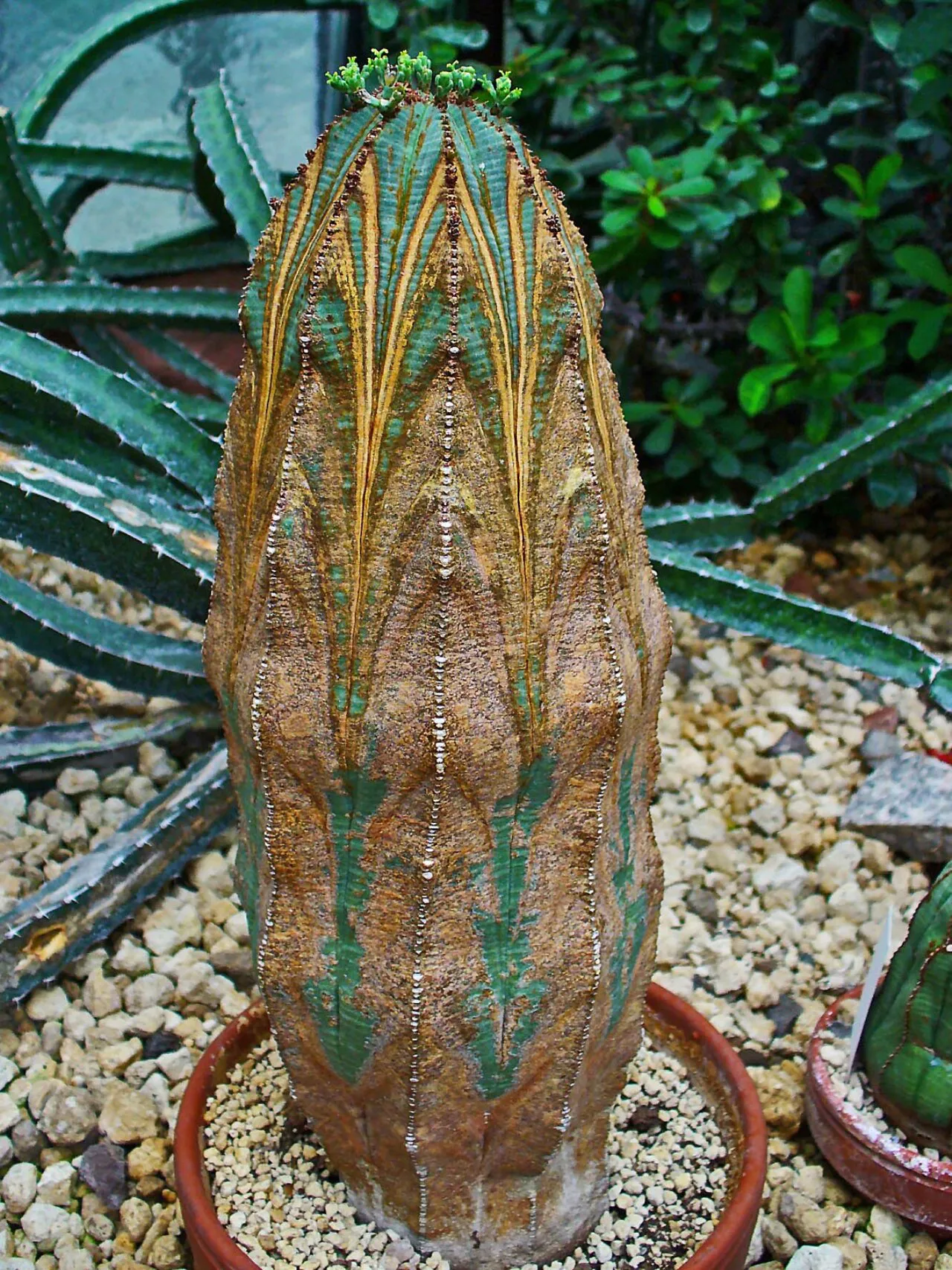
Cactus collection
Plant 10 / 45 Cactus collection
 Plant 10 / 45
 probable Euphorbia obesa-type hybrid or selection
Dragon's Egg


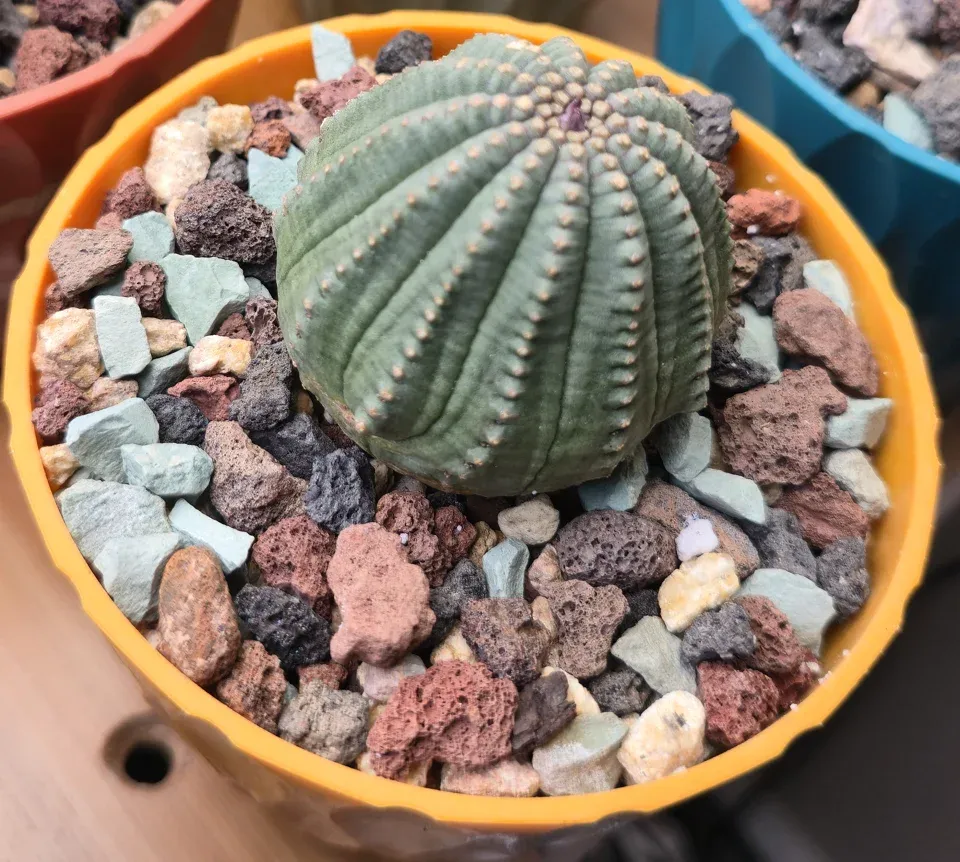
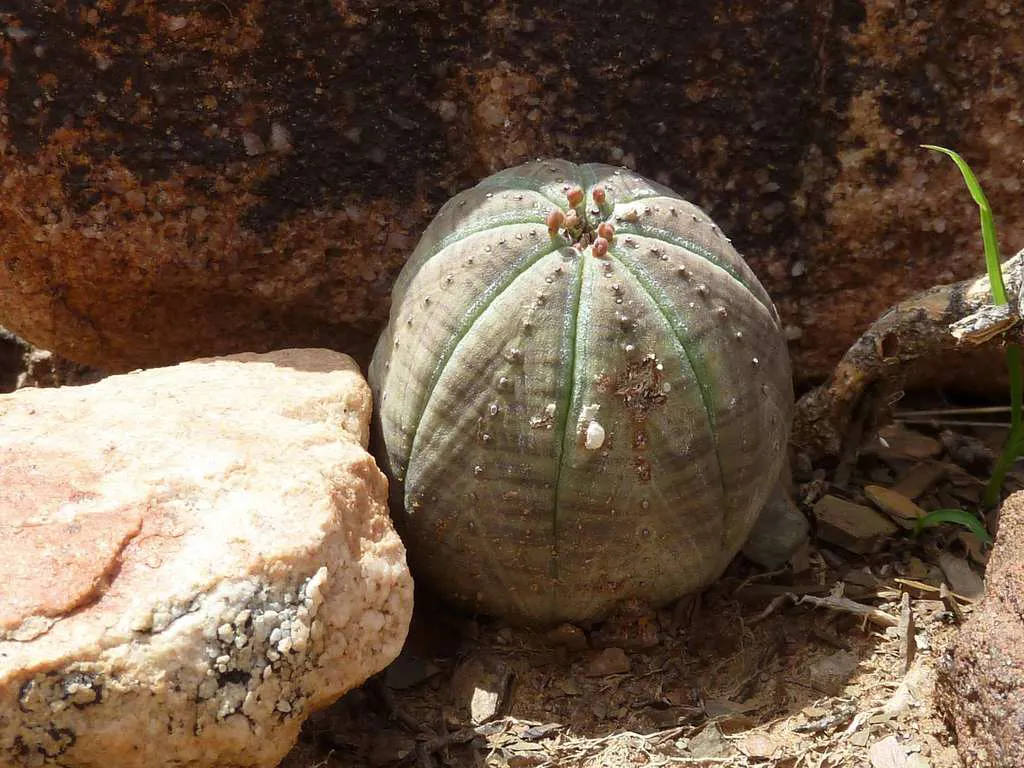
Species reference · H. Zell · CC BY-SA 3.0 · Photo Source ↗
 Collection Record
- Starter-11
 Permanent Label
D1 Identification
 Status
 Acquired From
- Altman Reserve
 Acquired On
- 2026-07-23
 Google Sheets ID
- P10 ↗
 Photo History
- 4 captures · newest ↓
Measurements and Care History
 Measurements and Care History
Weights, watering, events, and charts for P10.
Spot it
 Spot it
What it looks like
A rounded, almost ball-like body marked by vertical ribs and muted green-to-brown striping, with little or no visible spine growth and a small cluster of structures at the crown.
One curious thing
 One curious thing
Did you know?
Despite its cactuslike shape, this is a Euphorbia: its tiny “flowers” are specialized cyathia, and damaged tissue can release the caustic latex typical of the genus.
Explore This Plant
A closer look
How this plant works
 How this plant works
The ribbed body carries crosswise color bands and tiny flowering sites near the crown.
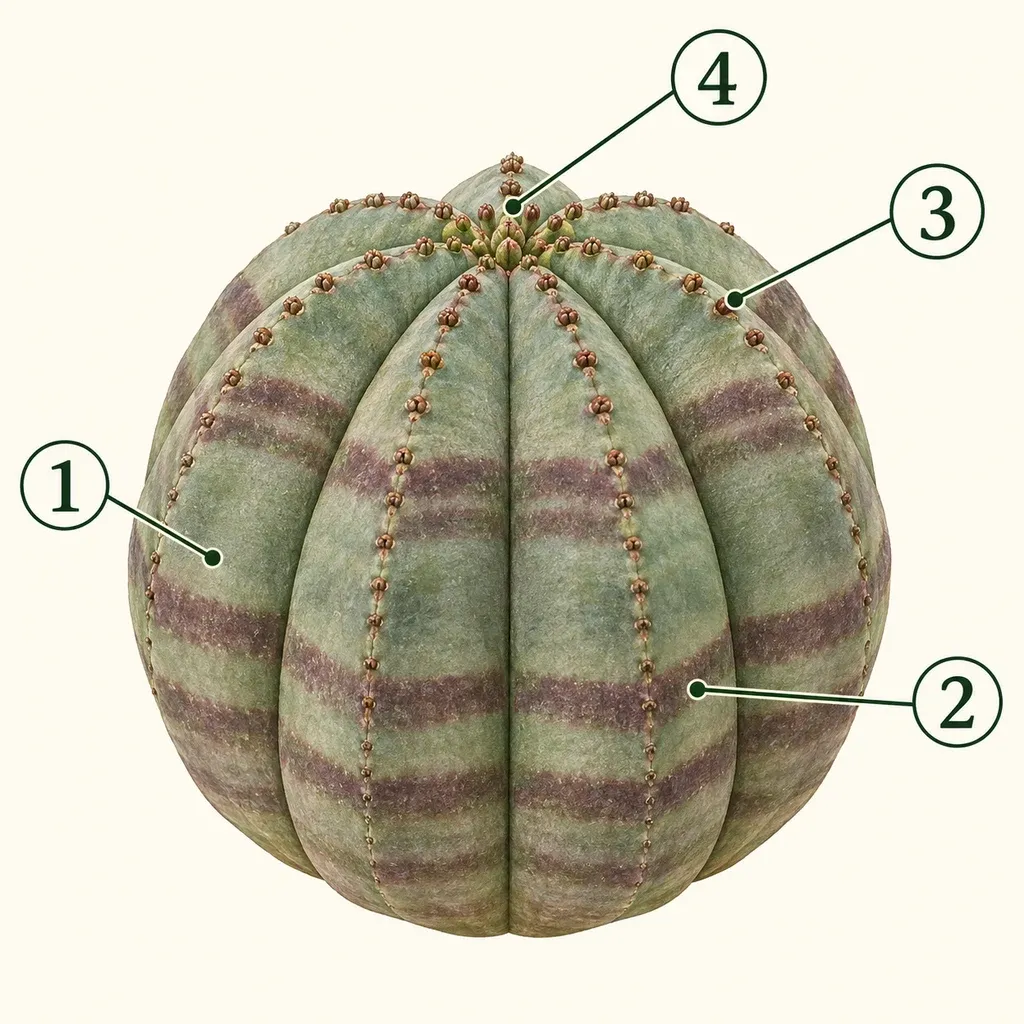
Fleshy rib
The rounded rib is part of the succulent body.
Transverse band
Purple-brown markings cross the grey-green stem; they are coloration rather than separate leaves.
Flowering eye
Small sites near the upper rib crests can produce cyathia, the characteristic Euphorbia flower clusters.
Crown
The upper growing region continues the rib pattern as the body develops.
Habitat and origins
 Habitat and origins
Wild Euphorbia obesa grows in the Great Karoo near Graaff-Reinet in South Africa’s Eastern Cape. Its rounded, stone-like body stores water through dry periods. This is the species background of the collection’s obesa-type Dragon’s Egg selection.
Habitat sources: [1]
What growth can look like
 What growth can look like
- Stage 1
Rounded youngster
The obesa-type body begins as a compact ball.
- Stage 2
Developing ribs
The stem enlarges while keeping its strongly grooved outline.
- Stage 3
Older form
The rounded stem enlarges; wild obesa becomes more cylindrical with age.
In wild Euphorbia obesa, tiny leaves appear briefly and soon drop away, leaving the succulent stem as the lasting green body.
Growth sources: [1]
Flowers
The tiny cups called cyathia each contain highly reduced flowers. In wild Euphorbia obesa, separate male plants produce pollen-bearing flowers and female plants develop seed capsules; a capsule can eject its seeds when it ripens.
As it matures
Wild Euphorbia obesa develops from a ball into a short cylinder, reaching about 20 cm high and 9 cm wide. Dragon’s Egg is grown for its compact ribbed form.
Sources: [1]
Behind the name
The cactus resemblance is an example of similar succulent shapes appearing in unrelated families. Euphorbia’s floral structure and milky latex reveal its very different botanical identity.
Sources: [2]
Similar plants, useful clues
Monk’s hood cactus ↗
Both plants have rounded, ribbed bodies. Astrophytum has woolly, spine-bearing areoles; this Euphorbia has small flowering eyes along its rib crests.
This plant in the collection
Its story so far
Then and now
Explore the sources
 Explore the sources
Names and identity
| Kind | Name |
|---|---|
| Best working ID | Euphorbia obesa-type hybrid or horticultural selection |
| Trade name supplied | Dragon's Egg |
| Species common names | Baseball plant, sea-urchin euphorbia |
| Family | Euphorbiaceae—not the cactus family |
“Dragon's Egg” is the Altman Plants retail name. Its ribbed ball and tiny crown structures resemble E. obesa; the collection records it as an obesa-type hybrid or selection.
Wild Euphorbia obesa
The reference species has a very restricted natural range in the Great Karoo south of Graaff-Reinet in South Africa's Eastern Cape. It grows low among shale and stones in a summer-rainfall area receiving roughly 200–300 mm annually. Young plants are round and older ones become slightly columnar, usually with eight broad ribs and patterned gray-green skin.
Peter MacOwan found the plant in 1897 and sent material to Kew. It flowered there in 1899; Joseph Dalton Hooker's formal botanical publication followed in 1903. obesa refers to the rounded “obese” form. Intense collecting and habitat pressure devastated some populations. South Africa lists it as Endangered, protects exact locality data, and regulates trade. Nursery-propagated plants are the ethical source.
The crown makes tiny cups called cyathia, each containing highly reduced flowers. In wild E. obesa, a male cyathium contains several pollen-bearing flowers and a female cyathium contains one female flower. Plants are male or female, so seed requires both sexes. Ripe capsules can eject seeds away from the parent. Flowering from seed may take five to eight years.
Care in this collection

| Topic | Practical approach |
|---|---|
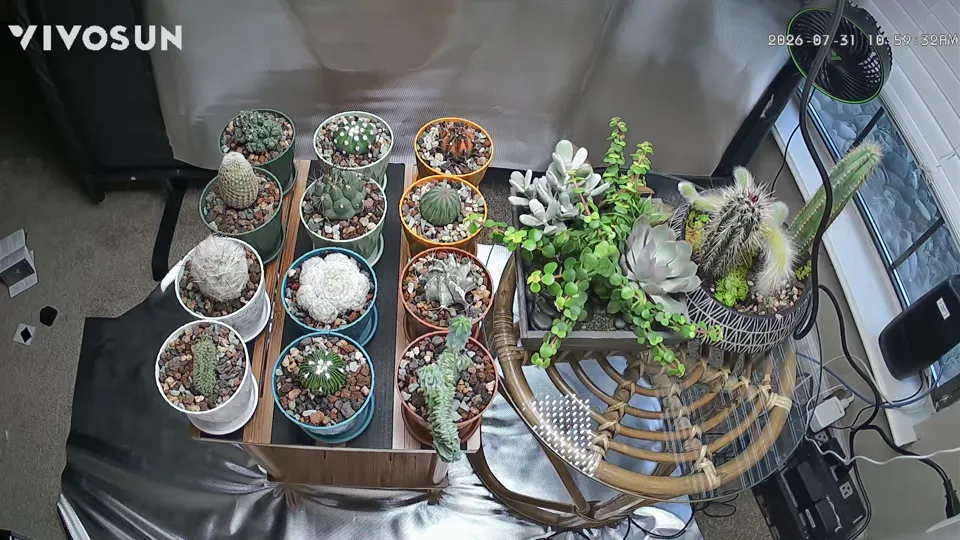
| Grow-light position | R1C4 · Bright. September 15, 2026 photo layout, facing the window (six columns, four rows). Front-center, with bright exposure and room around the crown. See the current placement guide. |
| Water | During warm growth, soak and drain after the pot is fully dry. Keep much drier during cool or stalled growth. |
| Light | Strong light helps maintain a compact ball, but exposed skin can scar from an abrupt jump. |
| Pot and mix | Keep the drained 4-inch pot only as wet as the small root system can use. A mineral, airy mix is safer than rich moisture-retentive soil. |
| Feeding | Sparse dilute feeding in active growth; slow is normal. |


Latex safety and watch points

- Any cut can release milky latex that irritates skin and can seriously injure eyes. Wear gloves and eye protection for cutting or repotting, keep it away from children and pets, and wash exposed skin promptly.
- Do not use flame to stop latex and do not touch the face while handling it.
- Root or basal rot appears as loss of firmness, translucence, or a spreading dark area. Normal pigment and corking remain firm.
- Mealybugs collect around the crown and rib seams.
- Seeds from a hybrid may vary widely and will not reliably reproduce the “Dragon's Egg” appearance.
Sources

Through the seasons
Plant Photo History
Recent photographs of this plant. Open a photo or its collection for the complete history.
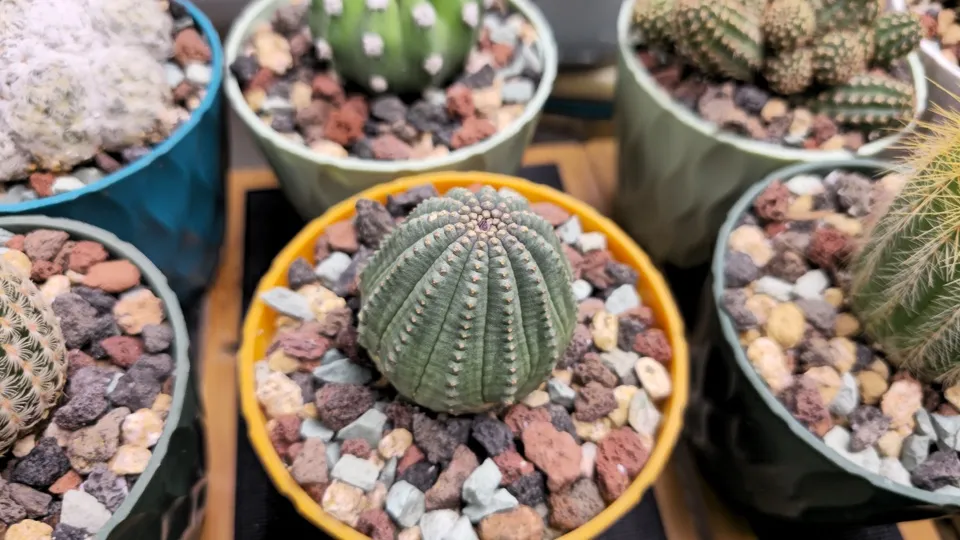
From the nursery
Nursery Labels
Original nursery labels and packaging.
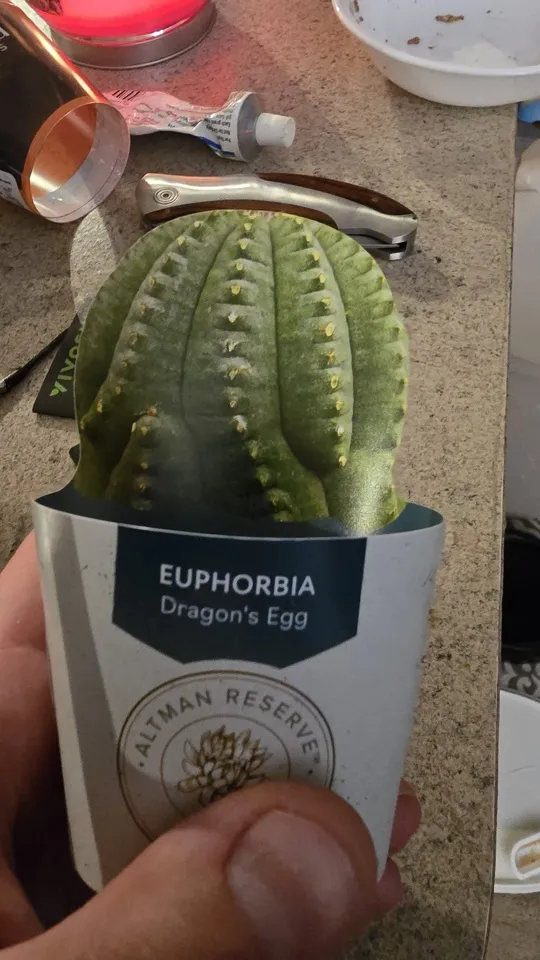
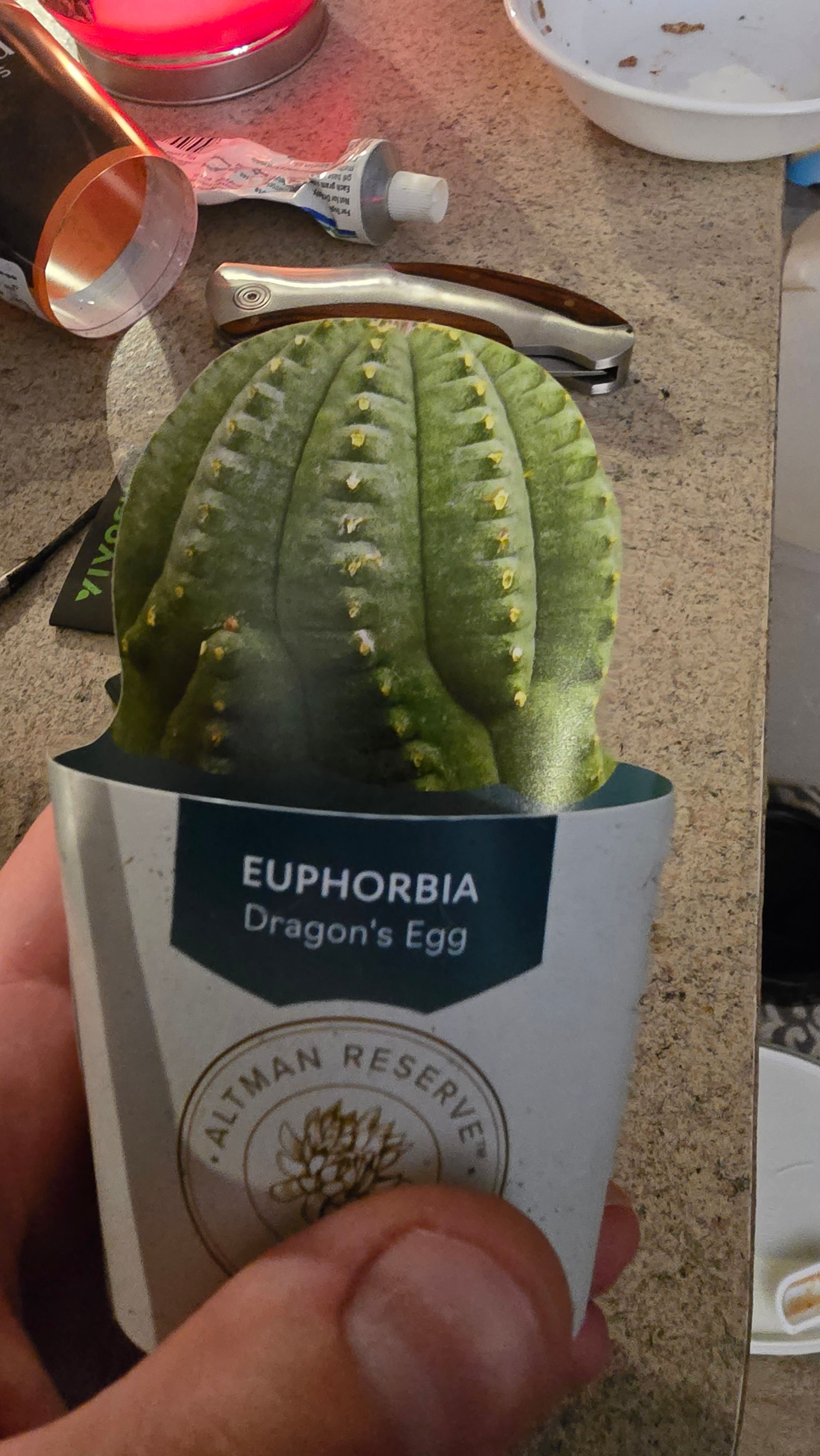
Botanical reference photos
Reference Gallery
Euphorbia obesa species comparisons
Form and growth


Look closer


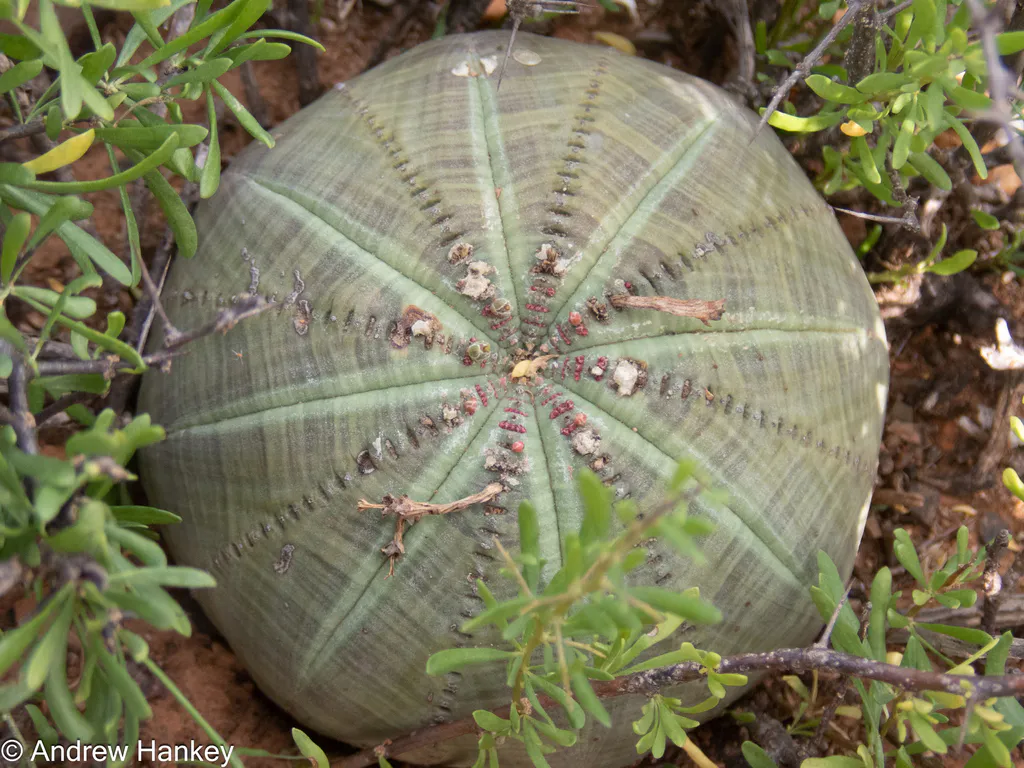
Flowers and buds


In the landscape

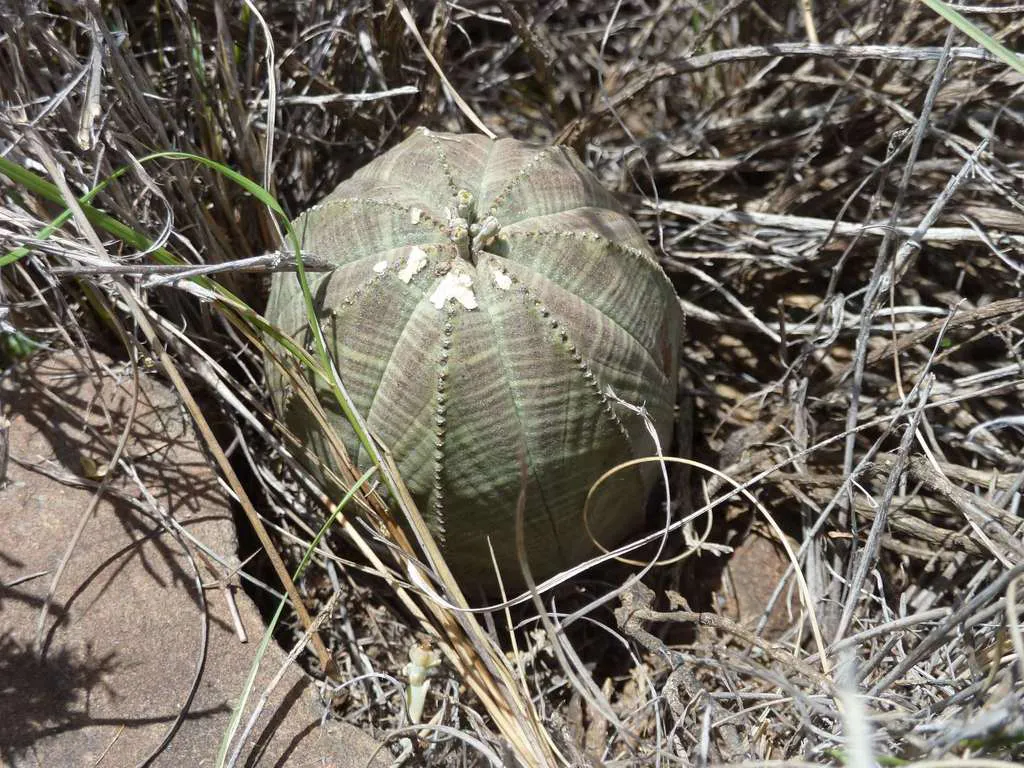
Research Trail
- Collection Notes on GitHub
- Complete Photo Archive and Credits
- iNaturalist Observations — Euphorbia obesa species comparisons