


Equipment Reference
VIVOSUN AeroLight Wing AW200SE and GrowHub E25
 View on GitHub ↗
September 13 update: the owner has hung the AW200 beside the new AeroLight 240 W and applied the latest layout, with AW200 at 45% and AeroLight 240 W at 38%. The room end remains open without the two-foot return reflector. The owner confirms an 18-inch plant-tip reference and the same 13 h 15 m total cycle for both lights, including 15-minute sunrise and sunset transitions at the start and end. This page preserves the earlier AW200SE research.
Historical model research: the installed fixture was identified as AW200 with tunable spectrum on September 9, when its reported program was 60%, 13.25 hours daily, with quarter-hour sunrise/sunset transitions. The AW200SE specifications, spectrum assumptions, PPFD maps and 12-hour conversions below do not describe a measured light survey of that AW200 or the current two-light setup. See the current setup and placement guide.
Last updated: 2026-08-29
This guide converts the manufacturer's cannabis-oriented data into a practical starting point for this cactus and succulent collection. The numerical targets are deliberately ranges. Exact species trials are unavailable for most of these plants, and a reflective tent map is not a measurement of an open shelf.
The dated AW200SE operating schedule preserves the earlier controller and acclimation plan. Use the installed two-light record for current reported settings.
Hardware summary
| Specification | AW200SE / E25 information |
|---|---|
| Nominal light power | 200 W |
| Fixture size and weight | About 26 × 13 × 2.3 in; 6.9 lb |
| Advertised coverage | 2 × 4 ft |
| Photon efficacy | 2.75 µmol/J |
| Approximate photon output | About 550 µmol/s if 200 W and 2.75 µmol/J describe the same operating point; this is a calculation, not a separately published test result |
| Spectrum | Advertised 380–780 nm output, including white LEDs, 660 nm deep red, and 730 nm far red |
| Manual dim levels | Off, 25%, 50%, 75%, and 100% |
| App/controller range | VIVOSUN advertises 25–100% but does not publish the increment size; the installed AW200SE/E25/VIVOSUN app combination was tested on 2026-07-24 and accepts every whole-percent setting in that range |
| Integrated fan | Up to 84 CFM; advertised 33 dB |
| External circulation | Two AeroWave E6 Gen2 pole fans aimed from opposing ends of the black divider, each rated 12 W and up to 320 CFM, with 90° horizontal oscillation, 10 E25/app speed levels, and 5 oscillation levels. Fan 2 is clipped high and aimed slightly downward. |
| Durability claims | 50,000-hour life and IP65 fixture rating |
| Controller network | 2.4 GHz Wi-Fi; three independent E25 paths control the AW200SE and the two E6 Gen2 units. Fan 2 has its own E25. RJ45 chaining is for compatible AeroLights, not either fan, and the fans are not daisy-chained. |
| Climate sensing | The E25 itself is not the room's temperature/RH probe; VIVOSUN points to the separate AeroLab THB1S sensor for climate data |
The adjustable wings have three useful geometries. VIVOSUN says the wide position increases coverage about 10%, while the narrow position increases central PPFD about 10%. Standard or wide makes more sense for a mixed-height, mixed-light collection; narrow concentrates an already strong hotspot.
IP65 on the fixture does not make the wall outlet, E25, connectors, or power strip safe to soak. Keep every electrical connection above any watering spill path and use secure hangers at both ends of the light.
The manufacturer's PPFD data does not fully agree
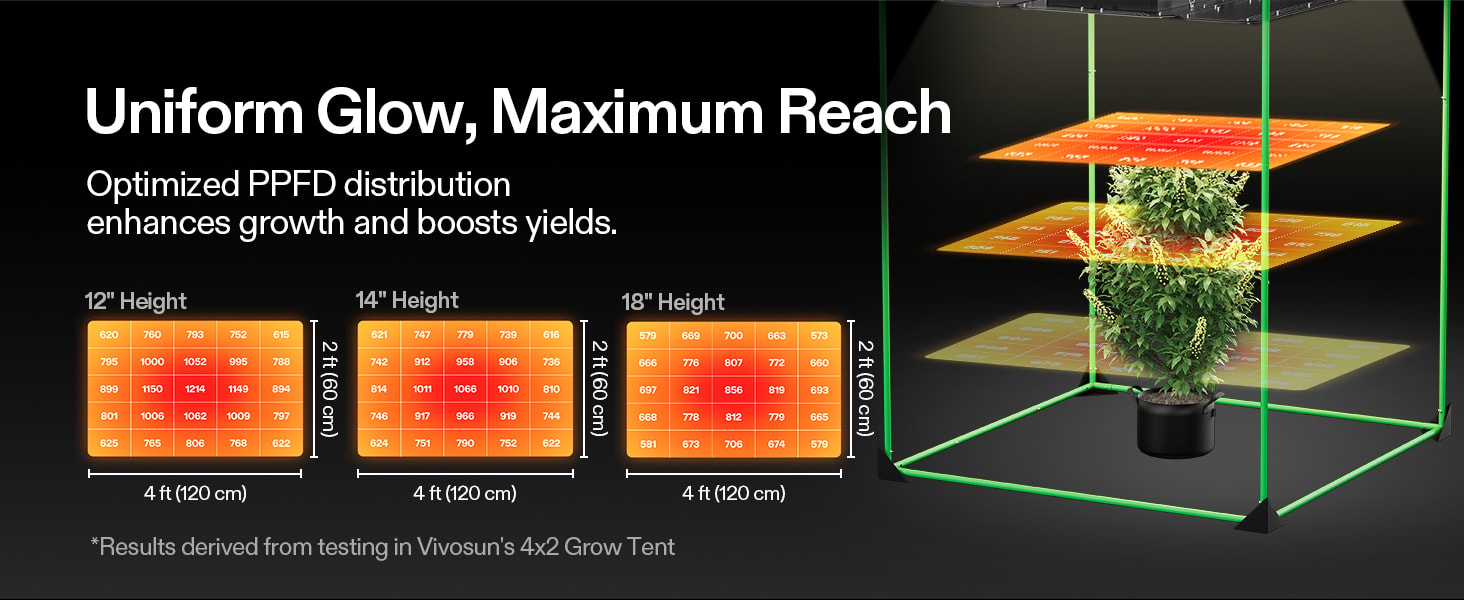
The product specification table gives a single figure of 691 µmol/m²/s at 12 in. A separate official 5 × 5 map, described as measured at 100% in a VIVOSUN 4 × 2 reflective tent, gives much higher 12-inch values:
| Height | Map minimum | 25-point mean | Center | Map maximum | Minimum ÷ mean |
|---|---|---|---|---|---|
| 12 in | 615 | 870 | 1,214 | 1,214 | 71% |
| 14 in | 616 | 812 | 1,066 | 1,066 | 76% |
| 18 in | 573 | 707 | 856 | 856 | 81% |
The means above are calculations from the printed grid, rounded to the nearest whole number. The 12-inch map average of about 870 does not reconcile with the separate 691 specification. Possible causes include a different wing setting, grid area, meter, fixture revision, or reporting convention, but VIVOSUN does not explain the difference on those pages.
For planning, the map shows why height and room geometry matter:
- distance lowers the central hotspot and improves map uniformity;
- reflective tent walls keep the printed edge values unusually high;
- an open shelf can lose much more edge light than this map suggests; and
- the only number that describes this collection is a measurement at the actual plant tops.
Open VIVOSUN's original PPFD map image.
Raw map transcription
These are the manufacturer's printed grid values, retained so future shelf measurements can be compared with the original claim.
12 in at 100%
| 620 | 760 | 793 | 752 | 615 |
| 795 | 1,000 | 1,052 | 995 | 788 |
| 899 | 1,150 | 1,214 | 1,149 | 894 |
| 801 | 1,006 | 1,062 | 1,009 | 797 |
| 625 | 765 | 806 | 768 | 622 |
14 in at 100%
| 621 | 747 | 779 | 739 | 616 |
| 742 | 912 | 958 | 906 | 736 |
| 814 | 1,011 | 1,066 | 1,010 | 810 |
| 746 | 917 | 966 | 919 | 744 |
| 624 | 751 | 790 | 752 | 622 |
18 in at 100%
| 579 | 669 | 700 | 663 | 573 |
| 666 | 776 | 807 | 772 | 660 |
| 697 | 821 | 856 | 819 | 693 |
| 668 | 778 | 812 | 779 | 665 |
| 581 | 673 | 706 | 674 | 579 |
Estimating dimmed output
LED photon output is often roughly proportional to dim setting. Until measured, multiply a 100% map value by the selected fraction:
estimated PPFD = map PPFD × dim percentage
This is a planning estimate, not calibration. Driver behavior, wall reflections, wing angle, and meter uncertainty prevent exact scaling.
| Height | Location | 25% estimate | 50% estimate | 75% estimate | 100% map |
|---|---|---|---|---|---|
| 12 in | Grid mean | 217 | 435 | 652 | 870 |
| 12 in | Center | 304 | 607 | 911 | 1,214 |
| 14 in | Grid mean | 203 | 406 | 609 | 812 |
| 14 in | Center | 267 | 533 | 800 | 1,066 |
| 18 in | Grid mean | 177 | 353 | 530 | 707 |
| 18 in | Center | 214 | 428 | 642 | 856 |
At 18 inches and 50%, the tent-map estimate is already about 353 average and 428 at center. Over 12 hours that is roughly 15.3 and 18.5 mol/m²/day DLI—solid succulent light, not a weak “half power” setting.
VIVOSUN's own stage chart recommends 24 in/50%/18 h for cannabis seedlings, 18 in/75%/18 h for vegetative plants, and 12 in/75–100%/12 h in flower. Those are manufacturer recipes for a fast annual crop in a tent. They are not cactus care instructions and should not be copied wholesale.
PPFD, DLI, and lux without the jargon
- PPFD is the instantaneous number of photosynthetically active photons landing on a square metre each second, traditionally measured from 400–700 nm. It is the best direct “how strong is the plant light right here?” value.
- DLI adds those photons across the whole light period. A moderate lamp for a long day can deliver the same DLI as a stronger lamp for a shorter day.
- Lux weights light for human vision. It is convenient and cheap to measure but underweights deep red and almost ignores the AW200SE's 730 nm far red.
For a fixed light:
DLI (mol/m²/day) = PPFD × hours × 0.0036
Twelve-hour conversion table
| Average PPFD | DLI over 12 h | Very rough AW200SE lux range |
|---|---|---|
| 100 | 4.3 | 5,500–7,000 lx |
| 150 | 6.5 | 8,250–10,500 lx |
| 200 | 8.6 | 11,000–14,000 lx |
| 250 | 10.8 | 13,750–17,500 lx |
| 300 | 13.0 | 16,500–21,000 lx |
| 350 | 15.1 | 19,250–24,500 lx |
| 400 | 17.3 | 22,000–28,000 lx |
| 500 | 21.6 | 27,500–35,000 lx |
| 600 | 25.9 | 33,000–42,000 lx |
| 800 | 34.6 | 44,000–56,000 lx |
| 1,000 | 43.2 | 55,000–70,000 lx |
Apogee shows why no universal lux conversion exists: its factors range from about 54 lux per µmol/m²/s for sunlight to 74 for white fluorescent light. Published broad-white horticultural sources cluster around 59–65. VIVOSUN does not publish an AW200SE-specific conversion. Using 55–70 lux per PPFD is a deliberately wide estimate for this mixed white/red/far-red fixture:
rough PPFD range = lux ÷ 70 to lux ÷ 55
For example, 20,000 lux suggests roughly 286–364 µmol/m²/s, not one exact number. A phone sensor is still useful for finding relative hotspots if the same phone, orientation, and app are used every time.

Working light targets for this collection
These are starting hypotheses, not published species thresholds. They combine native exposure, growth form, variegation, broad succulent research, and the need to avoid stretching under indoor light. Most exact taxa have never been tested in controlled DLI trials.
| Inventory ID | Label ID | Plant | Working DLI | 12 h average PPFD | Placement cue |
|---|---|---|---|---|---|
| Starter-01 | B2 |
Oreocereus trollii | 12–20 | 280–460 | High light |
| Starter-02 | B1 |
Stenocactus phyllacanthus | 10–18 | 230–420 | Bright middle/high |
| Starter-03 | C2 |
Echinocereus rigidissimus subsp. rubispinus | 14–24 | 325–555 | High light after acclimation |
| Starter-04 | A3 |
Nyctocereus serpentinus | 10–18 | 230–420 | Bright middle; allow support |
| Starter-05 | A2 |
Mammillaria plumosa | 10–17 | 230–395 | Bright; avoid a wet crown |
| Starter-06 | D2 |
Echinopsis subdenudata | 10–18 | 230–420 | Bright middle |
| Starter-07 | A1 |
Variegated Gymnocalycium mihanovichii | 6–12 | 140–280 | Edge/gentler zone |
| Starter-08 | C1 |
Gymnocalycium saglionis | 10–18 | 230–420 | Bright middle |
| Starter-09 | B3 |
'Indigo Wave' | 12–22 | 280–510 | Middle/high; watch raised ridges |
| Starter-10 | D3 |
'Ming Thing' | 10–18 | 230–420 | Middle; uneven surface |
| Starter-11 | D1 |
Euphorbia obesa-type hybrid | 8–15 | 185–350 | Middle/edge |
| Starter-12 | C3 |
Astrophytum ornatum | 12–22 | 280–510 | High light |
| Cactus-01 | E1 |
Probable Espostoa melanostele subsp. nana | 12–20 | 280–460 | Bright middle/high after edge acclimation |
| Cactus-02 | E2 |
Echinopsis hybrid, Chamaelobivia Group | 10–18 | 230–420 | Bright middle; inspect dense clump |
| Cactus-03 | E3 |
Probable Mammillaria mammillaris | 10–18 | 230–420 | Bright middle; move outward if the body develops persistent red stress color |
| Cactus-04 | F3 |
Parodia leninghausii | 12–22 | 280–510 | High light after acclimation; watch growing column |
| Cactus-05 | F2 |
Myrtillocactus geometrizans 'Fukurokuryuzinboku' | 10–18 | 230–420 | Bright middle; keep waxy folds off hotspot |
| Cactus-06 | F1 |
Probable Mammillaria cf. rekoi | 10–18 | 230–420 | Bright middle; use compact new growth as the response signal |
| Succulent-01 | #2 |
Probable Echeveria pulidonis | 10–18 | 230–420 | Brightest side of planter |
| Succulent-02 | #2 |
Portulacaria afra | 8–17 | 185–395 | Middle; lower if golden |
| Succulent-03 | #2 |
Probable Kalanchoe bracteata | 8–16 | 185–370 | Middle |
| Succulent-04 | #2 |
Kalanchoe orgyalis | 8–17 | 185–395 | Middle |
| Succulent-05 | #4 |
Aeonium haworthii 'Dream Color' | 8–15 | 185–350 | Outer/room-side zone; protect variegated rosettes |
| Rehab-01 | #1 |
Variegated Pilosocereus pachycladus | 12–22 | 280–510 | High light, pale side off hotspot |
| Rehab-02 | #1 |
Cleistocactus colademononis | 10–18 | 230–420 | Bright middle |
| Rehab-03 | #1 |
Probable Echinopsis spachiana | 12–22 | 280–510 | High light |
| Rehab-04 | — | Probable Mammillaria bombycina | — | — | Removed 2026-07-24; historical record only, with no viable salvage retained |
| Houseplant-01 | #3 |
Pachira glabra | 5–12 | 115–280 | Bright window/periphery; not in cactus hotspot |
| Cactus-07 | H3 |
Austrocylindropuntia subulata | 12–22 | 280–510 | Bright middle/high after edge acclimation; plan for height |
| Cactus-08 | G2 |
Tephrocactus articulatus var. papyracanthus | 10–18 | 230–420 | Bright middle after arrival inspection; stabilize detachable segments |
| Cactus-09 | G1 |
Gymnocalycium mihanovichii 'Black Widow' | 6–12 | 140–280 | Gentler variegated edge; verify the darkest face before rotation |
| Succulent-06 | G3 |
Pleiospilos nelii 'Royal Flush' | 10–18 | 230–420 | Bright succulent zone; separate leaf-cycle watering logic |
| Succulent-07 | H2 |
Echeveria 'Raindrops' | 10–18 | 230–420 | Bright succulent zone; compact center without bleaching |
| Succulent-08 | H1 |
Sempervivum 'Coconut Crystal' | 10–20 | 230–460 | Indoor-only; use the brightest, coolest practical succulent position |
Research support is strongest for the general direction, not every row. A recent Echeveria cultivar experiment found 12.8 DLI produced more compact growth and better performance than 4.8. A study of six other Kalanchoe species found improvements as DLI rose from 4.3 to 8.6 or 17.2, depending on species. A classic Opuntia CAM study reported light saturation near 700 µmol/m²/s under its conditions; that result should not be pasted onto every cactus genus.
Simple starting program
This is the low-fuss summary. The operating schedule provides the complete six-week table and outdoor-day rules.
- Set the wings to standard or wide.
- Measure from the tallest cactus or succulent tip inside the direct light footprint, not the shelf or peripheral money-tree canopy. Begin at 20 inches at 40% for seven days, then use 18 inches at 40% for a second week.
- Run a fixed 12 hours on / 12 hours off. A schedule such as 8 a.m.–8 p.m. is easy to inspect and leaves a real dark period.
- The installed AW200SE/E25/VIVOSUN app combination has verified 1% adjustment from 25% to 100%, so the schedule can use small changes. The older planter's month outdoors provides some acclimation, but brief sun in bright shade is not the same as a stationary close lamp.
- Put the variegated moon cactus, Dragon's Egg, and the pale side of the variegated blue torch toward an edge. Put rainbow hedgehog, Astrophytum, golden torch, and Old Man of the Andes nearer the stronger zone.
- Raise short high-light pots on stable risers instead of lowering the lamp until a tall plant is too close. Leave all August additions directly on the second wooden table until their tabletop-to-tip heights are measured.
- The actual setup reached 18 inches and 45% on August 14, three days before the former Day 15 step. Hold 45% through August 30 while the emergency repot and paired airflow are evaluated. Try 50% on August 31 only if the plants and new-medium dry-down are stable.
- Use 50–55% at 18 inches as the likely later indoor range, arranged by zones. Use 55% only while the plants remain healthy; 60% is an optional evidence-based ceiling, and 75–100% is not the default goal.
The money tree is not a cactus: keep it at the window/periphery, move or shade it if leaves bleach, and use its separate watering rule. The Kiwi aeonium also starts below the strongest cactus center. The August additions do not reset the established light ramp; they acclimate at the edge before moving inward.
The six Mountain Crest plants ordered on 2026-08-25 were received, inspected,
and repotted into 4-inch pots on 2026-08-28. Live 2026-08-29 Ruler records give
height × width as P23 1.25 × 1.15 in, P24 1.0 × 2.55 in, P25 1.35 × 2.75
in, P26 1.8 × 1.6 in, P27 0.5 × 1.2 in, and P28 1.3 × 1.7 in. Those plant
dimensions are not measured light clearances or maintained positions, so their
rows remain starting ranges. Do not move the fixture or raise the whole
collection's power for them; use the outer zone and watch for the response to
indoor acclimation. The Split Rock and indoor-grown Sempervivum keep separate
seasonal and watering logic even when they share the room with the cacti. Their later positions are recorded in the current placement guide.
If plants spend meaningful hours outside, outdoor and indoor DLI add together. Do not automatically give a full 12-hour lamp day after a sunny outdoor day. Preserve at least an ordinary nighttime dark period.
What to watch
| New observation | Interpretation | Adjustment |
|---|---|---|
| Compact new growth, normal color, stronger spines | Setting is working | Hold it steady |
| Narrow pale tip, wider areole spacing, open echeveria center | Too little light | Move inward/raise pot or increase power gradually |
| Fresh bleached, hard tan, or papery patch facing lamp | Increase was too fast | Move outward or raise/dim lamp |
| Purple/red/copper color without tissue damage | Often protective pigment | Watch, but do not react to color alone |
| Soft translucent base or black spread | Water/root problem, not a request for more light | Isolate watering and inspect |
| Plant surface stays unusually hot | Excess radiant load or poor airflow | Increase distance/air movement |

Measuring the real shelf
A measurement grid is more useful than one center reading.
- Remove or work between plants without changing the normal wing position.
- Hold a PAR sensor—or the same phone lux sensor—horizontal at actual plant-tip height.
- Record at least a 3 × 5 grid across the occupied footprint, plus the tallest tip and the variegated plants.
- Note dim percentage, distance, wing setting, reflective walls, and whether room daylight was blocked.
- Compare minimum, mean, and maximum. Arrange plants around that map before buying more equipment.
- Repeat only after a meaningful height or dimming change.
A real quantum/PAR meter is the direct tool. A consistent phone lux setup can help compare relative bright and dim spots; retain its spectrum-dependent conversion as an estimate. Photographing the same growing points monthly is the other half of the measurement.
E25 and airflow use
The confirmed E25 controllers are useful mainly for repeatability:
- put the light on a fixed daily schedule;
- put each controllable pole fan inside that light window on its own shorter schedule;
- change dimming deliberately rather than by accidental button presses;
- use the app's automatic programs only after checking what hours and intensities they actually send;
- remember that the controller does not know leaf temperature or room humidity without additional sensors; and
- keep 2.4 GHz Wi-Fi available during pairing.
VIVOSUN says each separately controlled device needs its own controller path. Keep the light's E25 in the AW200SE Type-C controller port and one E25 on each E6 Gen2. The light's RJ45 ports do not join a fan to the existing controller. Compatible AeroLights can share an E25 through an RJ45 light chain, but AeroWave fans do not directly daisy-chain fan-to-fan; the installed setup uses three independent E25 paths rather than a splitter.
Use the integrated fan at its lowest gentle Natural Wind setting. The two pole fans supply opposing, offset cross-canopy sweeps. Begin both E6 Gen2 units at Natural Wind Level 1–2 of 10 with Level 4 of 5 oscillation where supported. Fan 2 is clipped high on the opposite divider end and points slightly downward. Test each alone and then both together. Reposition before raising either fan. The canonical schedule caps each E6 at 11 hours 30 minutes per day and gives the placement and seasonal timer values.
Slight intermittent leaf, hair, or tissue-strip movement is useful. Rocking plants, flattened hairs, moving top dressing, desiccated tips, or one side drying much faster than the rest mean the airflow is too concentrated.
At full rated light power for 12 hours, the fixture uses approximately 2.4 kWh/day or 72 kWh per 30-day month. At an idealized 50% it is about 1.2 kWh/day or 36 kWh/month; actual driver and fan consumption may not scale perfectly. Multiply monthly kWh by the local electricity rate for cost.
Sources
- VIVOSUN AW200SE product specifications
- VIVOSUN AeroLight SE manual and stage chart
- VIVOSUN GrowHub E25 guide
- VIVOSUN AeroWave E6 Gen2 specifications
- VIVOSUN AeroWave E Series manual
- VIVOSUN E42A Type-C splitter for multiple fans
- Apogee Instruments: PPFD-to-lux conversions by light source
- Apogee Instruments: instantaneous PPFD to DLI
- Horticulturae: DLI responses in Echeveria cultivars
- University of Minnesota: DLI responses in six Kalanchoe species
- Plant Physiology: light response in CAM Opuntia ficus-indica